Facebook
 Google
 GitHub
 Linkedin
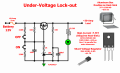
I've got a circuit that runs on a 6S Lipo battery that switches some solenoid valves, powers an MCU, and has some other sensors (like pressure transducers). At max a draw of 4A. The lowest discharge for the 6S Lipo is 18v, before it becomes damaged, so I need a low voltage protection circuit that cuts off at 19 or 20v.
I have looked through all types of designs including using a zener diode, a comparator (with smaller regulated voltage and a divider), and other unique designs. In my case, I have a small MCU that will also be monitoring voltage, so I was considering using a simple CMOS flip-flop (with FET) and have the MCU "flop it" off with a pulse if the voltage is too low. Is that crazy? Would the "hanging flip flop" burn too much current in the off state?
I have looked through all types of designs including using a zener diode, a comparator (with smaller regulated voltage and a divider), and other unique designs. In my case, I have a small MCU that will also be monitoring voltage, so I was considering using a simple CMOS flip-flop (with FET) and have the MCU "flop it" off with a pulse if the voltage is too low. Is that crazy? Would the "hanging flip flop" burn too much current in the off state?