Low voltage mosfet h-bridge no workie

Thread Starter

Hamlet

Joined Jun 10, 2015
560
Preface: I had help with this in the past (pre-covid/one-million years ago), and we reached
a satisfactory solution, thanks. Today, I am attempting to change it up, or down, as it may be...
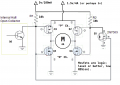
1639676616616.png
I built it with the following voltages, 5v for gate control, 1.5v for motor supply. It
didn't work. I increased motor supply to 3v, and it worked, but could not supply
much current. I tried PNP power resistors, and lowered the gate/base resistors
to 100ohms, and it was a little better, but unbalanced.

At this point, I'm guessing this is unworkable, or that I somehow need to implement
a split supply...? Maybe there isn't enough voltage drop to turn on the P channel
mosfets, and the attempt is impossible and unworkable.

In conclusion, let me add that the "motor" is a solenoid that activates a lever in a
back-forth motion, as determined by the hall sensor (Q6). The 5v gate signal is
derived from a switching regulator supplied by the motor battery. This voltage
held up okay even when the motor is working, so it isn't sagging. The entire
project is part of a kinetic sculpture that is designed to operate briefly from a single
"D" cell battery (that's my challenge).
 

ronsimpson

Joined Oct 7, 2019
4,712
The MOSFETs turn on/off by the G-S voltage not just the voltage measured from ground.
Q3,4 have a 5V turn on voltage.
Q1,2 are the problem. The Gate can only go to "ground" or near ground. The G to S voltage can not be more than the 1.5V supply. These two MOSFETs are not getting a good turn on voltage.

Are you using this circuit for speed control or just forward/reverse?
 

Ian0

Joined Aug 7, 2020
13,158
Is the 1.5V supply essential? Could you use a 5V supply for everything? (Or four smaller batteries in series) IF so, why not power the solenoid from 5V using PWM with a mark-space ratio of 1.5/5?
Then you can get ICs to do the job, such as Texas's DRV series.
 

Thread Starter

Hamlet

Joined Jun 10, 2015
560
Is the 1.5V supply essential? Could you use a 5V supply for everything? (Or four smaller batteries in series) IF so, why not power the solenoid from 5V using PWM with a mark-space ratio of 1.5/5?
Then you can get ICs to do the job, such as Texas's DRV series.
I'm considering using boost regulator(s). Additional batteries is not an option. I will search "Texas TI DRV series" and see what I can find.
 

Ian0

Joined Aug 7, 2020
13,158
If more supply voltage isn't feasible, then stick to the 1.5V supply. If you use logic-level MOSFETs, using N-channel devices all round should work - you will have 3.5V drive for the top devices and 5V for the bottom devices. You'll need inverters to drive one MOSFET of each pair.
 

Thread Starter

Hamlet

Joined Jun 10, 2015
560
If more supply voltage isn't feasible, then stick to the 1.5V supply. If you use logic-level MOSFETs, using N-channel devices all round should work - you will have 3.5V drive for the top devices and 5V for the bottom devices. You'll need inverters to drive one MOSFET of each pair.
Inverter , um, like a cd4011?
 

ronsimpson

Joined Oct 7, 2019
4,712
There are several fixes. Are you "PWM" driving so there is a signal most of the time. Or you using the circuit for forward/reverse so the signal does not change for a long time?
 

ronsimpson

Joined Oct 7, 2019
4,712
If you keep a signal going all the time. (example 1 to 99%) This will work. The diode I added to the Gate of Q1,2 will keep the signal from going above 1.5V (supply) and the signal will swing below ground. (AC coupling the gate) But if you leave the circuit to 0% or 100% for a time it all stops working. T=RC 0.1uf and 10meg ohms.
1639692668508.png
The Gates of Q1,2 will go negative.
 

Thread Starter

Hamlet

Joined Jun 10, 2015
560
LIke a 4011 but perhaps not a 4011, perhaps something with a bit more output drive, like a 74HC04, 74HC00 etc. or even a 74AC00 which is even better.
I have the 4011, and the freq will be no more than 30hz......
 

Thread Starter

Hamlet

Joined Jun 10, 2015
560
There are several fixes. Are you "PWM" driving so there is a signal most of the time. Or you using the circuit for forward/reverse so the signal does not change for a long time?
PWM is a possibility, but not at this time. Foreward/reverse, about 1Hz to perhaps 30Hz.
 

Thread Starter

Hamlet

Joined Jun 10, 2015
560
Rather than scrapping my previous pcb, I finished it for 6v operation, and shelved it for later use.
I'll grab another copper clad sheet and start over with Ron's changes and see how that works.
(Thanks Ron!) It might take me a few days to get back this way.

Am I to understand the meaning of "it all stops working" as it flops into one state or another?

I'll have to post a video once I am done. This is an interactive kinetic art display, that serves no useful function.
The solenoid drives a wheel in free space, that once set in motion, continues in that direction, until someone
flips it another direction, or stops it altogether. If this was an industrial control for a small electric car intended to be driven by naughty mice inhabiting the "D" cell battery factory, we might chose another approach.
 

ronsimpson

Joined Oct 7, 2019
4,712
Am I to understand the meaning of "it all stops working"
I am trying to make a -4V supply for turning on Q1,2 but that supply will decrease with time if no on/off signal. When the -supply decreases Q1,2 will turn off. (Both will be off)

Is there another clock? Anything? I am looking for a signal 0/5V or 0/3.3V that is there all the time. (maybe 10khz or 10hz or almost anything) We could make a -5V supply another way.
 

Thread Starter

Hamlet

Joined Jun 10, 2015
560
I am trying to make a -4V supply for turning on Q1,2 but that supply will decrease with time if no on/off signal. When the -supply decreases Q1,2 will turn off. (Both will be off)

Is there another clock? Anything? I am looking for a signal 0/5V or 0/3.3V that is there all the time. (maybe 10khz or 10hz or almost anything) We could make a -5V supply another way.
Nope, no other clock. The wheel spins, or it doesn't, that's it. The wheel, having inertia, will gain rpm until equilibrium is reach between all pieces (friction/coil energy). A magnet on the outside/rim of the wheel
interacts with the hall sensor to time the switching of the coil.

If it is worthwhile, a small circle of magnets near the hub might induce a voltage in a coil...
 

Thread Starter

Hamlet

Joined Jun 10, 2015
560
I got up early and put together Ron's circuit.
I tried 1M resistors, but found 10M worked best; I'm driving/oscillating a 0.5 ohm solenoid with 1.5v!

Much thanks to everyone who participated, and a big hug to Ron for his genius solution. :)
 
Top