Low noise dc-dc converter

Thread Starter

Spaken

Joined Mar 28, 2021
14
Hello.

I am having some problems with a LED-driver. The problem is that it makes so much electromagnetic interference that an I2C pressure sensor installed close to it is outputting nonsense. The LED driver is the Lumiboost. I am not sure if it is the Lumiboost itself or the PWM used to dim it that is causing the EMI.
I was thinking about designing my own LED-driver using analog 0-10V dimming, but I am a complete novice so this is where I need some advice.

The LED driver needs to accept DC input 19-48V and output 30-34V DC at a maximum of 4A. It also needs to be dimmable. It will power a 120W COB LED.

Would a boost-buck converter be a good choice or do these circuits also produce EMI that can interfere with other sensitive components?
Any help appreciated :)
 

michael8

Joined Jan 11, 2015
472
I'm trying but don't understand the combination of "problems with a LED-driver" and "I2C pressure sensor .. outputting nonsense"

Wouldn't that indicate a problem with the sensor or it's signal path?

What' are the whole system signal and power paths?

Perhaps the EMI is getting into the measurements via something easily changed.
 

Thread Starter

Spaken

Joined Mar 28, 2021
14
I'm trying but don't understand the combination of "problems with a LED-driver" and "I2C pressure sensor .. outputting nonsense"

Wouldn't that indicate a problem with the sensor or it's signal path?

What' are the whole system signal and power paths?

Perhaps the EMI is getting into the measurements via something easily changed.
There is definitely a problem with the LED-driver as the problems start when it is powering the LED. The I2c pressure sensor works fine on it's own. The Lumiboost LED driver also knocks out my DAB radio from many meters away. It is also not very rugged and breaks very easily.
Using the Lumiboost is not an option as I see it. I want to design my own LED driver.
 

LowQCab

Joined Nov 6, 2012
5,101
Switching-Regulators are naturally noisy, especially very high-efficiency designs.
A Linear-Regulator is completely quiet, but generates a lot of HEAT, and is therefore, not very efficient.
.
.
.
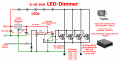
High Power LED Current Regulator 2 FLAT .png
 

Thread Starter

Spaken

Joined Mar 28, 2021
14
Is there any way to reduce the interference from a switching regulator?
And how much heat would a linear regulator outputting 120W produce?
 

Ian0

Joined Aug 7, 2020
13,097
Your LED appears to need a voltage of around 32V. If you had a supply of 36V you could use @LowQCab 's circuit and only need to dissipate 16W at full power.
 

Thread Starter

Spaken

Joined Mar 28, 2021
14
when you said 19V to 48V, I thought you had a choice.
It would dissipate 32W, which would be rather too warm. Almost as inefficient as using a 48V filament lamp!
I'm sorry, it turns out I only have the option of using 48V input.

I found this 10 tips for EMI reduction. Maybe if I use the tips in the guide I can make something with low noise. I guess I could also just buy a cheap buck converter with similar I/O and see if it interferes with the I2C pressure sensor. If not, maybe there's just something strange with the Lumiboost.
By the way, the I2C pressure sensor is connected to and Arduino Uno if that helps.
 

Ian0

Joined Aug 7, 2020
13,097
Does the interference disappear if it is running at full power? If so, it isn't the PWM dimming that is causing the problem.
Does the pressure sensor share any power supply cables with the LED or the driver?
 

Thread Starter

Spaken

Joined Mar 28, 2021
14
The interference is there as long as the LED is on. When it is switched off it dissapears. The pressure sensor and led-driver don't share any cables, but they are both connected to the Arduino Uno. The pressure sensor is connected to the Arduino Uno via 4 cables. +5V, GND, SCL and SDA. The Lumiboost LED-driver is connected to an analog out pin on the Arduino.
 

Juhahoo

Joined Jun 3, 2019
302
You can try to isolate the boards firstly by just distance, then some metal shielding or enclosure, then disconnect boards totally and see what happens when they still both operate and so on, isolate problems and get an understanding what effects to what..... These are hard to solve by just guessing so you need to find a pattern what minimizes the problem and what makes it worse.
Most propably the board wasnt designed EMC in mind, and therefore it can cause whatever issues on that area.

Designing such LED board (which will drive LED only) can be tricky since these high end driver chips with high voltage and current can have many issues which non experienced person can not solve, so you end up to square one.
Easiest is to buy a demo board and modify it if needed. They are often expensive and not targeted to consumers but more likely to designers and engineers as a quick development platform.

But to get a sense how these are constructed, this board could fill your needs, you can download its schematic files so you see how its made. Is it something you could make yourself?
https://www.digikey.com/en/products/detail/analog-devices-inc/DC1831A/4866608
 
Last edited:
Top