Looking to replace a blown fuse

Ian0

Joined Aug 7, 2020
13,158
Why not? Assuming that the fuse is in the hot line AND the plug isn’t polarized, if the plug is reversed, the fuse is on the neutral line. From plugged in device hot, through the fuse, and to neutral, is a dead short. The device neutral is protected for 15A; the iron is protected for 0.5A. The iron fuse will blow.
Perhaps I should have included another sentence in the quote: it starts
" IF your iron has a three wire plug then the tip is grounded. "

So, from my limited knowledge of American plugs, it means that live and neutral must have been correctly connected (although that is irrelevant)
The tip, being connected to earth, was accidentally connected to a circuit that was live. Current flows from the circuit being worked on to earth, through the soldering iron's earth connection. It doesn't go through the soldering iron's live or neutral, so it doesn't blow the soldering iron's fuse.
 

Thread Starter

SeanV123

Joined Nov 12, 2020
124
Bottom line - fully diagnose the problem before you start buying parts. Of course you'll need a new fuse, that goes without saying. But don't just buy one.
Really appreciate your help Tony. As a electronic hobbies newbie I am grateful for your help. MERRY Christmas from Ireland
 

Ian0

Joined Aug 7, 2020
13,158
Some of the features:
Features & Benefits

• Supply 220 V in / 24 V out
• Temperature accuracy ±10% of nominal temperature
• Antistatic Tip earthed via mains lead
• Safety transformed Class II 230V/24V to 50 Hz
• Power output: 55 W

This means it has an internal transformer. The iron itself runs on 24V. The tip is grounded to earth ground via the power cord. So we can assume the Weller fuse didn't blow because of an accidental exposure to an external current source. So the failure is from within. Since I didn't find a schematic on the machine I can't begin to guess where the failure might be. But it would seem that it has something to do with either the 220VAC input or the 24V output. And I don't know if that's AC or DC. IF it's DC then there's a possibility the rectifier could have blown the fuse. But it could also be a bad cap or some other electronic component inside the base unit.
Weller TCPs are 24V AC, with no electronics in the base unit. (It's a Curie-point thermostat inside the iron).
If the fault remains a mystery then there is a chance the fuse could have been blown by transformer inrush.
 

Tonyr1084

Joined Sep 24, 2015
9,744
So is the fuse on the Line side or on the 24V side? Since it's 315mA I would guess it's on the Line side of the transformer. If so, something may have gone bad in the transformer; and that's not very likely. Not impossible, but not likely.
 

LesJones

Joined Jan 8, 2017
4,509
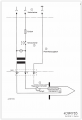
I have just downloaded the service manual which contains the schematic.
Screen Shot 12-20-20 at 05.04 PM.PNG
The iron itself is a 24 volt 50 watt iron. The base unit just contains a transformer, a switch and fuse. Assuming it is the 240 volt version then the fuse is the correct rating. (If it is the 120 volt version the fuse rating should be about twice as much.) I have a similar Weller unit that uses the same soldering iron that does not have an earth wire so the tip is floating. The primary DC resistance is about 25 ohms. (Mine is a 240 volt version.) Measuring the primary resistance would only show up a very severe short. (It would not show a few shorted turns.) The fuse in mine is a fast blow fuse. This is one source of fuses on ebay. I suggest first trying it without the soldering iron connected to the base unit.

Les.
 

Tonyr1084

Joined Sep 24, 2015
9,744
Based on the drawing, either the element has shorted to the case of the tip (ground) or the element has shorted to itself, causing excessive current to be drawn through the transformer.

Unplug the iron from the base and test for voltage using a 500mA fuse if you have one. If the fuse blows then you have a bad transformer. Or possibly the Neon bulb may have somehow shorted (unheard of - but not out of the realm of possibility).

Pins 1 & 2 should have 24VAC present.
 

KeithWalker

Joined Jul 10, 2017
3,608
The Weller WTCP 51 has a 24 volt transformer in the base. The switch and fuse are in the primary 220 volt circuit. It has a 55 Watt element so it will only draw 1/4A from the supply. The temperature is regulated by curie point of a magnet in the base of the tip. The iron has a 3-pin plug so it will be easy to check if the element is open circuit or shorted to ground by measuring the resistances between the three pins.
The usual failures are a short between the element and the steel body or an open circuit element.
 

du00000001

Joined Nov 10, 2020
191
Just checked the WTCP-51's user manual:
The fuse should be a slow-blow 0.315 A one.
Where to find (if at all)?
At some device that incorporates a transformer and is in the 40 .. 70 W power range. (Higher power would require a fuse with a higher rating, devices below about 50 W may come with a 0.25 A fuse as well.) Devices without a transformer might come with a faster blowing fuse :confused:

@all
Fuses age - especially those in the unfilled glass packages. (Ceramics resp. sand-filled glass packages are less prone to oxidation.) A combination of aging and inrush current might have killed the fuse without any real fault on the iron.
Prior starting to seach for an error it is viable to just replace a blown fuse (once): if the new one blows too, it's time to try to locate the reason. If not: might have been an unfortunate event but nothing serious.
And for those speculating about the reason: a degraded wire isolation in the transformer would result in a blown fuse as well.
 
Top