Looking for someone to design/modify a circuit...

Thread Starter

John A. Smith

Joined Sep 28, 2014
24
Bernard,

Thanks, I'm going to learn Greek if it kills me. ;)

Sounds like it needs one of these 4020 14 stage binary counter and than someone who knows how to use it.
 

Bernard

Joined Aug 7, 2008
5,784
I'll bet that there are many 4020 users on AAC, I've never used one but have several in stock just in case.
Wrong chip- stages 2 & 3 missing, need 4040, 12 stages, all available.
4020 still may be OK, might only need 11 stages.
 
Last edited:

SgtWookie

Joined Jul 17, 2007
22,230
John,
Bernard's idea is using 4000 series CMOS IC's, originally developed by RCA Corporation in the 1960's: http://en.wikipedia.org/wiki/4000_series
Here is a partial list of what was available: http://en.wikipedia.org/wiki/List_of_4000_series_integrated_circuits
along with links to datasheets/datasheet search engines. Many manufacturers have dropped support for some or all of the 4000 series as well as the 7400 series of logic ICs.

While discrete logic ICs can be useful for quickly breadboarding up a project or function, it's becoming far less common, as microcontrollers (aka MCU's, uC's) are so inexpensive, readily available and relatively flexible it really no longer makes sense to use the old logic ICs except when very specific functions (like port expansion) are required. uC's can make your bill of materials shrink; instead of requiring a variety of discrete logic ICs, you just need one uC and a few support pieces like capacitors, resistors, MOSFETs and the like. Also, if you make provisions for it, the uC can be re-programmed in-circuit, so you can completely change the sequence/timing of events.

A PICAXE is a Microchip PIC uC that has a custom 3rd party bootloader preloaded in it's flash memory. The bootloader enables a user to load new program code in flash memory using a minimal hardware interface (just a few wires) to keep things low-cost and relatively simple for neophyte home experimenters, or engineers who may simply not want to learn yet another programming language. These PICAXE uC's can be very handy for one-off projects, but you pay extra for the preloaded boot loader; that extra cost makes it undesirable for a project headed for mass production.
 

elec_mech

Joined Nov 12, 2008
1,500
These PICAXE uC's can be very handy for one-off projects, but you pay extra for the preloaded boot loader; that extra cost makes it undesirable for a project headed for mass production.
+1. This is why I asked about quantities from the beginning. I suggested PICAXE for the reasons SgtWookie stated - simple to use and for one-off projects. Now that we know the OP ultimately wants production quantities, PICAXE is out of the picture. I suggest sticking with the same uC for both projects. It will save a lot of time and money in the long run. Since ISB123 is looking into the ATtiny for the sound project, I suggest using this as well for the motor project or something similar from ATMEL.

Unfortunately, I won't be of much help as ATMEL typically uses the C programming language and I'm more of a BASIC language guy. With enough time, I could do something with a PIC microcontroller using PicBasicPro, but this is an expensive program for the OP to invest in if he want to make changes himself later.
 

Thread Starter

John A. Smith

Joined Sep 28, 2014
24
I've read up on the PICAXE, looks very similar to the Arduino that didn't work either, but it could have been me.

The PICAXE-18M2 microcontroller is only 2.00 pounds. I could see doing one to five of these to make sure the functions work and the speeds and times are right, but than it would have to be "ported" (?) over to a standard chip.

I need to take a class, I have no idea of the questions to even ask.

Thanks for the help.

John
 

SgtWookie

Joined Jul 17, 2007
22,230
John,
Here's a link to all of the modules in the Navy NEETS course:
http://www.phy.davidson.edu/instrumentation/NEETS.htm
A great many of these modules are nearly identical to those I studied while attending various schools at then-NAS Memphis around 1975. It's a LOT of reading, and fair bit of math as well. However, you can't beat the price ;) It'll take you awhile to get through them all.

2 pounds sterling is ~ $3.21 USD. There are plenty of uC's that are smaller and cheaper that will do the job. Question is; do you want one board to do both projects, or are these completely separate projects (nothing to do with each other)?
 

Thread Starter

John A. Smith

Joined Sep 28, 2014
24
Thank Sgt. Wookie for the NEETS information, you've just ensured my wife will be an electronics widow instead of a football widow. It will take me some time but I've saved the information and will be working though it. I can't stay ignorant forever.

Digikey, Newark, Mouser - is pointless to look at as there are so many options for IC and terminology that is unfamiliar. Not even sure of what I'd need at this point as uC's are a pretty common item.

Good times,

John
 

SgtWookie

Joined Jul 17, 2007
22,230
It can be bewildering to try to choose a uC at first. However, if you firmly establish your list of requirements, and use a parametric search to match those requirements, the list of uC's meeting your requirements will be trimmed down in a big hurry!

Just for example; let's say you want to be able to program/re-program the uC on the PCB. You want to control three motors, two of which won't need PWM for speed control, and one will need PWM.
Programming a PIC requires access to Vdd (the + power pin), Vss (GND), the MCLR/VPP pin, the ICSPdata and the ICSPclk pins.
Seems that a PIC12F683 would meet your requirements thus far; it has six I/O pins so your requirements are taken care of without even having to share pins.
If you needed other inputs/outputs to the uC, you could "share" the ICSPdat and ICSPclk pins.

You haven't mentioned how you want project #2 to be activated or deactivated.
Did you want it to run continuously?
Or to run through one or more cycles after being activated, with perhaps a delay in between?
Or activate at some random interval?

When did you want to have a prototype ready to experiment with?
 

Thread Starter

John A. Smith

Joined Sep 28, 2014
24
Sgt. Wookie,

That looks like a nice chip, it can also be programmed at the factory for like $0.10 once the code is proven out. The chip under 100 units is only $1.18.

For the actual running of the program, I was thinking a "Power On" switch for the device, and than a run button to start the cycle and run once and reset to a wait state. Change the thing and push run again.

I understand the PWM is the motor control portion of the chip, but that would have to put out a signal of some kind to control the speed of the main motor. With the chip only being supplied 3.3v and the motor would need 12v so a relay, MOSFET or ?. I just read up a little on MOSFETs, i might run to radio shack and pick up a couple to play with.

I hear there is "Magic Blue Smoke" in chips, and if you let it out, the chip will no longer work. I'll keep you advised. ;)

John
 

SgtWookie

Joined Jul 17, 2007
22,230
Hold on a minute!
Radio Shack has a VERY limited selection of FETs. The only power MOSFET they carry is the IRF510, which is practically an antique, low current rating, and is a standard, not a logic level MOSFET. Basically, standard level MOSFETs are considered OFF when Vgs (that's the voltage on the gate when measured relative to the voltage on the gate) is zero, and considered ON when Vgs is 10v. The threshold voltage (where the MOSFET begins to conduct) shouldn't be considered when you wish to use the device as a switch.

If you allow Vgs to exceed ±20v, even for an instant, the MOSFET will be destroyed! The magic smoke may not be visible, but it will have left the building! Static electricity that's way too low for you to feel will kill them; you don't start feeling a "tingle" until static charge exceeds around 3kv (3,000 Volts).

The uC can run on 5v from a simple linear regulator (a switching regulator would be more efficient, but I don't know what you're running this thing from).

You can get logic-level MOSFETs in tiny surface-mount sizes pretty reasonably. I just picked up some PMT21EN.115's which are N-channel 30v rated 7.4A drain current in an SOT-223 package; really quite small. However, need to get a better idea of what that stall current is, as "start up over one amp, I couldn't put a load on it without shooting water all over the place, sorry..." just doesn't quite cut it ...

Products engineered for consumer goods need to be fault-tolerant, and have enough "overkill" in the specifications that you won't have very many failures in the field. Satisfied consumers tend to be quiet (good news travels slowly). Angry consumers will curse your name and product using every viral media imaginable, and cackle with glee when you go broke (bad news travels faster than light). Damage control (honoring warranties) can be VERY expensive if the product is poorly engineered.
 

Thread Starter

John A. Smith

Joined Sep 28, 2014
24
Sgt. Wookie,

I understand that rough order measurements are a WAG. I have a Yokogawa DL750 16 Channel O-Scope that I can record with pretty high speed. I can bring the motors to work and set it up. I assume your expecting the in-rush current to be higher than the sustained current by a factor of x and that the board and components must be able to handle the total plus a a 100%ish load factor. IE - Current at start up is 5 amps at 12v, so the components need to handle a 10A at 12v as a minimum. Overkill is fine with me, why use a grenade when a Cruise Missile will work also. ;)

I do the HALT/HASS Testing at my work, so I'm pretty familiar with setting warranty limits and life expectancy.
 

SgtWookie

Joined Jul 17, 2007
22,230
Your background in HALT/HASS test will come in really handy on this gig. ;) You never really mentioned what your experience was; only that you didn't get the water flow analogy used in some beginning electricity/electronics lectures. What was your MOS?

Not saying I'm "Old Corps" or anything, but I was a 6657, which you won't find on current MOS listings, as that was a Vietnam-era MOS; I was a radar systems/missile fire control technician on the F-4J and F-4S Phantom II. As a matter of fact, right before I hit EAS as a Sgt, I used to park my '74 Olds next to a light blue '74 convertible VW Beetle that belonged to 2ndLT Jim Amos who was a pilot in my squadron, VMFA-122 "Crusaders", and we shot the breeze a few times about cars, planes & stuff. Amos is the outgoing CMC. He still has his Beetle.

Worked on a bunch of fun stuff after EAS, but time is short at the moment. I'm tinkering a bit with your project, but all day tomorrow is shot - probably going to be wednesday before I can make any meaningful progress.
 

Thread Starter

John A. Smith

Joined Sep 28, 2014
24
Sgt. Wookie,

I can do some things, jack of all, master of none. I test Fiber Optic Components at work and design mechanical fixtures for testing various items. Just finished up on a Flush Mounted Aircraft Handle, needed 5 stepper motors, two linear actuators, one load cell, one torque cell and had one of the guys LabView the data collection for me. Testing was done at +125º, ambient and -55ºC. It really stopped working down around -40ºC, the grease would solidify ;) I normally use Applied Motion Products for stepper/servo motors and controller and use their software to control them. I understand the process of HALT/HASS- which means I get to break things and someone else either fixes them or we stop testing.

Old Corp '81- '86- Not the same today as it was. I was a 6821 - Weather Observer - That MOS is gone now they are all 6800's. We had a bunch of retreads tie up the promotions in my field so I was out after 5, corporal for 3.5 years, with no promotions in sight. I was stationed at MCAS Tustin, Ca. the helicopter base, no closed. I started a non-profit about 9 years ago, we go down to Camp Pen and support the Squadron Parties.

I'll take a poke at this thing, but make no promises.

Thanks,

John
 

elec_mech

Joined Nov 12, 2008
1,500
SgtWookie,

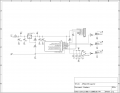
If I might, I'd like to ask some questions about the schematic. This is for my own curiosity and ever-growing electronics development, but hopefully the OP will get a better understanding as well.

Is there an advantage to using a LM317 over a LM7805 or other dedicated 5VDC regulator?

I assume C3 is to account for spikes or dips from the power supply, does C4 do the same for the motor loads?

Should diodes be added across the MOSFETs' drain and source pins for back EMF protection from the motors?

Forgive my ignorance, but is it common to use both Ux and ICx as designations? May I ask the difference between the two or rather when to use them?

I understand motor 1 will be speed-controlled via PWM. What purpose does IC1 serve? I assume it is being used as a MOSFET driver, I'm just curious why the PIC isn't being used to drive it directly (and thus revealing further ignorance on my part I'm sure).

John,

I don't know what experience you have programming if any, but here a quick breakdown of some options.

Assembly: free, but not for the faint of heart and requires a lot more code writing and in-depth understanding than any other option.

Basic: There are a few versions from different companies all slightly different from one another. Price goes from free (Great Cow Basic) to almost $300 USD (PicBasicPro, my favorite). Basic, as the name implies, is probably the simplest language to learn. There is a free non-commercial version of PicBasicPro for the PIC SgtWookie has selected if you wanted to play with Basic, but you'd have to pay for one of the versions in end since this will be used for a commercial product.

C: Most commonly used language. Not as easy as Basic, but much easier than Assembly. While I've found it difficult to learn, there should be plenty of examples online and Microchip, who makes the PIC microcontroller, offers a free version as I understand it. You can pay for a pro version, but the only benefit is better optimized code, meaning you can write bigger programs on smaller PIC's - not a concern here. Insofar as I understand C, you can easily use the same program with next to no changes on different compilers. This means if you write C code using Microchip's C compiler then decide to use a third party C compiler or move to another microcontroller altogether, you should be able to use the same program without major modifications. Not the case with Basic.

I won't be of much help to you with C, but assuming the free version from Microchip can be used for commercial applications (you'll need to check first), this offers the best bang for your buck.
 

Thread Starter

John A. Smith

Joined Sep 28, 2014
24
Elec_Mech,

10 Print "What are you talking about?"

That's about all I remember from basic ;) and that's kind of fuzzy. That's been almost 30 years ago. I'm sure I could sweep off a couple brain cells and check it out. I lost contact with a awesome C++ guy that I worked with at Corning Inc.

Thanks, I'll have to check out the free one for now - My wife knows I'm up to something again, she's not sure what, but shes watching the bank account. ;)

Sgt. Wookie,

Allow me to take a stab at the drawing. Starting from the right top corner.

12v + input with 12v - below
F1 Is a reset able fuse?
C3 is a 470uF capacitor
+12V extra 12 volt output?
C1 is a .33uF capacitor
U2 is a voltage regulator (which takes the 12v and outputs a clean 5v supply for the chips?
R1 is a 330k resistor attached across 5v output and ground
R2 is a 1k resistor attached across 5v LM317 voltage regulator and ground?
C2 is a .1uF capacitor
C4 is a 100uF capacitor
PIC12F683SN Chip set
1. 5volt input
2. Q3 is motor output at 5v going to R5 22 resistor to Q2 MOSFET (where is it getting the 12v to power the motor unless VSS is 12V?
3. Q2 is motor output at 5v going to R6 22 resistor to Q3 MOSFET
4. VPP/MCLR - appears to be a reset?
5. Q1 is the Pulse Width Modulator for controlling the speed of motor 1, which is connected to a MIC4420 (MOSFET Driver) Chip
6. ICSPCLK - Not even going to guess
7. ICSPDAY - Not even going to guess
8. VSS - Ground?
ICSP -IN-CIRCUIT SERIAL PROGRAMMING (ICSP) - I assume this is where any connection would be made to work on the program.

Trying to wrap my head around where the 12v is coming and going to from.

Thank,

John
 

SgtWookie

Joined Jul 17, 2007
22,230
SgtWookie,

If I might, I'd like to ask some questions about the schematic. This is for my own curiosity and ever-growing electronics development, but hopefully the OP will get a better understanding as well.
Fair enough - I kind of threw it together in a hurry; as I mentioned before, it's not complete, and subject to modifications/substitutions/replacements/scrapping even.

Is there an advantage to using a LM317 over a LM7805 or other dedicated 5VDC regulator?
This is a prototype, and the regulator may change. Our TS, John, hasn't mentioned where the 12v comes from, nor how important efficiency is vs cost, etc. A switching regulator would certainly be more efficient, as more power will be dissipated in the regulator than in the uC and the gate driver. The LM317M is a surface-mount device good for up to 500mA current; however the PPTC (polymeric positive temperature coefficient aka resettable fuse) F1 limits the maximum current to 100mA / 0.1A.
The 7805 has about 5mA-6mA idle current with no load. The values I've chosen for R1/R2 will have the LM317 idle current at around 3.82mA. One can easily change the output voltage of the LM317 by changing one resistor; one might INCREASE the output of the 7805 by adding resistance between the GND pin and GND, but not so easy to reduce the output voltage if required. It's nice to have options.

I assume C3 is to account for spikes or dips from the power supply, does C4 do the same for the motor loads?
C3 is a wild guess right now, as I have no idea how long the wires will be connecting the board to the power supply.
C4 does nothing for the motor loads. The motors are not supplied current by this board - yet. That's one of the things missing, along with diodes across the motors. However, I need more data about the motors first.

Should diodes be added across the MOSFETs' drain and source pins for back EMF protection from the motors?
Actually, they're going across the motor's leads. It'll have a similar effect as going across the MOSFETs, except there will be less wiring, hence less inductance, in the back-EMF path.

Forgive my ignorance, but is it common to use both Ux and ICx as designations? May I ask the difference between the two or rather when to use them?
As I mentioned before, this was a hurriedly thrown-together schematic. I'd actually changed the PIC reference designator from IC1 to U1, but I was out of time and didn't change the MIC44210M from IC1 to U3. One does not generally mix reference designators for IC's on the same schematic; it leads to confusion and questions like these. Sorry. It'll be fixed when I have more time.

I understand motor 1 will be speed-controlled via PWM. What purpose does IC1 serve? I assume it is being used as a MOSFET driver, I'm just curious why the PIC isn't being used to drive it directly (and thus revealing further ignorance on my part I'm sure).
Good question!
Motors 2 and 3 are all-or-nothing; that is, they'll either be on or off. It won't matter if the turn-on or turn-off takes awhile due to relatively low source/sink capability of a PIC's I/O pins, as the ratio of time they'll be in transition to a steady state ON or OFF is extremely low, so practically no power will be dissipated in the MOSFETs, thus very little heat will be generated.

The PWM'ed motor, on the other hand, will have the MOSFET spending very significantly more time in transition states, which will generate heat if it's not done pretty quickly. In order to minimize the power dissipation in the MOSFET and ensure reasonable life expectancy, a gate driver IC is used to minimize the transition times.

The gate driver may prove not to be necessary. In that case, the gate driver IC may simply be jumpered across. However, it's easier to jumper across an IC that's no longer required, than it is to try to add one in that you failed to plan for in the first place.
 

SgtWookie

Joined Jul 17, 2007
22,230
Elec_Mech,

10 Print "What are you talking about?"

That's about all I remember from basic ;) and that's kind of fuzzy. That's been almost 30 years ago. I'm sure I could sweep off a couple brain cells and check it out.
LOL!

Thanks, I'll have to check out the free one for now - My wife knows I'm up to something again, she's not sure what, but shes watching the bank account. ;)
Mikroelektronika has MikroC Pro, MikroBasic Pro, and MikroPascal Pro available for download that you can use without a license key for programs up to 2k words in length; which should be more than enough for this simple of an application. And if it isn't enough, I have a license for MikroC Pro. ;)

Sgt. Wookie,

Allow me to take a stab at the drawing. Starting from the right top corner.
I'm sure you meant top LEFT corner... ;)
A couple of conventions that I follow with schematics:
Inputs come from the left, outputs flow towards the right.
More positive voltages towards the top, more negative towards the bottom.
If you follow these conventions when drawing your own schematics, others will be able to more readily grasp what's going on in them.

12v + input with 12v - below
OK, just to keep things from getting confused - the X'es on the left are labeled 12V and GND. This circuit has just one supply voltage, and I have decided to go with convention, and keep the 12v return side (what you're calling 12v-) referenced to GND, or zero volts. If you start referring to +12 and -12, then people are going to start thinking that you have +12, -12 and GND all in one circuit, and that the difference between +12 and -12 is 24v.
The X's are actually wire pads on a circuit board; they are small octagons with a hole through the center that you can solder a wire to. The +12 and GND labels will show on the board, so you can tell which pad to connect what wire to.
Further to the right, you'll see what looks like an upside-down sucker/lollipop labeled VSS. VSS is used in circuits as a supply label where CMOS is the technology used, and refers to the common point where the source terminals would be connected where applicable. The schematic program I used is Cadsoft Eagle, and the particular library model for the PIC12F683 was defined using VSS for the ground-side power pin. Had I selected a label other than VSS to connect to the PIC's VSS pin, the schematic editor would have flagged it as an error. But I digress...
F1 Is a resettable fuse?
Yes.
C3 is a 470uF capacitor
Yes, more specifically an aluminum electrolytic capacitor. Caps over 1uF tend to be aluminum electrolytic unless otherwise specified, as other types would tend to get quite physically large and expensive.
+12V extra 12 volt output?
That +12V "lollipop" is a label. All other points that have a similar +12V lollipop label can be considered connected together. It also makes figuring out what wire does what when working on the PCB in the editor much easier. It doesn't show up on the finished PCB as a pad nor as a printed label; it merely serves as documentation in the editors and on printouts.
C1 is a .33uF capacitor
typically ceramic or poly metal film.
U2 is a voltage regulator (which takes the 12v and outputs a clean 5v supply for the chips?
yes.
R1 is a 330k resistor attached across 5v output and ground
Close - R1 is a 330 Ohm (note: no k) resistor connected from the output of the LM317 to the ADJ pin of the LM317.
R2 is a 1k resistor attached across 5v LM317 voltage regulator and ground?
No, R2 is a 1k Ohm resistor connected from the LM317 ADJ pin to GND.
C2 is a .1uF capacitor
Yes; more specifically it's either ceramic or poly metal film - NOT aluminum electrolytic.
C4 is a 100uF capacitor
Yes; specifically aluminum electrolytic.
PIC12F683SN Chip set
It's a microcontroller, not a chip set (which would imply multiple ICs, which would make it NOT a microcontroller)
1. 5volt input
Yes, and since the model was defined with VDD (common drain connection) instead of +5v, it was flagged as a warning-level error!
2. Q3_CTRL is a PIC output at 0v to 5v going through R5 22 Ohm resistor to Q2 MOSFET's gate where Q2 will sink current from motor 2 to VSS/GND
Reworded
3. Q2_CTRL is a PIC output at 0v to 5v going through R6 22 Ohm resistor to Q3 MOSFET's gate where Q3 will sink current from motor 3 to Vss/GND
Reworded
4. VPP/MCLR - appears to be a reset?
MCLR must be pulled high to allow the program to run on the PIC. VPP is programming voltage applied via the ICSP port, it can be as high as 12v during programming.
5. Q1_PWM is the PIC's Pulse Width Modulation output pin, which is connected to a MIC4420 (MOSFET Driver) Chip which drives the gate of Q1 via R4 for controlling the speed of motor 1
Re-worded
6. ICSPCLK - Not even going to guess
ISPCLK is the clock signal supplied by the In Circuit Serial Programmer to tell the PIC when to look at the next bit of data present on ICSPDAT.
7. ICSPDAT - Not even going to guess
The data (program) that is clocked in by ICSPCLK
8. VSS - Ground?
Yes.
ICSP -IN-CIRCUIT SERIAL PROGRAMMING (ICSP) - I assume this is where any connection would be made to work on the program.
Exactly.

Trying to wrap my head around where the 12v is coming and going to from.
That's some of the missing pieces. The MOSFETs Q1 thru Q3 sink current from the motors (switch the ground side current); the connection to the motor's supply side is not shown yet, nor are the reverse-EMF diodes across the motors.

Unfortunately, it's taken so long for me to write all of this down, I am out of time to make any updates to the schematic/board this evening.
 
Last edited:

Thread Starter

John A. Smith

Joined Sep 28, 2014
24
Sgt. Wookie,

Thanks for the explanations. To answer some missing information the 12 volt power supply should be from a battery of some sort. I didn't want to get into power supplies to convert from AC to DC and worry about UL certifications. I work at a test house I know that testing can be expensive, just trying to reduce parts and testing cost. Most people that will use this have a car, truck, ATV, Motorcycle battery available.

The convention you mentioned makes sense +up power flow right to left. Right Hand Rule?

"Thanks, I'll have to check out the free one for now - My wife knows I'm up to something again, she's not sure what, but shes watching the bank account. ;)"
Mikroelektronika has MikroC Pro, MikroBasic Pro, and MikroPascal Pro available for download that you can use without a license key for programs up to 2k words in length; which should be more than enough for this simple of an application. And if it isn't enough, I have a license for MikroC Pro. ;)

I'll have to check that out. Last project I worked on she was a little concerned when $3,000 dollars in custom Solar Panels showed up and I was spending a lot of time in the garage. The idea worked as planned but than I ran into a UL Certification Hurdle to the tune of $125,000.00 for certifying the panels for sale in a grid tied system. I was able to work a deal with my company for some of the testing, but still left about a $45,000 to $55,000 remainder. Still viable and puts out roughly 25% more power than standard size and mounted panels. I don't understand why she didn't let me refi the house and pull some cash out. ;) Oh well when this one pays off..............who knows.

I started reading though those NEETs information. The fog is still there but by time I retire (15 years) I should have a handle on it. This is just not intuitive for me.

John
 

SgtWookie

Joined Jul 17, 2007
22,230
Well, invest some of the last project's profits into this project ;)

One good solution for the power supply dilemma is to use "wall wart" type regulated plug supplies, perhaps something like this:
http://www.mpja.com/12-Volt-Plug-In-Adapter-Supply-3A-Condor/productinfo/31830 PS/
These things are about as numerous as houseflies, relatively inexpensive, and have already gone through UL certification - so your project doesn't have to. However, your project uses fluid(s) of some type, and I don't know if there's a possibility of spraying water on the supply or not.

I didn't put a power switch on the schematic because:
1) I didn't know if the board was going to be located where a switch would be convenient to reach.
2) It's as easy to use an external switch.

You got the convention backwards; it's left to right. Inputs come from the left, outputs flow towards the right.
There are some exceptions to this, for example when drawing an H-bridge schematic (H-bridges are frequently used for reversing DC motors). The schematic is much easier to understand when the right side of the H-bridge is basically the mirror image of the left side.

My time is still pretty well booked up, but I'll try to check in now and then.
 
Top