Looking for a decent 3d printer

shortbus

Joined Sep 30, 2009
10,049
Yeah, stereolithography is the first thing I thought of when I looked at this new printer type
I had never seen these for home use so had to do some looking. Seems it is a form of stereo lithography but called MSLA Masked Stereo Lithography. Cool looking thing, have fun with it!

I also looked up your machine. Seems affordable
There are even some more affordable. And it seems like the LCD and other parts are the same in most of them. A pretty good over view of the affordable ones;

But from the first look at these I don't know if you can print on something. Seems like it has to be done on the aluminum plate on the Z axis. They talked about failed prints due to the plate not being totally flat out of the box on some of them.
 

Thread Starter

cmartinez

Joined Jan 17, 2007
8,788
Just got my printer a few days ago, but I've been so busy that I haven't even opened the package to look at it. I'll eventually get to it, since I need to produce a prototype within the next three weeks. One thing that's been bothering me in the back of my head is that I need to be able go glue the pieces that I produce out of it. @jpanhalt, do you know of any special adhesive or solvent that I could use for this purpose? Or is it dependent on the specific type or brand of resin being used?
 

joeyd999

Joined Jun 6, 2011
6,337
Just got my printer a few days ago, but I've been so busy that I haven't even opened the package to look at it. I'll eventually get to it, since I need to produce a prototype within the next three weeks.
How can you stand the wait? As soon as the post arrived, I'd be like a kid on Christmas morning tearing the presents open.
 

Wolframore

Joined Jan 21, 2019
2,619
Just got my printer a few days ago, but I've been so busy that I haven't even opened the package to look at it. I'll eventually get to it, since I need to produce a prototype within the next three weeks. One thing that's been bothering me in the back of my head is that I need to be able go glue the pieces that I produce out of it. @jpanhalt, do you know of any special adhesive or solvent that I could use for this purpose? Or is it dependent on the specific type or brand of resin being used?
the glue is the same resin you have. Just need to cure it with UV. I have the filament printer didn’t want to venture into the messy resins yet but the resolution is better but build size is smaller.
 

Thread Starter

cmartinez

Joined Jan 17, 2007
8,788
How can you stand the wait? As soon as the post arrived, I'd be like a kid on Christmas morning tearing the presents open.
Well... number one, I was out of town when the package got here. Two, it arrived with no resins whatsoever because they ran out of the type that I was most interested in testing, and was told that I'd have to wait a month for them to ship it (thanks, but no thanks). And three, I did order a few different types of resin (plus the one I was interested in) through another supplier, but they don't deliver in Mexico, so I had them shipped to McAllen, TX, and I'll be driving up there this Tuesday to pick'em up... so it won't be until this Friday when I'll finally open that sucker up and start playing with it.

Stay tuned...
 
Last edited:

Thread Starter

cmartinez

Joined Jan 17, 2007
8,788
the glue is the same resin you have. Just need to cure it with UV. I have the filament printer didn’t want to venture into the messy resins yet but the resolution is better but build size is smaller.
Thing is, if the resin used in the original part is not transparent, then the UVL won't be able to reach too deep into the seam... right?
 

jpanhalt

Joined Jan 18, 2008
11,087
Sorry to get back late. Since I was tagged in post #82...
do you know of any special adhesive or solvent that I could use for this purpose? Or is it dependent on the specific type or brand of resin being used?
It depends on the plastic. Of course, the adage that like can be used for like may apply. That is, a polyester/styrene photopolymer may be "glued" by the same thing or a chemically initiated equivalent (e.g., MEKP initiated boat resin). I suspect most may also be solvent welded, e.g., the acrylics and ABS-like plastics. Some may even be heat weldable, like PVC, Noryl, ABS. Silicones will probably be harder to "glue."

One caveat to consider is whether the surface contains a release agent, wax, or something to promote full cure. For example, polyester resins for finish coats contain a wax that migrates to the surface and allows full hardening. Otherwise, the surface remains sticky. That wax needs to be removed before additional coats will adhere. Epoxies do not need that wax.

As for the resin needing to be transparent to UV (@405 nm), while I suspect the resin cannot be absolutely opaque at that wavelength, the photochemical reaction involves a promoter/sensitizer, not the structural resin itself (https://en.wikipedia.org/wiki/Photopolymer ). The photo-activated promoter (photosensitizer) has a much longer half-life than the initial excited singlet state produced by the UV, and in the case where the photosensitizer produces a radical or ion that initiates a chain reaction, there will be some diffusion and depth to those reactions. Moreover, the chain-reaction itself (radical, cation-initiated, etc.) may continue to propagate once initiated.
 

Thread Starter

cmartinez

Joined Jan 17, 2007
8,788
Moreover, the chain-reaction itself (radical, cation-initiated, etc.)
Which means that using the same photosensitive resin as an adherent might work because the main parts' chain reaction could help kick start another curing reaction in the adhesive itself?

And also... that tells me that it would be best to use only the required amount of resin for the part in the bucket (plus a little more to be on the safe side) and not to pour whatever was leftover back into the bottle... right?
 

Wolframore

Joined Jan 21, 2019
2,619
that's how I've seen it done... use the resin and UV curing lamps.

the issue with pouring used resin back in is that once exposed to UV the resin will start a chain reaction hardening over time without further UV exposure.
 

shortbus

Joined Sep 30, 2009
10,049
And also... that tells me that it would be best to use only the required amount of resin for the part in the bucket (plus a little more to be on the safe side) and not to pour whatever was leftover back into the bottle... right?
Just my understanding of what a Youtube video said. They filter the excess polymer and put it in a bottle after the print is made. There are some forums that are dedicated to doing this.
 

jpanhalt

Joined Jan 18, 2008
11,087
Which means that using the same photosensitive resin as an adherent might work because the main parts' chain reaction could help kick start another curing reaction in the adhesive itself?
As they say, yes and no. One example of the former is that a second coat of varnish or other curing finish (e.g., boiled linseed oil) will cure faster than the first. Another is when using laminating epoxy, one should add additional laminations while the earlier ones are "green." You then get a chemical bond. However, if the reaction is fully completed (sometimes days or weeks later), that advantage is lost. So, it depends on the completeness of cure.

And also... that tells me that it would be best to use only the required amount of resin for the part in the bucket (plus a little more to be on the safe side) and not to pour whatever was leftover back into the bottle... right?
I would do that simply as a matter of good practice. You never want to contaminate your bulk source, but you may save it for later use. Now, for those resins that are pre-mixed with sensitizer (as I suppose yours are), exposure to room light might cause some initiation/thickening. As a non-photochemical example, varnish (oxygen curing) will thicken in the can once opened. That is why I store my remaining stock of varnish under argon. I also store epoxy catalysts (liquid type) and polyester/styrene resins under argon. Epoxy resins are much less sensitive.

I am not sure argon will help in your specific instance, but it can't hurt.* I use the same cylinder of argon as I use for TIG welding.

*I say that with caution because oxygen prevents some resins from polymerizing. Loctite anaerobic curing bolt locking CA is an example.
 

Thread Starter

cmartinez

Joined Jan 17, 2007
8,788
Just my understanding of what a Youtube video said. They filter the excess polymer and put it in a bottle after the print is made. There are some forums that are dedicated to doing this.
Yeah, I was gonna say... best practice would be to use another bottle to save the excess resin for later use, so as not to contaminate the original one.

Also, many, many thanks @jpanhalt for your input, it's thoroughly appreciated.
 

Thread Starter

cmartinez

Joined Jan 17, 2007
8,788
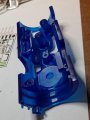
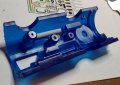
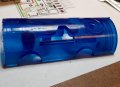
First results are in ... and I must say I'm very impressed ... the quality of the print (0.05mm/layer) is such that its surface finish almost looks polished compared to the filament type print ... and just as expected, the part is extremely resistant to breakage in all directions equally. It's so good that I'll have it print the actual working test prototypes I'm making for a very important project. Also, even though the resin is quite expensive ($40.00 bucks for half a Kg), I'll be spending only $4.00 dlls per part I make ... all one has to do is compare that to the $300.00 dlls that my local workshop quoted for milling the part!

7f0a2762-dbaa-4bc7-bfc8-abb23e9f08fd.jpg
6c867faa-27d8-4a39-a049-37325e71502f.jpg

ce9989ab-8bd0-42e4-8799-3123df8790a2.jpg
 

dendad

Joined Feb 20, 2016
4,641
That looks very good!
I only have filament printers myself. A guy here had offered me a couple of resin printers he was not using but that has not come about as yet.
Did you see this one? The 3D Printer Nerd's "HUGE Resin Printer - First Impressions of the Peopoly Phenom mSLA 3d Printer"
VERY impressive!
 

Thread Starter

cmartinez

Joined Jan 17, 2007
8,788
I forgot to mention. Along with the resin and supplies, I also bought a 60W UV lamp and a jewelry rotary display such as this one so that I could place the part on it and properly finish curing it by slowly roasting using said lamp.

1573340884851.png

Well, the stupid lamp when "poof!" on my first time I plugged it in, and magic smoke came out... so I started bragging to my wife that I was sure I could fix it, but then she asked me how long that would take me... and it was an awful feeling of defeat ... Lucky thing is that I was still in McAllen Tx, when that happened, and Kohl's department stores have an Amazon return program in which all you have to do is leave the item with them and they'll pack, label and ship it for free ... so that took care of that.

As soon as I came back to Monterrey I ordered another set of two lamps (which were a little more expensive, but no matter). But unfortunately their delivery time is about two weeks. Expected arrival is about the 16th of this month ...

My point is that I haven't have the chance to properly finish curing those parts, and they still feel a slightly rubbery, and their surface a little soft. One can easily dent them by digging one's thumbnail in them... but I'm sure that'll change during the next few days while the curing reaction progresses naturally. I placed them a couple of hours under the sun today, but today wasn't a sunny day at all. Maybe tomorrow I'll have better luck.
 
Top