Update: I've been doing plenty of experimenting with ABS and PLA ... and one of my conclusions is that PLA sucks ... it's the worst crappy material available out there, afaik ... I know it's supposed to be easy to use, but the learning curve for ABS wasn't much harder. And parts made with ABS turn out to be tough and durable, whilst parts made out of PLA are fragile and ... well, sucky ...
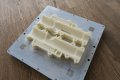
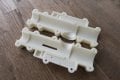
The first usable part I've produced is an extended reel support arm for the Monoprice Ultimate printer itself, due to the fact that the Hatchbox filament reels that I bought are wider than the Monoprice brand one that came along with the printer. I printed the new, extended arm, along with its unorthodox thread (30mm o.d., 7/5 mm thread pitch), and it fit perfectly on the printer, the plastic nut wrapped itself on the arm's thread without a problem, and its reel-holding function is being performed wonderfully.
ABS is a pain to print as you need to keep it warm.
Here is the case I made for mine. https://www.thingiverse.com/thing:2351805
Easy to make and very effective. Just remember, the ABS fumes are not really good for you so print in a ventilated area.
Yes, standard PLA is pretty weak. I have made a few hundred geckos to just give away for fun. https://www.thingiverse.com/thing:1862194
and centipedes too. https://www.thingiverse.com/thing:2867299
If I drop the PLA ones, they have bits snap off.
But the PolyMax ones bounce. It is 9 x stronger than PLA and a bit stronger than ABS.
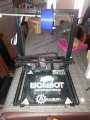
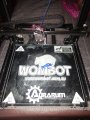
Just a couple of days ago, I was offered a second hand WomBot 3D printer.
It is BIG!
I can easily fit 28 geckos on it at one time.
A single gecko looks pretty lonely!
400x400x400mm print
And for a VERY good price. I jumped at it.
In general there are only three SYSTEMS for 3d printers. The most oldest is those having linear bearings on the rods, where long screws are turned, and contact place is between two nuts with a strong spring between those nuts to squeeze out the gaps. Mostly, the embalage is something like a plastic or metalloplastic planks and plate. The hardly altered construction is those built on the parallel long screws like an embalage and motion is organized by sinus-shaped teeth rubber band. It is order of magnitude faster and more exact. The first goes about day per 20x30cm artwork, while second maybe 2-4 hours. First has 10 microns in the best case, but worst 50, while second 10 microns are warranted. The third is made by large paralellogram mechanism, pantograph, where outhern legs are moved while printing head runs by inner. Thus this is the solely capable for printout so thin objects like plastic film made shopping sack, but the price is some 10 fold slower acting.
Thus, first make a choice on the size-rapidness-exactness. And then now that all printing heads are just the same thing only differs be made for thin wire or thick wire. Thin are simple, the CNC motor drives them straight, but appetite for wire is huge. The thick wire means cheaper products, but CNC motor demands a sprocket wheel gearbox, about 1:2 to 1:4. This wire is sth what may be made by own forces, in kitchen on the knee, and then the secondary (junk) plastics are all Yours - means printing costs nothing, what is very important for kilograms heavy artworks.
However, for some very special purposes and absolutely in another skyscraping price category comes heads for printing with ultraviolet light in the metacrylate liquid bath (irradiated solidifies), printing with plasma gun with a metal powder etc etc.
Dont forget that plastic printerhead must be properly ventilated with one or two micro-fans, and artwork must be started on the hardly heated surface (control of T), probably more of fans.
I went away during the weekend, and left the printer running a part that was projected to last 19:30 hours. When I got back home, this is what I found:
The print head made contact with the composite build surface adhered to the plate, and dug itself into it; carving a horrendous pattern that completely destroyed the surface. Fortunately, the machine came with a spare, and after quite a few minutes invested in removing the previous surface, and thoroughly cleaning the plate with paint thinner, the thing again looks just like new.
What happened was that every set screw in the printing head came loose due to vibration. One of the linear bearings in the print head actually came out and was lying on one extreme of the rail when I inspected it. Even the socket head cap screws holding the step motor in charge of feeding the filament into the printing head were lose! ... Has no one in the Monoprice assembly line ever heard of threadlocking compounds? ... not one single screw in that thing has remnants of it in any of its screws! ... I agree that a lock washer should be enough for most assemblies, but in any machine subject to vibration the use of a threadlocker is a must! I know, because I make a living designing and building machines! Besides, this machine hasn't even been active for more than 48 hours! This is unacceptable!
Even the leveling nuts underneath the build plate came off! ... No matter, I've already taken off every single screw in the machine and applied blue loctite to it, re-tightening them very carefully. Half of the screws in the machine that were not part of the printing head were also loose.
Fortunately, I have all the tools, the means and the skill I need to fix this sort of mishap. But I feel sorry for the average Joe out there when the same thing happens to him.
I'll also be adding counter-nuts and lock washers to the leveling nuts under the build plate, to make sure that they never, ever, accidentally come loose again due to the machine's intense vibration... And even after all those precautions, from now on I'll be checking every screw and make sure that the plate is properly leveled before starting on another part.
Wow. that is not good.
My problems have not been that bad.
A few things like this.
And a broken arm when I forgot to set Cura to a delta instead of a Cartesian layout.
It's a "closed ecosystem" - you gotta buy their consumables and use their software.
But... it works, It's a solid workhorse that just pumps out parts- once you sort a few things out.
So many things to tweak to get 3D printing to work right, I have no interest in learning all those details, I just want PARTS.
The premium I pay seems worth it.
Those parts look very good quality. But being locked into their supplies is a bit of a pain. I just think of my colour laser printer. "Real" carts for it would set me back $800 a set. I use "fake" ones for $38 a set. It is very hard to justify that sort of difference. Better that 20 to 1.
I have managed to infect some folks with the 3D printer bug. Just today, the young lady at our local Jaycar store showed me the parts she has printed. After introducing her to the treasures available from Thingiverse, she has not looked back.
Yes ... every freaking screw holding the z-nut together was also lose ... thank God I took the time to double-check all components in this printer. Of course, I've already tightened those screws and applied a generous amount of loctite. Important observation: The z-axis origin reference is determined by the actuation of a microswitch, which is calibrated by adjusting the height of a socket head screw that makes physical contact with it ... idiotically, said screw is properly mounted in a threaded hole in the build plate, but no means of firmly securing the screw to the plate exist. That is, the screw can be very easily rotated using one's fingers, and nothing more. That means that vibration can also very easily affect it, and therefore affect the distance between the nozzle and the build plate. It also explains why the nozzle dug into the build plate and destroyed it in the first place... of course, I've already added and firmly secured a counter-nut to that critical screw so that it won't be an issue anymore for a long time ... hopefully.
Right this moment I'm starting a new process that will be run overnight. Hopefully, tomorrow morning will bring no nasty surprises.
Assuming that someone may see this thread before buying and assembling a Anet A8 3D Printer made of acrylic, Don't use Loctite!
Long but informative assembly video
Anet A8 3D Printer - Review, Upgrades and Experiments
Apparently just the fumes from Loctite disintegrate Acrylic.
A quote from comments after the video.
"Well let me tell you, I did not see your video, nor know about NOT using Blue Loctite until last night. However the night before i also put together my Anet A8 AFTER having my wife bring me home a tube of the blue death. I did not drop a blob on. Infact i put it on with a toothpick. Got the frame all done and when i got up the next morning it was cracked everywhere! And I also read in a forum that i should use it while putting it together."
I can confirm that methacrylate adhesives ("super glue," CA, and Loctite are members) will cause at least some plastics and hard rubber to become extremely brittle. Several model airplane crashes were attributed to using CA to affix control guide tubes inside the fuselage. They disintegrated in flight and all control was lost. Didn't happen to me, but I did a bench test to show it.
Also, I had CA's and an accelerator ("Insta-Set") and a WWII identify friend or foe (IDFF) B-29 model made of hard rubber stored in the same large cabinet. That model also disintegrated after several years. (Fortunately, my B-17 model survived with only a little blistering on a wing.) I keep my CA adhesives stored in canning jars either in the freezer of out in the open now -- nowhere near other stuff. Epoxy fiberglass itself seems OK with CA.
Thanks, John and DNA, for your warning about Loctite. I didn't know that blue loctite contained methacrylate and its effects on acrylic. I'll keep that in mind whenever I assemble acrylic parts.
On a side note, another thing I've noticed about this printer is that it contains non-standard parts. In example, the nozzle has an M7x1 thread, for which a tap and die are very hard to find. I'm assuming that the manufacturer chose that design so as to prevent easy replication of those parts by a third party.
McMaster-Carr (https://www.mcmaster.com/#standard-taps/=1e2zc7x) carries M7x1 taps. It does ship to Mexico. The agent I call estimated shipping at $35 to $45 ! Amazon also lists that size and probably has cheaper shipping.
It's a "closed ecosystem" - you gotta buy their consumables and use their software.
But... it works, It's a solid workhorse that just pumps out parts- once you sort a few things out.
So many things to tweak to get 3D printing to work right, I have no interest in learning all those details, I just want PARTS.
The premium I pay seems worth it.

 Facebook
 Google
 GitHub
 Linkedin