logs / dB

Thread Starter

James4553

Joined Jun 7, 2008
35
Hi Guys,

We're doing logs now in our maths subject and the lecturer was explaining logs/dB's etc.
He was writing about dBm (dB to the base m) and how that means milliwatts or something but I forgot how to go from, say, 5dBm to the equivalent wattage.
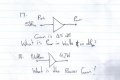
Below is a picture of the question I'm having trouble with.

Thanks in advance.
 

Attachments

steveb

Joined Jul 3, 2008
2,436
Once you have the basic formula and understanding for dB and dBm, you should develop the ability to do quick calculations in your head. This seems difficult at first, but turns out to be really easy if you memorize a couple of facts.

Remember that addition and subtraction of dB (relative to dBm) is multiplication and division of a constant (relative to power in mW).

dB level is relative, but dBm level is absolute power.

0 dBm = 1mW
10dB is a factor of 10
3 dB is about a factor of 2 (actually 3.01 dB, but it's close enough)

So, what is 20 dBm in mW? 1mW x10 x10 = 100 mW

What is -10 dBm in mW? 1mW / 10 = 0.1 mW

What is 37 dBm in W? 40 dBm is 10 W, so 40dBm-3dB=10W/2=5W

What is 4 mW in dBm? 4 mW = 1 mW x 2 x 2 , so 4 mW = 0 dBm+3dB+3dB=6dBm

As an exercise, count from 0 to 100.

0 dBm = 1mW
1 dBm = 10dBm - 9dB =10mw/2/2/2 = 1.25 mW
2 dBm = 20 dBm - 18 dB = 100mW/64
3 dBm = 2 mW
4 dBm = 1 dBm + 3 dB = 2.5 mW
5 dBm = 20 dBm - 15 dB = 100 mW/32
6 dBm = 4 mW

Notice that some numbers such as 2 dBm and 5 dBm are not nice round numbers. You can fine tune your approach by noting that 1 dB is a factor of about 1.25. So 2 dBm = 1.25 mW x 1.25

If you don't need to be very accurate, you can use a rule of thumb that 5 dB is about a factor of 3 (actually it is sqrt(10)=3.16).

As i look back at what I wrote, I see that it looks complicated, but trust me, it is very easy once you work it out.

It's important to be able to make these quick conversions, and before long you will do it without even thinking.

Why is this useful? For example, your second problem can be quickly estimated. You instantly know that 4.2 mW is reasonably close to 4 mW which is 6 dBm. So you know instantly that the approximate answer is about 6 dBm-0.6 dB for a gain of 5.4 dB. That's pretty close to the true answer, and if your calculator gives you something that is way off, you know there is an error somewhere.
 
Last edited:

Thread Starter

James4553

Joined Jun 7, 2008
35
Thanks a lot for the help guys.

Steve, I went back over my notes several times to try to get an understanding to this and it seems like my lecturer has taught it a different way to what you have shown.

For example, he uses the equation:
dBm = 10log(P/1mW)

I'm still working on question 17 but could you please let me know if this is right for question 18?

dBm = 10log(P/1mW)
0.6 = 10log(P/1mW)

10^(0.6/10) = P/1mW
P(input) = 1.15mW

Ap = Vout/Vin = 4200/1.15 = 3652 Gain

dB = 10logAp = 10log3652 = 35.6dB

Does this look right?
 

Thread Starter

James4553

Joined Jun 7, 2008
35
OK, I think I have the solution for qu 17:

5dBm = 10log(P/1mW)
10^(5/10) = P/1mW
P(input) = 3.16mW

Gain = 45dB = 10logAp
Ap = 10^(45/10) = 31622

Pout = Ap x Pin = 31622 x 3.16
= 99.9W


Pout (dBm) = 10log(P/1mW) = 10log(99.9W/1mW)
= 50dBm

Is this right or am I way off?
 
Last edited:

steveb

Joined Jul 3, 2008
2,436
Yes, you got 17 right, but you did it the hard way. The easy way is to say that the the output is 5dBm + 45 dB = 50 dBm.

Looks like I made a mistake on 18. I misread the output power and thought it was 4.2 mW instead of 4.2 W. Your answer is correct.

I want to be clear of what I was saying before. The way the teacher taught you is correct. My previous post was trying to point out that you can do quick estimations in your head. In school, this is helpful so you can quickly verify that your answers are reasonable (after you calculate it precisely). When working in the field, you can quickly get the approximate answer without pulling out a calculator. If you work with dB and dBm all the time, you can't spend all day punching numbers in a calculator. I would compare learning this technique with learning the resistor color code. You could get by without it, but you look inexperienced if you don't know it.
 
Top