Logic families - 5426 v 54LS26

Thread Starter

scMicropt

Joined Apr 20, 2017
11
Hi
I am typically an RF engineer but am looking to replace a 5426 die with a 54LS26 equivalent. What is the impact of using a LS part - I don't remember my legacy TTL families. This is for an old military product. Is it just the input levels of the logic at the inputs since this is a high voltage output.

Any advice appreciated.
 

crutschow

Joined Mar 14, 2008
38,503
The maximum output current drive level of the LS part is lower than the non-LS part.
How many inputs does its output have to drive?
 

Thread Starter

scMicropt

Joined Apr 20, 2017
11
The two circuits are on the same datasheet. In fact, the 5426 (which we can't get hold of) is unavailable and not mentioned on the datasheet. So I guess we have to go with the LS part as the LS26 drives some transistors.
 

Attachments

ian field

Joined Oct 27, 2012
6,536
Hi
I am typically an RF engineer but am looking to replace a 5426 die with a 54LS26 equivalent. What is the impact of using a LS part - I don't remember my legacy TTL families. This is for an old military product. Is it just the input levels of the logic at the inputs since this is a high voltage output.

Any advice appreciated.
It might well be OK. The L is low power and probably wont source/sink enough current, the S is high speed shottky and power hungry. The LS was a sort of compromise. generally its better than the base number device - but not all improvements work in your favour.

Might be worth examining the spec for an ALS part - its one more place to look anyway.
 

MrChips

Joined Oct 2, 2009
34,807
Hi
I am typically an RF engineer but am looking to replace a 5426 die with a 54LS26 equivalent. What is the impact of using a LS part - I don't remember my legacy TTL families. This is for an old military product. Is it just the input levels of the logic at the inputs since this is a high voltage output.

Any advice appreciated.
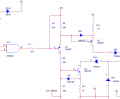
When you say "die" I presume you mean IC or integrated circuit. One refers to "die" when discussing IC fabrication.

54xx series refers to extended operating temperature range -55°C to 125°C or what we refer to as "military spec".
74xx series is commercial operating temperature range of 0°C to 70°C. Do you need the extended temperature range.

7426 are 74LS26 are high voltage open-collector NAND gates. Do you need 15V capability?

7403 and 74LS03 are normal 5V output open-collector NAND gates.
 

AnalogKid

Joined Aug 1, 2013
12,126
My guess is that this is a hybrid circuit tech refresh.

The LS part will have less propagation delay, but only by a few ns. The output rise and fall times should be faster, but other than a slight increase in conducted and radiated noise that shouldn't be a problem for the downstream circuits shown in post #5.

ak
 

Audioguru

Joined Dec 20, 2007
11,248
You might need to try some LS parts to find ones that produce the needed 10mA output low current. The maximum load for an LS part is 8mA but some do better.
 
Top