LM3914 Battery voltage indicator

dl324

Joined Mar 30, 2015
18,219
Could someone help me how to make a circuit for 18 volts to 25 v battery indicator, as I referenced many resources including datasheets but I find it hard to figure out its exact working?
It's just a bunch of window comparators with some circuitry to implement constant current drivers and dot or bar mode.

Are you asking someone to read the datasheet and figure out how to establish your desired range?
 

crutschow

Joined Mar 14, 2008
38,316
EDIT: Changed circuit slightly to reduce interaction between the two pot adjustments.

Configuring the operation of the LM3914 to do what you want can be a little confusing.
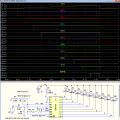
Below is the LTspice sim of the circuit with offset to light the first LED at an input of 18V and the last LED at 25V:

R1 and R1 form a 10:1 attenuator to give a voltage within the LM3914's operating range, so the Sig voltage is 2.5V for a 25V In voltage.

The voltage at Rlo determines the voltage to energize LED1 and the voltage at Rhi determines the voltage that energizes LED10.
Rlo and Rhi are connected to an internal divider string of ten 1kΩ resistors in series which determines each of the LED energize voltages.

The reference voltage of 1.25V appears between pins Ref and Adj, so the (constant) Ref current through R13 and pot U2 is 1.25V/2k = 0.625mA.
This current goes through the resistors and pots in series to determine the voltages at Rlo and Rhi.

The Ref current also determines the LED currents, which are 10 times that value, giving a nominal LED value of 6.25mA.
This should give adequate brightness, especially with high brightness LEDs.
You can change the LED currents by changing the value of U2 and R13, but that then would require a proportional change to R3 and pot U3.

You will need to adjust the1kΩ pots, U2 and U3, to compensate for component tolerances and get D1 and D10 to light at the desired voltages.
There is some interaction between the two pots so adjust U3 first to set the 18V D1 activate point, and then adjust U2 for the 25V D10 point.
You may have to go back and forth between the two adjustments to get the final desired LED operation.
Start at about 50% for both pot wipers.

If you want to operate in the Dot mode, where only one LED is lit at a time, connect the Bar/dot input to ground.

1702232835314.png
 
Last edited:

Thread Starter

flipayush

Joined Nov 6, 2023
10
hello eyeryone, first of all thank you everyone for replying, but still i did not find an solution to the problem, the circuit described by @crutschow is a bit complex to understand and as well difficult to implement on hardware and do we have to add another 5v source if yes then that is very difficult.
@MisterBill2 please could you give me the reference for application notes
@LowQCab i already read that part in datasheet 2 times but it was difficult to understand
@dl324 if that is possible please or else just guide me a bit with signal reference low and refernce high pin
 

crutschow

Joined Mar 14, 2008
38,316
still i did not find an solution to the problem
The circuit I posted is a solution to your problem.
the circuit described by @crutschow is a bit complex to understand and as well difficult to implement on hardware
You are not likely to find anything simpler. :rolleyes:

It consists of one integrated circuit and a few passive parts that can be easily done on an electronic perf board.
Why do you consider it difficult to implement?
 

Thread Starter

flipayush

Joined Nov 6, 2023
10
The circuit I posted is a solution to your problem.
You are not likely to find anything simpler. :rolleyes:

It consists of one integrated circuit and a few passive parts that can be easily done on an electronic perf board.
Why do you consider it difficult to implement?
do i need to add extra 5volts to the circuit??
 

MisterBill2

Joined Jan 23, 2018
27,164
The application notes were published by the National Semiconductor in the late 19770-1980 time frame. They are in the public information realm.
The 5 volts in the circuit powering the LEDs can be rep[laced by a suitable resistor selected to allow the desired LED current, in the "dot mode". The V+for the IC can be from an LM78M05 regulator, or maybe an LM78M12, the LM3914 can use either. And that same device can also supply the LEDs.
 

crutschow

Joined Mar 14, 2008
38,316
The 5 volts in the circuit powering the LEDs can be rep[laced by a suitable resistor selected to allow the desired LED current, in the "dot mode".
That won't prevent the maximum voltage being applied to the output drivers (which have a 25V absolute maximum limit) when the LED is off.
thanks for the help but since i have space problems, is there any way to make it without the use of extra voltage regulators
No.
You don't have room for one of the small packages the 78L05 comes in such as the SOT-25 or TO-92?
Where are you putting this circuit?
 

dl324

Joined Mar 30, 2015
18,219
if that is possible please or else just guide me a bit with signal reference low and refernce high pin
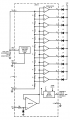
1702312832049.png
The TI datasheet states that REF OUT can be 1.2-12V. That means you'd need to use a voltage divider for the voltage range you want to use.

If you divide by 3, the indication range would be 6-8.3V, so you'd set RLO to 6V and RHI to 8.3V.

The current out of the reference voltage source is typically 75uA with a 120uA maximum. Assuming 100uA to make the calculations easier (you'll have to adjust for the actual current), you want the voltage on REF ADJ (pin 8) to be 8.3V-1.2V=7.1V. That requires a 71k resistor from pin 8 to ground (obviously you're going to use a pot to accommodate reference voltage/current variation).

The voltage at RLO needs to be 6V. Using the voltage ratio and the 10k resistance in the LM3914, the resistor from RLO to ground would need to be 26.1k. The datasheet says that the divider resistance can be 8-17k, with 12k typical, so you also need to take that into consideration.
EDIT: just noticed that the RLO calculation needs to account for the bottom 1k resistor. Exercise left to the student...

The supply voltage needs to be high enough for the reference voltage source to function.
 
Last edited:

ericgibbs

Joined Jan 29, 2010
21,390
Hi,
If using a 78L05, with an LED current of say 10mA/LED, it would be advisable to use Dot Mode.
Watts (25v-5v)/10mA = 0.2Watts per LED Load.
The 78L05 is rated at 500mWatt max.
E
 

eetech00

Joined Jun 8, 2013
4,704
If the total LED current can be kept below 10mA, then a resistor divider might be used to drop the supply voltage to an acceptable level. Maybe a hi efficiency bar graph display?
 

MisterBill2

Joined Jan 23, 2018
27,164
That won't prevent the maximum voltage being applied to the output drivers (which have a 25V absolute maximum limit) when the LED is off.
No.
You don't have room for one of the small packages the 78L05 comes in such as the SOT-25 or TO-92?
Where are you putting this circuit?
The diodes can all be powered from the 12 volt regulator if that is OK to power the LM3914 for this application. The 5 volts is not needed anywhere.
 
Top