WOW!! I had not been aware of the brown glue being corrosive to copper. But it does make sense, given the "generous" 90 day warranty occasionally offered.
The schematic you posted does not show the power amplifier section that has the problem.
The difference in DC voltage at the outputs of the paralleled ICs produces a current in their series output resistors that heats both of them. The amplifier manufacturer probably selected matched ones so the voltage difference and resulting current and heat are tiny.
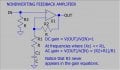
Here is a schematic from the datasheet with my comments:
Either AG is looking at different drawings or has a different equation for amplifier gain. I do see that there are capacitors in series in the driver circuit on the other sheet. But there is a resistor to common for both positive inputs, and as there is no other connection to the inputs that must therefore be Rin, and the single 20K resistor must be the DC feedback, so that the DC gain is still Rf/Rin. And so while the calculated gains are similar the actual DC conditions are also affected by leakage in any of those severa capacitors in the circuit. And unfortunately not all capacitors have zero leakage. AND, given that the overheating stayed when the IC was replaced, the fault seems to be in some other location.
Hi, I don't know if you ever got to the bottom of your issue but I thought this might be worth knowing for anyone with Truth 2031s that are reading this. I have had a pair of these for many years but they have not been in service for about 5 years. Yesterday I got them out to test before trying to sell them. I found that one would not switch on - no green LED. +15v and -15v seemed OK. I ended up removing the pcb and trying to trace the mute circuit. The only available schematic is not correct to this pcb and IC11 is actually IC8 - the mute op-amp. I then noticed that some of the electrolytic caps including the big 6800uF plus a 4-lead opto coupler had been 'stuck down' for vibration purposes with the dreaded Japanese, and now Chinese, brown glue. This was used in Japan in the 80s and early 90s before it became known that it ages and becomes conductive, and also corrodes the copper track and component leads. It has reputedly made a reappearance in pcbs from China recently. I had not caught this in time but the pcb in the other speaker was the same but had not really started to cause an issue. The main damage was to fine tracks and vias around the opto-coupler. I have not repaired them yet and it will be a VERY difficult task. A steady hand and fine wire, plus I intend to drill a hole adjacent to pass the repair wires through from one side to another. This is worth checking on any 2031s. The best way to deal with it is to remove the components and clean off the glue with a knife and glass fibre brush etc. This will also reveal where the glue has eaten under the solder resist. If you are not too familiar with removing components from double-sided boards then ask someone who is or it is easy to wreck the board.
The attached pics don't show the areas cleaned up but are as found, with the glue scraped off. I will take some better pics of the other 'good' pcb in case anyone has a really bad board and wants to know where the traces go to/from.
I first encountered this awful glue on an ignition unit for a Kawasaki V-twin mower engine. It had eaten not only the track but component leads too, and had resulted in ignition timing chaos for the second cylinder which had burned out an exhaust valve.
It seems that the 20K resistor between the output and the inverting input must have a fair effect on the DC gain in most op-amp circuits. It probably has some effect on the AC gain also.
It seems that the 20K resistor between the output and the inverting input must have a fair effect on the DC gain in most op-amp circuits. It probably has some effect on the AC gain also.

 Facebook
 Google
 GitHub
 Linkedin