Facebook
 Google
 GitHub
 Linkedin

Audioguru again
- Joined Oct 21, 2019
- 6,826
My math was wrong.
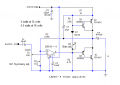
With a 12V supply and the low current load of the output transistors, the LM386 output is the 5.25V peak shown on the datasheet but the diodes are not used to turn on the transistors so the bases get 0.7V peak more than the 5.25V peak (if the 1k base resistors do not cause any voltage loss). so the bases get 5.25V + 0.7V= 5.95V peak and the emitters get 0.8V less which is 5.15V into the 8 ohms + 0.22 ohms which makes 504mA. Then the 8 ohm speaker gets 1W (if the 1k base resistors do not cause any voltage loss).
But of course the 1k base resistors will have a peak current of 504mA/20= 25.2mA in them which causes a 25.2V loss so the output power is ZERO.
If the transistors have their typical current gain of 100 then the voltage loss in the 1k base resistors is 504mA/100 x 1k= 5.04V then the output to the 10.22 ohms load resistors is 5.15V - 5.04V= 0.11V peak producing a whopping 0.048W in the 8 ohm speaker.
With a 12V supply and the low current load of the output transistors, the LM386 output is the 5.25V peak shown on the datasheet but the diodes are not used to turn on the transistors so the bases get 0.7V peak more than the 5.25V peak (if the 1k base resistors do not cause any voltage loss). so the bases get 5.25V + 0.7V= 5.95V peak and the emitters get 0.8V less which is 5.15V into the 8 ohms + 0.22 ohms which makes 504mA. Then the 8 ohm speaker gets 1W (if the 1k base resistors do not cause any voltage loss).
But of course the 1k base resistors will have a peak current of 504mA/20= 25.2mA in them which causes a 25.2V loss so the output power is ZERO.
If the transistors have their typical current gain of 100 then the voltage loss in the 1k base resistors is 504mA/100 x 1k= 5.04V then the output to the 10.22 ohms load resistors is 5.15V - 5.04V= 0.11V peak producing a whopping 0.048W in the 8 ohm speaker.