LM386 Amplifier With A Class AB Push-Pull Stage - 2 Watts

Audioguru again

Joined Oct 21, 2019
6,826
My math was wrong.
With a 12V supply and the low current load of the output transistors, the LM386 output is the 5.25V peak shown on the datasheet but the diodes are not used to turn on the transistors so the bases get 0.7V peak more than the 5.25V peak (if the 1k base resistors do not cause any voltage loss). so the bases get 5.25V + 0.7V= 5.95V peak and the emitters get 0.8V less which is 5.15V into the 8 ohms + 0.22 ohms which makes 504mA. Then the 8 ohm speaker gets 1W (if the 1k base resistors do not cause any voltage loss).

But of course the 1k base resistors will have a peak current of 504mA/20= 25.2mA in them which causes a 25.2V loss so the output power is ZERO.
If the transistors have their typical current gain of 100 then the voltage loss in the 1k base resistors is 504mA/100 x 1k= 5.04V then the output to the 10.22 ohms load resistors is 5.15V - 5.04V= 0.11V peak producing a whopping 0.048W in the 8 ohm speaker.
 
The LM386 is over 45 years old and it was not a great design in the first place. I started with it as a kid and had lots of fun with it. Nothing has been able to dethrone it. Laugh at the LM4871 that runs only up to 5.5V like they never heard of 6V-up battery arrangements.
Everyone wants make a portable "guitar amp" with them, where you can't easily notice 10% THD.
They love to oscillate around 13MHz due to the "bottom fuzzies" of the lateral PNP of the Sziklai pair. This radiates out the loudspeaker leads and causes much bewilderment. The input stage loves to rectify AM radio, add a wire and listen to the news. The voltage efficiency is poor always at least ~2Vpp of swing lost and THD and freq. response are abysmal. It's love/hate for me with this IC.

With 12V rails, you get about 8Vpp into 10R load, or 6.5Vpp at 8R according to the charts.
The charts are showing 0.8W out at 10%THD at 8R load, with the IC roasting dissipating 0.8W Would you like to see my breadboard meltdown when I tried that?
 

345wspo

Joined Jul 10, 2020
15
None of this is relevant! We want a spice model that works. I for one have a couple of these chips
and I want to experiment with them as I expect the author of this thread does. Either help us with that
or go away and have your discussion elsewhere.
 

sghioto

Joined Dec 31, 2017
8,634
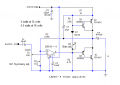
Here's a real world circuit I designed using a LM386-4 driving a push-pull output stage for experimentation This was just for fun and although it does work it's not very practical.
SG
EEE LM386 to TIP42,TIP41 driver.png
 

Audioguru again

Joined Oct 21, 2019
6,826
Good, now we have an audio power amplifier instead of the old-school circuit using the LM386 to drive the output transistors OFF with lots of voltage loss. This new circuit drives the lower output transistors ON with a small voltage loss and the bootstrapping of the upper output transistors adds voltage swing and output power.
Of course the 4 ohm speaker doubles the power of an 8 ohm speaker.
 
None of this is relevant! We want a spice model that works. I for one have a couple of these chips
and I want to experiment with them as I expect the author of this thread does. Either help us with that
or go away and have your discussion elsewhere.
It took me 5 minutes to draw the IC sch in LT Spice. It's not hard, with 7 resistors and 10 transistors.
 

ericgibbs

Joined Jan 29, 2010
21,454
hi
@aac044210

One last shot. ;)
LTS requires that the Auto Generated model has to be done on your PC.
I did a test run of the zip I posted, on a laptop, got the same problem as you.
Tried to auto gen on the laptop and got the correct result.

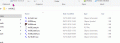
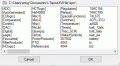
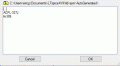
I have attached a zip, containing a folder showing clips of the steps required to create the model, give it go.

E
 

Attachments

Thread Starter

aac044210

Joined Nov 19, 2019
178
hi
@aac044210

One last shot. ;)
LTS requires that the Auto Generated model has to be done on your PC.
I did a test run of the zip I posted, on a laptop, got the same problem as you.
Tried to auto gen on the laptop and got the correct result.

I have attached a zip, containing a folder showing clips of the steps required to create the model, give it go.

E
LM386-4 is rated at a higher supply voltage.
22 volts max but 18 volt max recommended
Thanks sghioto.
 
Last edited:

Thread Starter

aac044210

Joined Nov 19, 2019
178
hi,
Open the LM386.sub file in LTSpice
then follow the steps I posted in the 1st zip, [with images]

E
Thanks E. Got it working. One last question. Assume I am creating a new circuit schematic. How would I find the
LM386 component to place on the schematic, as it doesn't appear in my component list?
 

ericgibbs

Joined Jan 29, 2010
21,454
hi,
It should be under F2,,, Auto generated.

Update:
An alternative way is
Create a New schematic, then open an asc file with circuit that has the LM386 in it,

Click Copy on the top menu, click on the LM386 image, then select the new schematic and Paste the LM386 image.
Don't forget the .include

E
 

Attachments

Last edited:

Thread Starter

aac044210

Joined Nov 19, 2019
178
hi,
It should be under F2,,, Auto generated.

Update:
An alternative way is
Create a New schematic, then open an asc file with circuit that has the LM386 in it,

Click Copy on the top menu, click on the LM386 image, then select the new schematic and Paste the LM386 image.
Don't forget the .include

E
Thanks very much E.
 
Top