LM358N power supply requirements / specs

bertus

Joined Apr 5, 2008
22,952
Hello,

The TL431 is a precision voltage reference.
It can be abused to be used as an amplifier.
In the datasheet you will find this schematic:
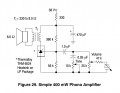
TL431_amplifier.png

Bertus
 

Attachments

crutschow

Joined Mar 14, 2008
38,569
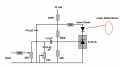
The polarities are okay.
The top resistor should be 330Ω, not 330kΩ.
The gain may be a little high. If so you can increase the value of the 47kΩ resistor.
I don't think you need a tone control so you can remove the 10k pot and the .05μF cap.
What laser diode current do you want?
 

Thread Starter

Tonyr1084

Joined Sep 24, 2015
9,744
Got it from a Dollar Store. One of those dog toys (or cat toys). cost $3.00 and comes with three button cell batteries. Have messed with them before, they're cheap and quick.

330Ω power feed. Yeah, I goofed on that one. Good catch. I'll make the changes.

˚J˚
˘
 

Thread Starter

Tonyr1084

Joined Sep 24, 2015
9,744
Correct me if I'm wrong but the "Tone Control" - won't that (in its current configuration) attenuate the treble? If so I most likely won't want that. Actually if anything I might want to attenuate the base frequencies more so because the base notes tend to hide the high frequencies.

As for the laser current, I have to disassemble one to read the resistor on it. Coupled with three button cell batteries, I'd imagine I = 4.5/R. Should be able to figure out how much current they're giving it so I can likely calculate the needed current for my laser diode.
 

AnalogKid

Joined Aug 1, 2013
12,174
Back to opamps and ground pins, one more caution.

Some things that look like opamps are not, and some analog device pins marked GND really are GND. The perfect example of both is another old part, the LM386 audio power amplifier. This is a stripped-down version of the LM380, and is a weird little critter. It is designed to be a low circuit cost, battery-powered, single-supply speaker driver. It has non-inverting and inverting inputs marked + and -, but internally they are referenced directly to the negative power input pin, which really should be the system/signal ground. Rather than use traditional negative feedback to set the gain, the part has specific gain setting pins. Also, the output automatically biases itself at 50% of Vcc even when the inputs are grounded, a very non-opamp maneuver. At least once a year someone asks why their opamp circuit isn't behaving and it turns out that they are using a 386 thinking it is a normal opamp.

ak
 

Thread Starter

Tonyr1084

Joined Sep 24, 2015
9,744
Sounds like a cool project. Maybe when you finish it you may like to post it in the finished projects forum.
Spending the morning looking for the "Finished Projects Forum." Haven't found it yet. Can you assist? And no, my project is no where close to finished yet, but it would be interesting to see what others have been building while I await parts via snail mail.

And thanks for the help.
 
Top