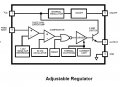
Thanks for the explanation i can understand what an op-amp does. Appreciate the explanation tho. I was carried away by the way the 3A BJT connected in the block diagram of this datasheet.
This has actually been done before and someone posted the results. I think it could have been in this forum too but i'll see if i can find it.
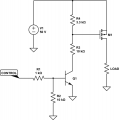
The solution was to use a NPN bipolar combined with a P-MOSFET. The NPN drives the P_MOSFET.
The reason for the MOSFET was to get very low voltage drop, the bipolar was used to invert the signal from the IC output to drive the MOSFET.
It may be better to use an inverting MOSFET driver chip though for faster switching.
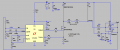
Using a PWM IC with a built-in power transistor to drive a power transistor seems wrong. There are many PWM ICs designed to drive an external part. Here is an example. LT1243 is the same as UC3843.
C7 is the storage cap. I used a much smaller value for a test. D2, Q1, R1, L1 need changed to get more current.
This version charges at 14A. L1+L2 could be one. I was playing with using a transformer to get more output current.
Here I have the large cap connected to +12 and Q1 pulls to ground.
U2 looks at the voltage across the cap and creates "CapV" which is referenced to ground for the error cap to look at.
Running at only 160khz. I think this charger needs to run "current mode" like this example.
I can see a different IC which drives two MOSFETs. The second MOSFET would replace D2. Slightly better power loss.
Okay deleted my last post as i made a mistake, MRai is correct that would be one of the best methods. I think something like this.View attachment 205993
Just want to caution you that 10k is going to be too high to drive the MOSFET properly.
Although the MOSFET has high static impedance, it has very low dynamic impedance. This means it should be driven with a low impedance source capable of delivering at least 1/2 amp or so drive current. This is to get the MOSFET to switch fast. If it does not switch fast enough it could overheat and of course burn out. At least check for that, and use a lower resistor set to drive the MOSFET.
I am low on board space. So what AI said would be possible to squeeze in but not sure if i have to compared to what is already done in #15. Is it just the voltage drop that makes this better ? Two reasons to use the N-channel, this has more components while am trying to keep that low. Second the Rds ON resistance on an N-Channel is lower.
I am low on board space. So what AI said would be possible to squeeze in but not sure if i have to compared to what is already done in #15. Is it just the voltage drop that makes this better ? Two reasons to use the N-channel, this has more components while am trying to keep that low. Second the Rds ON resistance on an N-Channel is lower.

 Facebook
 Google
 GitHub
 Linkedin