Lithium Ion battery indication by led through voltage measurement

Thread Starter

Vindhyachal Takniki

Joined Nov 3, 2014
598
1. Have to make a led level indicator of lithium battery of 7.4V (two cells in series of 3.7V each).
Led level indications are 0-20,40,60,80 & 100% i.e by 5 leds.

2. Need to make it simple by voltage measurement only. Voltage range of battery pack is 5.7V to 8.4V. Need to break that into 5 different voltage ranges & then indicate by led.

3. I know voltage measurement is not accurate way, but in most application its good enough & I ave to keep simple in this application.

4. Currently doing it by MSP430G2553 MCU & its working fine, but I was thinking is there any dedicated IC available for this, need to be real low power?
Problem with MCU is everytime I have to burn program in it.

Check lots of chinese power banks, they have some dedicated IC, but there parts number are not traceable or available on net.
Any low power ic solution for this?
 

Picbuster

Joined Dec 2, 2013
1,059
use a pic @ 32Khz and low power mode.
Pic's like 12F or 16Fseries. (both have internal oscillator)
Pic 12f675 has 8 pins 2 for power one ADC(10Bits) 5 pins left to put into a demux.
or
use the pic 16f690 no demux needed
the 16f690 has also one serial port allowing to communicate.
Pic allowed to drive led directly =<20mA.
resulting in a power consumption defined by led(s). (mpu & pwr (MCP1705) fraction of led consumption see datasheet)

Picbuster
 

Dodgydave

Joined Jun 22, 2012
11,395
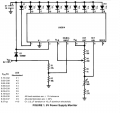
That's a 2.7V range in 5 leds, so 0.54V per led. A Lm3914 bar/dot mode can do that easily. ..the upper and lower voltage levels are set by the pins 4,6

585.png
 

Thread Starter

Vindhyachal Takniki

Joined Nov 3, 2014
598
Can we integarte switch with LM3914 also, so that when switch is pressed, led glows for 2-3 seconds, after that led goes off & system goes into low power mode to save power
 

crutschow

Joined Mar 14, 2008
38,546
Can we integarte switch with LM3914 also, so that when switch is pressed, led glows for 2-3 seconds, after that led goes off & system goes into low power mode to save power
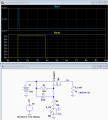
Here's a simple one-shot using a P-MOSFET, 1 capacitor, and 2 resistors.

The simulation shows the output power staying on for nearly 3 seconds when the push-button SW is momentarily closed.
When off, the circuit draws only a very small leakage current.

The on time depends upon the P-MOSFET threshold voltage so the value of R1 may need to be tweaked to get the time you want, depending upon the particular MOSFET you get.

The P-MOSFET can be just about any logic-level type [Vgs(th) max of 2V or less] with an ON resistance of no more than about 100mΩ.

upload_2018-6-13_23-0-54.png
 
Last edited:

ebeowulf17

Joined Aug 12, 2014
3,307
Here's a simple one-shot using a P-MOSFET, 1 capacitor, and 2 resistors.

The simulation shows the output power staying on for nearly 3 seconds when the push-button SW is momentarily closed.
When off, the circuit draws only a very small leakage current.

The on time depends upon the P-MOSFET threshold voltage so the value of R1 may need to be tweaked to get the time you want, depending upon the particular MOSFET you get.

The P-MOSFET can be just about any logic-level type [Vgs(th) max of 2V or less] with an ON resistance of no more than about 100mΩ.

View attachment 154400
That's cool! I had no idea that turn on/turn off characteristics of a MOSFET would be so sharp with a ramping gate voltage. I expected a much longer, slower linear region. Good to know for future reference...
 

crutschow

Joined Mar 14, 2008
38,546
I had no idea that turn on/turn off characteristics of a MOSFET would be so sharp with a ramping gate voltage. I expected a much longer, slower linear region.
Once you reach the MOSFETs Vgs(th) voltage, it doesn't take much additional voltage to fully turn it on or off, since most have high transconduce gain just above Vgs(th).
The turn-off time is somewhat slow in absolute terms (≈40ms in the simulation) but that's plenty fast for this application.
It does depend upon the drain load current as higher currents will give a slower turn-off time.
For example, reducing the load resistance to 100Ω increases the turn-off time to about 100ms, still far from a problem in an application such as this.
 
Last edited:
Top