Liquid Rocket Motor - Intermittent Ignition Sparking

Thread Starter

physicscafe

Joined Jan 13, 2019
7
Hi,

This is my first post here.

I was hoping for hints about how to intermittently activate a spark plug using a basic circuit that can handle 12V auto battery current. I would like the spark plug to throw a spark anywhere from many times per second 10 Hz to as slow as 1 Hz.

I have looked at "NC buzzers" although I'm not sure how that would work. 555 timers would not be preferred, as it's being used for the igniter on a liquid rocket motor.

Thanks!
 

BR-549

Joined Sep 22, 2013
4,931
No, that's not what I mean. Let's say you already have a device that will fire from 1 hz to 10 hz.........what controls the change from 1 to 10 hz?

ok?
 

Thread Starter

physicscafe

Joined Jan 13, 2019
7
Tell me a little about the rocket you have in mind.
I can't really tell you much because it's a prototype for an aerospace startup. It will use 4x standard spark plugs to run continuous spark in the event of flame out. The controllers would need to run for at least 10 continuous minutes initially.

This will allow the motor to re-ignite as we trim the ox and fuel on the initial static fire and also prevent unburned fuel from spontaneously igniting on hot surfaces as we approach after tests.
 

Alec_t

Joined Sep 17, 2013
15,117
555 timers would not be preferred
Why? They're perfectly capable of generating 1-10Hz pulses, although, as with almost any other pulse generator, you would not be able to drive an ignition coil directly with the timer output but would need an intervening power transistor.
 

drc_567

Joined Dec 29, 2008
1,156
It should be possible to utilize a mechanical 4 plug automotive distributor for your purpose. After wiring the ignition coil and distributor to a 12 volt battery, the remaining task would be to connect the distributor drive gear to a variable speed motor of some sort.


Variable speed DC motors are available at reasonable prices. The motor shown here has a maximum rotational speed of approximately 1 Hz, which means that a 4 plug ignition assembly would fire about 4 times per second.
https://makermotor.com/pn00409-12v-...bpcXKfiJWD93itV_ZPWWrssqhlgJwYT4aAhNBEALw_wcBl
 

oz93666

Joined Sep 7, 2010
742
Liquid rockets seem an unnecessary danger , expense and complication when compared with solid ...

They have only one advantage ,you can vary the thrust ... are you sure you really need to do that?? if so multiple solid rockets maybe be much easier , lit at different times.

On a massive rocket like Apollo , liquid H2 and O2 may have a price advantage , but not for medium or small scale , with the danger and expense of storing volatile fuel/oxidizer. And the pumps needed to feed the engine with all the complications and weight that involves.

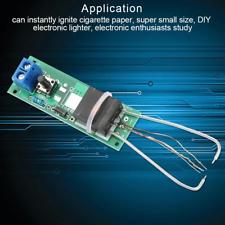
if you really want a spark generator there are a dozen different types on eBay all very compact , from $2 each , which run on one small 3.6V li battery

 
Last edited:

wayneh

Joined Sep 9, 2010
18,104
Just thinking out loud here, but how about a magneto? That's what makes the spark for every lawnmower, chainsaw and leaf blower you see. There must be some moving parts on this thing, in which a magnet could be embedded? Then you just mount a coil near the magnet's path and you get a nice spark with each rotation. You can kill the spark anytime by grounding the coil, just as you do to turn off a lawnmower.

A big advantage to a magneto system is reliability and ruggedness. And they're cheap.
 

jpanhalt

Joined Jan 18, 2008
11,087
Presumably by preventing the accumulation of unburned fuel in the first place.
I was hoping the TS had an explanation. Albeit, my experience with liquid fueled rockets is probably less than yours. I do remember from shuttle flights that excess fuel was vented, not ignited. It seems that igniting fuel in a engine at rest is risky.

Now as for reciprocating engines and pulse jets (as mentioned above, but not responded to by the TS), the most significant problem with unburned fuel is during the starting process of a cold engine, not shutdown.
 

Thread Starter

physicscafe

Joined Jan 13, 2019
7
Just thinking out loud here, but how about a magneto? That's what makes the spark for every lawnmower, chainsaw and leaf blower you see. There must be some moving parts on this thing, in which a magnet could be embedded? Then you just mount a coil near the magnet's path and you get a nice spark with each rotation. You can kill the spark anytime by grounding the coil, just as you do to turn off a lawnmower.

A big advantage to a magneto system is reliability and ruggedness. And they're cheap.
We would like to not use motor driven systems, that's why I didn't want to use a standard auto ignition system also.

Liquid rockets seem an unnecessary danger , expense and complication when compared with solid ...

They have only one advantage ,you can vary the thrust ... are you sure you really need to do that?? if so multiple solid rockets maybe be much easier , lit at different times.

On a massive rocket like Apollo , liquid H2 and O2 may have a price advantage , but not for medium or small scale , with the danger and expense of storing volatile fuel/oxidizer. And the pumps needed to feed the engine with all the complications and weight that involves.

if you really want a spark generator there are a dozen different types on eBay all very compact , from $2 each , which run on one small 3.6V li battery

Thank you, I have already found higher power models of these, and they are in consideration.

To address the various concerns, this is a legit, however, flying under the radar, company. We are just setting up the final pieces of the first static test fire, and this was one that was left on the back burner.

The engine is liquid, there's no way around that, it's the design intent.

I have probably found a solution the the problem for now. I hope the project is in the news in the next several months, I would be happy to share and answer questions.

If anybody has some circuit ideas, please feel free to chime in!
 

oz93666

Joined Sep 7, 2010
742
Not to encourage the OP, but a liquid fuel engine also has a higher ISP.
Yes your right Ylli ..... "Specific impulse is a measure of how effectively a rocket uses propellant . By definition, it is the total impulse (or change in momentum) delivered per unit of propellant consumed "

And I'm surprised at the difference.... 450 for H2 O2 .... only 250 for the solid rockets used on the shuttle . Of course for solid you don't have to carry the extra weight of pumps to deliver the fuel and oxidizer , and the rocket engine .. but I can't imagine that would make up for such a big difference in SP ... So why use two firework rockets tied onto the shuttle??? I seem to remember it was a political decision and not based on engineering... senators wanted jobs for their voters , the solid rockets could be made far away from launch site , brought in and tied on ... One advantage was suppose to be no moving parts , very simple , nothing could go wrong ....Hmmm...
 
Top