LiPo Cutoff with LED indicator?

Thread Starter

MythicalCoder

Joined Aug 28, 2015
83
I'm in the process of converting a Tyco Rebound (old 90's era RC car) from NiCD to LiPo. Long story short, my 2S LiPo needs a cutoff since the fully-charged NiCd is 6.0v -- exactly where the LiPo is considered fully discharged, and I'd like to have indicator lights to show good/bad (4x white/4x red respectively). On a bench power supply feeding up to 8.5v to the RC car, peak current @ 3A, stable was 0.75A or lower one side so for both let's say peak 6A, stable 1.5A. Battery fully charged is 8.2v

I thought it would be a cool touch to turn on "headlights" (white LED) when the car turns on and "brake lights" (red LED) when the battery is too low, essentially creating a rudimentary good/bad indicator that is visible from a distance at any angle. Also avoids annoying buzzers and since this is a car, a cutoff makes you go to investigate why it stopped and the lights immediately tell you it's a low battery. Four of each LED would be desired.

There's a ServoCity cutoff [link] that's been littered everywhere, but it merely cuts off and doesn't indicate. Also, 6.0v seems to be cutting it a bit short for a 2S battery to me -- or am I wrong on that? I did find a great circuit [link] (post #3) but it's just a warning indicator. I can't seem to wrap my head around how to combine a cutoff with a warning circuit with only one LED of space. I don't know if 6.0v is acceptable but I figure 6.2v gives enough runtime to the LED indicators once the cutoff occurs that the LiPo shouldn't be damaged even if you can't get to the car for a few minutes.

I've never really worked with serious wattage before, so forgive my newness to all of this. This circuit (or variant thereof) may later work with 3S or 4S LiPos on other projects that will be MUCH beefier, I'd imagine 6A stable even. I'm thinking MOSFET but I just don't know how a proper circuitboard can handle that much power, all the trace width calculators in the world top out far short of that, even at 2 oz. I'll be using KiCad if it helps, though not the v5 yet, I'm hesitant to butcher my giant library of parts/footprints that I've amassed thus far.

Did that circuit I find put me in the right direction? Red herring? I've been spending hours and hours on this and for such a seemingly simple thing I have no idea why it's not commercially available at all. Any help seriously appreciated!!! :)

EDIT:
I should also mention I can't SMD solder to save my life!!! Through-hole solder all day long but even the big SMD stuff is way out of my league. Guess I don't have the hands to hold my iron to such small parts!
 

crutschow

Joined Mar 14, 2008
38,503
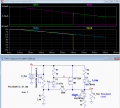
Below is a low-voltage cutoff circuit that should do what you want.
It uses the TL431 programmable 2.5V voltage reference as a comparator with trigger point adjustable by pot U2.
MOSFET M1 is turned off when the voltage drops below the set point (shown at ≈6.2V).
LED D2 is on above the cutoff voltage, and LED D1 goes on below the cutoff voltage

P-MOSFET M1 should have an on-resistance low enough so that the I²R loss from the maximum load current is less than 1W so the MOSFET wouldn't need a heatsink.
Thus for 6A the maximum MOSFET Ron should be ≤ 1/6² = 27mΩ.
The MOSFET also needs to be a logic-level type with a maximum threshold voltage, Vgs(th) of ≤2V.

R4 adds about 50mV of hysteresis so that the rise in battery voltage when the load is removed doesn't turn the output back on.

The current for the D1 diode, that turns on when the battery is low, flows through the load, but that should not be a problem with a motor load.

Four diodes can be put in parallel but they each should have their own current-limit resistor.

upload_2018-8-8_0-16-34.png
 

Thread Starter

MythicalCoder

Joined Aug 28, 2015
83
Wow, this is amazing, thank you! And I understand all of it, which is great! (And unusual! :eek: ) What kind of range will pot U2 accomplish as far as cutoff voltages?

Also trying to figure out proper high current design ettique. Does that only apply if you're using high current on the board components, or will passing serious wattage through a tiny board be a cause for design considerations? I spotted a few spikes as high as 9A, I'm going to overestimate and say 2A nominal at full power from bench testing. Or maybe a better question to ask is: at what point do you need to accommodate for high current with proper board design?
 

Thread Starter

MythicalCoder

Joined Aug 28, 2015
83
Wow, this is amazing, thank you! And I understand all of it, which is great! (And unusual! :eek: ) What kind of range will pot U2 accomplish as far as cutoff voltages?

Also trying to figure out proper high current design ettique. Does that only apply if you're using high current on the board components, or will passing serious wattage through a tiny board be a cause for design considerations? I spotted a few spikes as high as 9A, I'm going to overestimate and say 2A nominal at full power from bench testing. Or maybe a better question to ask is: at what point do you need to accommodate for high current with proper board design?
Bumping this, I don't have any circuit simulators handy and can't seem to find any good free ones, so hoping for a cutoff voltage that goes high enough for 4S or even 5S batteries, just to be on the safe side.

I've seen solder used on the entire trace to create a makeshift wire, as well as actually using wires, don't know what's needed here. Advice?

What's amazing is that this is entirely through-hole components. Resistors, a MOSFET, a schottky diode, and indicator LED's. It's so simple, what's not to love! :D
 

crutschow

Joined Mar 14, 2008
38,503
What kind of range will pot U2 accomplish as far as cutoff voltages?
The trip point occurs when the voltage at the TL431's Ref input reaches 2.5V.
So over the full adjusment range of the 10k pot, it will trip from 2.5V to about 9.6V.

You can increase that to an arbitrarily high value by increasing the value of pot U2.
For example a value of 20kΩ for U2 will give a maximum trip voltage of about 17V.

(I just noticed I cut off the bottom of resistor R5. It goes to ground as you may have surmised.)
I don't have any circuit simulators handy and can't seem to find any good free ones
I use the free LTspice simulator download from Analog Devices/Linear Technology.
It's one of the best free Spice simulators.
I've seen solder used on the entire trace to create a makeshift wire, as well as actually using wires, don't know what's needed here. Advice?
Here is a selection of articles discussing the current capability of PCB traces.

If the current is too high for a reasonable trace width then you certainly could replace it with a wire.

Solder has about 5 times the resistance of copper, so it would take a fairly thick solder layer to have a significant effect on the trace's current carrying capability.
But I have soldered a piece of bare solid copper wire to a trace to reduce its resistance.
 
Last edited:

Thread Starter

MythicalCoder

Joined Aug 28, 2015
83
Oh oops, I need to read better -- really should look up all part numbers before I start getting ahead of myself in the future!

Thanks for the LTSpice! I had heard about it before but thought it was a paid thing, I'll go grab it before they change their minds ;)

Used this one since it gives the same results as the rest but it's DigiKey (permalink hopefully for future reference):
https://www.digikey.com/en/resources/conversion-calculators/conversion-calculator-pcb-trace-width

6A current (future-proofing)
2 oz copper
15 C Temp Rise
95 F (35 C) Ambient (this is an outdoor toy, after all)
20mm Trace Length (probably too short but humor me)

Gives me 3.616 mm of "internal layers" but 1.390 mm of "external layers in air". This is also a 2 oz copper board ($$$), and I don't know if the 15 C temp rise to 50 C (122 F) is tolerable either. That said, I have used 2.05mm layers before no issue, which seems to be the max most of through-hole stuff can take, just not "in air" (I assume this means no silkscreen over it, which is a neat concept. What about an external layer NOT in air though?).

Here's the problem: any more width above 2.05 mm and it becomes an issue connecting to one pin at a time. Think of for example a TO-220 footprint and trying to connect to the center pin with 4 mm trace width -- how do you connect without also touching the outer pins as well? Is it even possible? I bumped it back down to 1 oz copper and it's saying 2.780 mm "internal in air", which doesn't bode well for keeping the boards cheap. Can you create a taper/funnel down to the pin at play, or does that defeat the purpose? Maybe an on-board wire is the best way, but it just seems a bit much to me.

Unless a good through-hole MOSFET is available with pins in wonky places (or maybe a TO-220, middle pin shared with the heatsink tab, which I can bend over to get that good clearance), I don't know I can get that high amperage. Always seems like high amperage is high copper and high $$$ but there just has to be a better way.

(News to me on the solder -- I took apart some Holmes space heaters and that's a trick they did for about a foot's worth of traces. Looked very manual and hackish honestly)
 

crutschow

Joined Mar 14, 2008
38,503
(I assume this means no silkscreen over it, which is a neat concept. What about an external layer NOT in air though?)
I don't think silkscreen makes a significant difference, as it's so thin.
Can you create a taper/funnel down to the pin at play, or does that defeat the purpose?
That would work as it's just for the two traces carrying the high current.
If it's a double-layer board you could also run parallel traces on both sides.
 

crutschow

Joined Mar 14, 2008
38,503
really should look up all part numbers
Yes, I know data sheets seem to be avoided by many neophytes on these forums because they can be somewhat cryptic, but they contain a lot of useful info in using the part.

The TL431, for example, is an interesting little IC.
It was designed as a programmable shunt voltage reference, but its design allows it to be also used as a comparator with an accurate trip point, which is how it's used here.
In that use it replaces what would otherwise require two parts: a voltage reference and a comparator.
I would not have known about that if I hadn't see the application circuit in the data sheet.
And as a bonus, it's a common, inexpensive part.
There is also a lower power, lower reference voltage (1.2V) version, the TLV431.
 

Thread Starter

MythicalCoder

Joined Aug 28, 2015
83
Nono, part numbers, not datasheets. I'll read datasheets all day long for the exact reason that terms like "comparator" and "shunt" are still moderately vague, but I saw the label next to what appears on the schematic to be a Schottky diode and just took the diagram at face value. And as well, how do you know how to hook a part up to a proper sample circuit without a datasheet even? The things I've found from reading those things!

Brilliant idea on the double-layer bit! Am I correct in assuming that trace width halves for that reason? Or is that a formula?

Also, I know we're all here to help each other out -- would you be okay if I designed this in KiCad and shared it on GitHub? I tend to release with BSD license ("just don't sue me and you're fine for any use" basically) but I'll at least run the top/bottom layers by you first as images, hopefully that will make sure I'm doing this right. In my mind, helps provide a visual to spot any errors beforehand.

Thank you for all the help you've given, man I'd be so lost by now if it weren't for this forum and everyone on it saving me when I need to learn and no one's already taught!
 

crutschow

Joined Mar 14, 2008
38,503
how do you know how to hook a part up to a proper sample circuit without a datasheet even?
Usually it's when I run into an unknown part in some other circuit and then look up its data sheet to learn more about it.
Basic technical curiosity, I suppose.
When I was a kid I had to know how everything worked.
Took a lot of stuff apart to find out, like clocks and such (and was able to put most of it back together :D).
Am I correct in assuming that trace width halves for that reason? Or is that a formula?
Basically yes.
But the two trace lengths have to be close to the same, otherwise the shorter trace will hog the current.
Remember that trace resistance is proportional to both width and length.
would you be okay if I designed this in KiCad and shared it on GitHub?
Fine with me.
But I'll only look at GitHub if I don't have to join. :rolleyes:
If you post them here, I'll take a look.
 
Last edited:

Thread Starter

MythicalCoder

Joined Aug 28, 2015
83
I tore everything apart but we never did get the rotary phone back together again... Everyone swore I was a savaant or something despite it taking me 20 years and Google to know what I saw in my childhood.

Good note on the trace width. I think I can literally match top/bottom exactly for this particular circuit on the high-power section. The rest taps off and I can pull it around as needed.

Joining GitHub is only needed for adding / editing stuff to GitHub. Like Thingiverse (3D printing), downloading or even viewing is just a few clicks needed, no account required, anonymous window shopping friendly! Heck, I can have images visible to show what it does. Both sites have a "batch download all files as ZIP" feature too. GitHub is just more Code Monkey oriented and, well, my name becomes self explanatory there :D (Also, I don't know where else takes the kind of files KiCad uses, but I figure close enough).
 

Thread Starter

MythicalCoder

Joined Aug 28, 2015
83
So, I ran into two issues with the IRF7220 MOSFET's: 1) every single one is SMD (read: unable to solder that and would require an assembly shop... yuck!) and 2) they're discontinued and next to nobody has that chip available at all.

Failing that particular one, I tried using your filtering techniques and failed. Hard. Only found two through hole guys that were up to the task on DigiKey [Link] Even then, "up to the task" is a loose term here, they really are far worse than the IRF7220 it seems. Any chance you got another one up your sleeve? Available in through hole preferably?

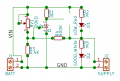
That said, here's the schematic with a hole in the upper-right simply missing the MOSFET in question. Does the rest at least look okay? TL431a programmable shunt is still widely available and super cheap on DigiKey [Link], $0.36 for one single guy that's nuts! Need to read up on what exactly a shunt is, but this looks very promising. Even picked one with a wide temp tolerance!

The rest is resistors and LED's and a trimpot and a couple sets of screw terminals, nothing fancy. That MOSFET though is the backbone to this whole operation, so man is it disappointing to see it's discontinued (although maybe for the better, so I don't have to learn SMD just for this?)

Full size schematic:

LiPo Cutoff with Status LED.sch.png
 

crutschow

Joined Mar 14, 2008
38,503
The one I picked was just one I had in my library and is really overkill for your application.

How about this one.
From this search.
It has <80mΩ maximum on resistance which is <200mw of dissipation @ 1.5A in the transistor which fine.
 

Thread Starter

MythicalCoder

Joined Aug 28, 2015
83
I can (should) heatsink the MOSFET honestly, so it can handle more current before heat becomes an issue. I'm designing for 6A stable though so I can use this exact same circuit on later applications that may use crazy high amperage. That's also why I used the 20 kOhm trimpot since the voltage you stated is well within 5S LiPo boundaries.

Will that MOSFET only handle 1.5A or is overheating simply non-existent at 1.5A? Would like one that can handle 6A steady, even if it means heatsinking it to achieve that level of current. I just don't fully understand the heat dissipation-to-temperature equation I guess. Note that I do understand a MOSFET that can handle 6A steady only pushing under 2A constantly doesn't exactly risk any heat damage, it just makes circuit design easier when I have this same circuitboard for many LiPo projects.

The Tyco Rebound has only 2 smallish motors in it to let you know, they seem to be similar to CD drive motors. It's not unreasonable to imagine scaling size up on size would require 5A on wheel motors alone, nevermind accessory current and whatnot (I plan to use this knowledge to, for example, build an off roading Roomba for hilarity, which needs three wheel motors and a vacuum motor... already got a couple donor Roombas!)
 

Thread Starter

MythicalCoder

Joined Aug 28, 2015
83
Don't know if you saw that. Busy week for me as well but haven't heard anything yet. Really want a MOSFET that can handle 6A with no heat problems, but I don't know how watts translates into degrees, so I get lost pretty quick knowing what's safe and what's not. Also should just heatsink this guy by default I think, maybe the lower current ones like the 1.5A Tyco Rebound I don't need to but helps for anything crazy like 6A.
 

Thread Starter

MythicalCoder

Joined Aug 28, 2015
83
More busy! But! I just noticed you already answered this part when you first responded:
P-MOSFET M1 should have an on-resistance low enough so that the I²R loss from the maximum load current is less than 1W so the MOSFET wouldn't need a heatsink.
Thus for 6A the maximum MOSFET Ron should be ≤ 1/6² = 27mΩ.
The MOSFET also needs to be a logic-level type with a maximum threshold voltage, Vgs(th) of ≤2V.
So it sounds like as long as, to use DigiKey terms, [ Vgs(th) (Max) @ Id ] is at or below 2 V, the "logic level" spec is met. At that point, the [ Rds On (Max) ] needs to be at or below 27 mΩ -- but the lower it is, the less heat that is produced, and the more suitable it is for my use case.

Filtering by those two (and sorting on the latter), as well as filtering for THT, active part, in stock, and orderable in quantity of 1, we get [ this DigiKey search ], which has 26 results. Ignore the $119 guy, obviously.

Result #3 is [ this guy ], with a mere 3.9 mΩ, almost a tenth of what it would take to maybe want a heatsink. Now, given the criteria, this appears to match VERY well -- I'd almost bet on it -- what say you? Is Result #3 that I linked to suitable? That guy almost sounds like he could handle 45 A, but let's not get crazy here -- 6 A is plenty, seriously, I'll revisit later should the need ever arise.

(And it probably won't)
 

crutschow

Joined Mar 14, 2008
38,503
Result #3 is [ this guy ], with a mere 3.9 mΩ, almost a tenth of what it would take to maybe want a heatsink. Now, given the criteria, this appears to match VERY well -- I'd almost bet on it -- what say you? Is Result #3 that I linked to suitable?
Yes, that would appear to be a good device for your needs.
It's low cost and should be able to carry at least 15A without a heatsink.
 
Top