Linear Systems question...

Thread Starter

Vim0314

Joined Sep 1, 2009
3
Hey guys. First time posting, but been reading stuff on here for a while.

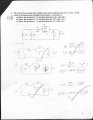
I have attached a scan from my old test and I'm having trouble figuring out part b. Could someone help me figure it out?

I understand the cap is replaced by a voltage source and the inductor is replaced by a current source. But I am having trouble figuring out the current in the voltage source and the voltage across the current source.

Thanks in advance!
 

Attachments

Ryoshima

Joined Mar 19, 2009
1
I believe that:

Ic = -20 A
Vl = 120 V

Don't think those are right, but they are the results that I obtained. I'll keep an eye on this thread to see if anyone can confirm or deny my calculations.
 

R!f@@

Joined Apr 2, 2009
10,007
I believe that:

Ic = -20 A
Vl = 120 V

Don't think those are right, but they are the results that I obtained. I'll keep an eye on this thread to see if anyone can confirm or deny my calculations.
Ryoshima, no one will deny your calculation or Vim0314 for that matter.
Some one will just confirm the calculations and will let you know if you are wrong or right.
 

t_n_k

Joined Mar 6, 2009
5,455
You need to write a loop voltage equation that satisfies the loop conditions at t=0+. Keep in mind that VC(0+)=16V and IL(0+)=4A

Assume a current I is flowing in the 6Ω resistor - from this and the above information you can write a suitable loop voltage equation with I as the unknown.
 
Last edited:

Thread Starter

Vim0314

Joined Sep 1, 2009
3
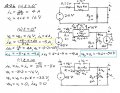
I found the answer in the solutions manual and here it is attached...

In blue I boxed in the correct answers I am looking for. But in yellow I have circled where I have a problem. Can someone explain to me how they figured out the Ir1? and how a 24 magically appears?

thanks
 

Attachments

t_n_k

Joined Mar 6, 2009
5,455
I found the answer in the solutions manual and here it is attached...

In blue I boxed in the correct answers I am looking for. But in yellow I have circled where I have a problem. Can someone explain to me how they figured out the Ir1? and how a 24 magically appears?

thanks
One could write ..... somewhat laboriously ......

VR1+VR2+VR3+48=0

IR1*2+16+IR3*6+48=0

IR1*2+16+(IR1-4)*6+48=0

IR1*2+16+IR1*6-4*6+48=0

IR1(2+6)+16-24+48=0

IR1(2+6)=-48-16+24

IR1=(-48-16+24)/(2+6)=-40/8=-5
 

t_n_k

Joined Mar 6, 2009
5,455
Give a geometric explanation of why a homogeneous linear system consisting of two equations in three unknowns must have infinitely many solutions. What are the possible numbers of solutions for a nonhomogeneous 2 x 3 linear system? Give a geometric explanation of your answer.
Rather than hijack a thread it's better for all concerned if you start a new thread.

Keep in mind also the expectation that homework forum posts will show an attempt at solving the problem.
 
Last edited by a moderator:
Top