Linear FET amplification?

Status
Not open for further replies.

djsfantasi

Joined Apr 11, 2010
9,237
My intention was only to spark the more creative imagination of others that read my post; towards a hoped for improvement in audio reproduction, through a better understanding of electronics science. I'm told that things can always be worse; and my understanding of that is the implication that maybe things can always be better too.
Creative imagination doesn’t play well to anyone audience of engineers that deal with reality. And who have significantly more training and real-world education than you display.

As such, you don’t come across well. I wonder who I’d believe is demonstrating better knowledge?
 

Papabravo

Joined Feb 24, 2006
22,082
Isn't the comment by papabravo just an be attempt to insult me and to trash my post? I'd like to report the disrespect in his remarks promoting this reply
It was not an insult, but rather a rhetorical question. You have, I think, 3 separate threads on this topic and your understandings and terminology do not appear to correspond to any objective reality. As far as I can tell there are no dissenting voices on that matter. If you wish to be insulted by such questions or observations, then I too will bow out of any of your current or future threads. Engaging on these matters is no longer a productive use of my time.
 

MrChips

Joined Oct 2, 2009
34,810
I made my post as an offering for others betterment, not because I was asking for advice of any kind. And at this time we, or I have several other advisors wanting to correct me with my matters too.
So you are saying that you are not looking to be corrected but just want to enlighten other members on AAC with your superior knowledge. Thanks for your generosity.
 

Thread Starter

PatrickMalarkey

Joined Oct 2, 2021
120
I think that most of the audio engineers on this forum could make an amplifier with distortion in the parts-per-million region, bandwidth to beyond audibility and noise below the threshold of hearing, using bipolar, JFET or MOSFET transistors.
That's not going to change anything about the alteration I was writing about. The waveform alteration is caused by capacitor-resistor "charging patterns" and that is consistent with the time-constant period as 63% full charge during the first time-constant. And then followed by 63% more of the remaining fully-charged voltage during the second time constant period. You aren't getting what I'm trying to convey to the reader.
 

Wendy

Joined Mar 24, 2008
23,798
Probably because what you are saying does not apply. That charge you are talking about is a capacitor being charged from a fixed voltage as in a power supply. While it can apply for a square wave most square waves will be such a high frequency compared to the capacitor that it still does not apply. Do not apply RC charge curves to audio.
 

Thread Starter

PatrickMalarkey

Joined Oct 2, 2021
120
Creative imagination doesn’t play well to anyone audience of engineers that deal with reality. And who have significantly more training and real-world education than you display.

As such, you don’t come across well. I wonder who I’d believe is demonstrating better knowledge?
No I don't use an engineer's terminology, partly because I haven't gone through 6 years of steady verbal education and I've only read a few books cover to cover. In my own vision I do fairly well at keeping up with a number of the big- shots of R&D dept.s in USA corporations. Have you ever heard, in recent news, about using a laser as the oscillator in a light frequency switching speed in AI computing? There are two matters that I know of that might contribute to that effort, and I'll list them for you
1. The constructive interference of light beams and destructive interference.
2. The rotation of the plane of polarization of light.
Binary code and Boolean logic might have an application with those light frequency switching speeds for computing, which in my view hold the promise of many algorithms that challenge human brains.
I know I don't know everything, do you?
 

Thread Starter

PatrickMalarkey

Joined Oct 2, 2021
120
Probably because what you are saying does not apply. That charge you are talking about is a capacitor being charged from a fixed voltage as in a power supply. While it can apply for a square wave most square waves will be such a high frequency compared to the capacitor that it still does not apply. Do not apply RC charge curves to audio.
Nope you missed what I was saying, and I'm not going to explain myself further.
 

Audioguru again

Joined Oct 21, 2019
6,826
Some audio amplifiers do not have coupling capacitors to provide a low frequency cutoff and to block any DC input. If an amplifier has coupling capacitors then they do not charge or discharge unless there is some DC on them (they should have no DC) and that DC voltage changes.
A high frequency tweeter has a coupling capacitor to block low frequencies from destroying it and the amplifier output has no DC to cause that capacitor to charge or discharge.
 

Ian0

Joined Aug 7, 2020
13,131
That's not going to change anything about the alteration I was writing about. The waveform alteration is caused by capacitor-resistor "charging patterns" and that is consistent with the time-constant period as 63% full charge during the first time-constant. And then followed by 63% more of the remaining fully-charged voltage during the second time constant period. You aren't getting what I'm trying to convey to the reader.
Nonsense.
 

Audioguru again

Joined Oct 21, 2019
6,826
You talked about an amplifier that cuts high frequency harmonics that happened in the output transformer of an old tubes amplifier and now you say it also is caused by the coupling capacitors in a modern solid state amplifier that is not true.

A coupling capacitor is a dead short at mid and high (harmonics) audio frequencies then it passes those frequencies perfectly.
The coupling capacitor blocks DC and reduces the signal of very low audio frequencies by charging and discharging. The -3dB cutoff frequency of a hifi amplifier is designed for a little lower than 20Hz, then lower frequencies are attenuated at -6dB per octave.
 

Thread Starter

PatrickMalarkey

Joined Oct 2, 2021
120
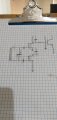
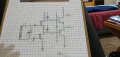
This is just an incomplete circuit diagram of an FM tuner and preamp, using what I hope is a solution to the "lost harmonics" of capacitive coupling and bypass during standard amplification techniques. It depicts usage of as few capacitors as possible during tuning and amplification. And does not propose to circumvent modern digital studio recording or processing, but hopefully provides a direction to follow for future musical reproduction.

Note the use of what I've termed "resistive coupling" wherever possible, from the RF stage to preamp stages and the not shown power amplifiers. This should be as self-explanatory as my comment is capable of, and this post is made asking not for reply, just as the conclusion to an unfinished matter.IMG_20211225_091815601~2.jpg
 

Audioguru again

Joined Oct 21, 2019
6,826
An FM tuner or radio has de-emphasis (treble frequencies cut) which cuts high audio frequencies to match the pre-emphasis (treble frequencies boost) that all FM radio stations use. Then hiss is reduced but audio has a flat frequency response and is not affected.
An FM stereo station transmits a 19kHz stereo pilot tone that must be reduced in an FM radio to avoid damaging a tweeter and avoid interference in a tape recorder.
Therefore the frequency response of an FM reception is flat to about 15kHz then a highs-reducing filter cuts 19kHz as much as is possible (-30dB?). Then harmonic sounds from 15kHz to 20kHz are missing which is necessary.

The radio frequency inductors and capacitors in an FM tuner have the very wide bandwidth of 150kHz to pass the 23kHz to 53kHz stereo sidebands and 67kHz stores Muzak. They have no effect on audio frequencies.

Coupling capacitors pass all high frequencies but block DC and reduce the levels of low frequencies. Some FM radios use a coupling capacitor to cut 50Hz and lower frequencies.
 

BobTPH

Joined Jun 5, 2013
11,515
AG, why are you trying educate someone who is so clearly superior in his knowledge to all of us combined? Can you not see the finery in which he has wrapped his exquisite arguments? The flawless logic of his assertions and inevitable conclusions from which we can only hope to grasp a glimmer of his omniscience?

Bob
 

Audioguru again

Joined Oct 21, 2019
6,826
When My hearing began showing my age I also blamed everything like TV stations were "hiding the mic" causing missing high frequencies.
This guy is similarly blaming "coupling capacitors" for causing missing harmonics. Maybe he also needs hearing aids like I got.
 

LowQCab

Joined Nov 6, 2012
5,101
I think it's more like he's sharpening his skills as
a "Flim-Flam-Man" selling "Swamp-Root-Snake-Oil" to people with more Money than Sense.
.
.
.
 

Thread Starter

PatrickMalarkey

Joined Oct 2, 2021
120
I think it's more like he's sharpening his skills as
a "Flim-Flam-Man" selling "Swamp-Root-Snake-Oil" to people with more Money than Sense.
.
.
.
Happened to come across this today while attempting to delete a prior circuit photo with a more completed one. Well IanO you've raised an interesting proposal, but I fear I might not be able to keep pace with demand for such an item.
 

Thread Starter

PatrickMalarkey

Joined Oct 2, 2021
120
This is just an incomplete circuit diagram of an FM tuner and preamp, using what I hope is a solution to the "lost harmonics" of capacitive coupling and bypass during standard amplification techniques. It depicts usage of as few capacitors as possible during tuning and amplification. And does not propose to circumvent modern digital studio recording or processing, but hopefully provides a direction to follow for future musical reproduction.

Note the use of what I've termed "resistive coupling" wherever possible, from the RF stage to preamp stages and the not shown power amplifiers. This should be as self-explanatory as my comment is capable of, and this post is made asking not for reply, just as the conclusion to an unfinished matter.View attachment 256029
IMG_20211226_091159969~2.jpg
 
Status
Not open for further replies.
Top