Line Coding: Transformers on the line

Thread Starter

richard3194

Joined Oct 18, 2011
193
Hi. If a transformer is on the line a condition of DC continuity cannot be met. I read that "Codes that have a zero average DC content been developed far ac-coupled lines". I also read " In the long run, the bipolar NRZ code....will accomplish this, provided that the message contains equal numbers of ones and zeros".

So, imagine a twristed pair of conductors terminating in the primary of a transformer with the secondary connected to another twisted pair.

Am I reading too much into what I have been reading to imagine that if bipolar NRZ is employed, the line coding signal (which is a digital signal of course) will get passed on through the transformer? Or, is this circuit example a problem?

Thank you. Rich
 

crutschow

Joined Mar 14, 2008
38,504
if bipolar NRZ is employed, the line coding signal (which is a digital signal of course) will get passed on through the transformer?
It will if the caveat "provided that the message contains equal numbers of ones and zeros" is followed by the signal.
This may require that dummy bits are added to the signal to make sure they are equal.
 

Thread Starter

richard3194

Joined Oct 18, 2011
193
Because I have little electronics knowledge I'm finding it hard to see how a digital signal can be passed through a transformer, even when using a bipolar line code.

If the system is idling at say -1 volts (logical 0), at the begining of a logical one, I "see "a voltage spike at the secondary and at the transition to a logical 0, I see a voltage spike of the opposite polarity. And because I'm seeing spikes, I'm having difficulty comprehending the secondary voltage or current as a digital signal.

I do see that a voltage or current that on average is zero, is used when transformers are involved.
 
Last edited:

crutschow

Joined Mar 14, 2008
38,504
If the system is idling at say -1 volts (logical 0), at the begining of a logical one, I "see "a voltage spike at the secondary and at the transition to a logical 0, I see a voltage spike of the opposite polarity.
Not with the correct transformer.
You must have a transformer that has a sufficient low frequency response to pass the lowest frequency component of the pulse (low frequency response no higher than about 1/10th of the lowest pulse frequency).
In that case you will see the digital signal with tolerable distortion (seen as droop on the flat portion of the pulse).

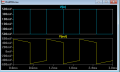
For example, below is the simulation for a 1kHz pulse passing through a high-pass circuit (which is what a transformer looks like) with a corner frequency of 100Hz.
Although there is noticeable droop on the flat portions of the pulse, this will not affect the detection of the signal or introduce any errors.
Typically you can detect the signal with a comparator, which will remove the droop, converting it back to a normal looking square-wave.

upload_2018-8-12_11-13-5.png
 

Thread Starter

richard3194

Joined Oct 18, 2011
193
So, if the bit rate is sufficiently high, and you have the right transformer, and maybe other circuit elements, you can use a bipolar line code when there is no DC continuity, that is, when there is a transformer on the line.

OK I have another issue: When I imagine the primary being fed with unipolar NRZ signaling, I get the same series of voltage or current spikes for the secondary. That is, a spike on the leading edge of a signal element (i.e.signal bit) and a spike on the trailing edge of the signal element. Of course each spike of opposite polarity. In fact as far as I can see the secondary waveform is exactly the same whether a unipolar code or a bi-polar code is fed to the primary of a transformer.

Anyway, if I have that right, I'm finding it difficult to grasp the comment "Codes that have a zero average DC content been developed far ac-coupled lines". Because I'm seeing (considering the voltage spikes) the use of unipolar code as satifactory.. But, there is some issue that makes unipolar line coding unsatisfactory with a transformer on the line. I know that unipolar coding will mean there is a no average DC. current flow in the primary.. For some reason that appears to be troublesome.
 
Last edited:

Thread Starter

richard3194

Joined Oct 18, 2011
193
I think pulsating DC in the primary might lead to core saturation of the transformer and that is why biipolar signaling is employed. My best explanation.

Apart from that issue unipolar NRZ does manage to work with ac coupled lines. It seems.
 
Last edited:

crutschow

Joined Mar 14, 2008
38,504
If you run a unipolar signal through a transformer you should probably couple it through a series capacitor, to prevent the signal from generating DC in the transformer core.
The output will then have an average DC value of zero, with the signal now being bipolar, going plus and minus around zero.
 
Top