Typical Amazon or Alibaba nonsense specification… 50/60 hz …DC!!
Give me a break!
Since there are two different speeds listed, it most likely is an AC synchronous gearmotor similar to what were ubiquitous inside the wall clocks of decades ago.
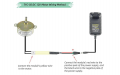
If you read the Amazon reviews, it is clear that the motor is a 12VAC motor. There is an external module that is a 12V DC-AC inverter (yellow wires +12VAC, red & black wires = 12VDC):
Who knows how either inverter will respond to dimming...
If you read the Amazon reviews, it is clear that the motor is a 12VAC motor. There is an external module that is a 12V DC-AC inverter (yellow wires +12VAC, red & black wires = 12VDC):
Where did you get that information from? If you check on the manufacturer's page, Chancs.com, you will see that they produce this type of synchronous motor for various various speeds and voltages, both AC and DC. The 12V DC version is available with a speed of 1 R/s or 0.8 R/s, showing that the internal DC to AC converter can be supplied as 50 or 60 Hz. You DON'T need an external module to run this motor. It works with 12 VDC ONLY!
Where did you get that information from? If you check on the manufacturer's page, Chancs.com, you will see that they produce this type of synchronous motor for various various speeds and voltages, both AC and DC. The 12V DC version is available with a speed of 1 R/S or 0.8 R/s, showing that the internal DC to AC converter can be supplied as 50 or 60 Hz. You DON'T need an external module to run the motor. It works with 12 VDC ONLY!
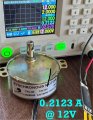
I got the information from the Amazon reviewer named Dan. He wrote: " Works as expected and pulls ~210mA @ 12V. A little bit loud but I can insulate the noise in my project. As others have said, this is actually an AC motor, but they provide the DC->AC converter circuit so make sure to connect that before supplying 12V DC source. " He shared this photo:
That will only work when the dimmer is set maximum. At lower settings, the motor will stop.
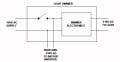
I f you MUST use the power switch in the dimmer for both light and motor, you will have to open up the dimmer and wire the motor inverter between the switched pole and 110V common.
That will only work when the dimmer is set maximum. At lower settings, the motor will stop.
I f you MUST use the power switch in the dimmer for both light and motor, you will have to open up the dimmer and wire the motor inverter between the switched pole and 110V common.
I like your idea but unfortunately I can't do that. This issue is the dimmer and the inverter are in 2 different locations in a house in which the house is already wired. The dimmer is in the switch box and the inverter is in the light/ceiling box with just a basic 2 wire 15amp cable connecting them. The intention is that this would be going into already finished homes where the wiring is already finished and the expense of adding another line is not really feasible for most people. I'm trying to come up with another solution for this.
I like your idea but unfortunately I can't do that. This issue is the dimmer and the inverter are in 2 different locations in a house in which the house is already wired. The dimmer is in the switch box and the inverter is in the light/ceiling box with just a basic 2 wire 15amp cable connecting them. The intention is that this would be going into already finished homes where the wiring is already finished and the expense of adding another line is not really feasible for most people. I'm trying to come up with another solution for this.
I realize there are a lot of conditions to make it work satisfactorily. I've tried to explain the conditions I'm working with and trying to come up with a solution that works for what I need.
I realize there are a lot of conditions to make it work satisfactorily. I've tried to explain the conditions I'm working with and trying to come up with a solution that works for what I need.

 Facebook
 Google
 GitHub
 Linkedin