Light Chaser, DUD Kit!!

Thread Starter

Icanmakeit67

Joined Sep 23, 2018
210
Diagnose the problem before building any more.
Ok. I believe I have eliminated the simple/mechanical possibilities. It’s down to theory now? Funny thing this is a wife requested project. She wanted to use this kit for one of her endeavors. I’ve built soooo many kits over the years that when I put one of them together for her and it did nothing I was very surprised. Then another and another….none worked. Down to the last of the 4 kits she bought and it occurred that I have had so much help here over the years, I’d just throw it out there and see what happened.
 

eetech00

Joined Jun 8, 2013
4,705
Ok. I believe I have eliminated the simple/mechanical possibilities. It’s down to theory now? Funny thing this is a wife requested project. She wanted to use this kit for one of her endeavors. I’ve built soooo many kits over the years that when I put one of them together for her and it did nothing I was very surprised. Then another and another….none worked. Down to the last of the 4 kits she bought and it occurred that I have had so much help here over the years, I’d just throw it out there and see what happened.
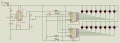
Why is C3 missing?

The circuit wouldn't work in my simulation until I installed C3.
 

ElectricSpidey

Joined Dec 2, 2017
3,335
Ok. I believe I have eliminated the simple/mechanical possibilities. It’s down to theory now? Funny thing this is a wife requested project. She wanted to use this kit for one of her endeavors. I’ve built soooo many kits over the years that when I put one of them together for her and it did nothing I was very surprised. Then another and another….none worked. Down to the last of the 4 kits she bought and it occurred that I have had so much help here over the years, I’d just throw it out there and see what happened.
Ok, just ignore post #19 and I'll be movin on.
 

Jerry-Hat-Trick

Joined Aug 31, 2022
822
Good that you've limited your power supply to 4.5V as 12V would probably have done serious damage. Absolute maximum supply voltage for the 74HC595 is shown on the TI datasheet as 7.0V but I really don't like the idea of driving the LEDs without series resistors. The NE555 is configured as an astable https://www.allaboutcircuits.com/tools/555-timer-astable-circuit/ so you could maybe look if this is working. The NE555 is specified as working between 5V and 15V - maybe your 4.5V is too low! A window between 5V and 6V may work?

If you increase R1 to 10K or C2 to 470uF you will slow it down to a speed where a digital multimeter between ground and pin 3 of the NE555 shows the change. Or better still, connect an LED is series with a resistor between pin 3 and ground to watch if it blinks.

As already suggested, take out the other ICs and check all the LEDs still work when you connect their cathodes to the -ve via a resistor. Their anodes are all connected to the positive rail.

With a 5.5V supply, a 555 providing a blinking output and the LEDs all working I'd be suspicious of the 74HC595s since they are being asked to sink the current through the LEDs without individual series resistors
 

ElectricSpidey

Joined Dec 2, 2017
3,335
C3 looks like a half assed way to bring the shift register clock high and presenting a small delay to the storage register clock going high then holding both high until the 555 output goes low.

1704317980383.png

1704317536750.png

I don't think the hold does anything because the chip is edge triggered.

The value of C3 is probably critical, too high and the storage register wont clock.

Perhaps without the cap the bottom function is in play?
 
Last edited:

panic mode

Joined Oct 10, 2011
4,982
it may be on the other side of the PCB (an SMD part). R2+C3 are needed to create delay for store/latch input. without this shifted bits will not be copied to outputs so LEDs will not reflect the state of shifting. also value of capacitor and resistor need to be matched or pulse will not be delayed enough or it will be smoothed too much.

btw the shown variant of those shift registers tells that they are CMOS parts. and that means the ICs are ESD sensitive. maybe the ICs are zapped already.

as for comment on soldering, i disagree. the picture is not the sharpest but it looks like the flux residue is still there. other than that, the soldering job looks quite neat.
 

AnalogKid

Joined Aug 1, 2013
12,129
I don't see any current limiting for the LEDs other than the SR output impedance. Not good. If the intent of the design is as simulated in #31, with most of the LEDs on all of the time, that probably exceeds the SR max internal power dissipation.

ak
 
Top