Facebook
 Google
 GitHub
 Linkedin
Hello everyone,
I recently followed the schematic of a light chaser circuit from Wendy, here is the url: http://forum.allaboutcircuits.com/threads/leds-555s-flashers-and-light-chasers.19075/#post-117649 .
I followed it pretty loyally except I differed in two areas the first is I used a digital Photometer, that is controlled by a Rpi(Raspberry Pi) and the second which I am not sure on was that I wanted to the ability to dim the LEDs if needed. For a brief recap the way her circuit works is that the Vcc connects to a transistors collector which sends the voltage through the transistor through a resistor to a LED. My first attempt was to have a simple voltage divider between the vcc and all the transistor's bases to act as voltage control but I noticed a lot of heat coming off the resistors and the potentiometer, my first idea was to get a higher wattage resistor and potentiometer. My second idea was that I have a spare LM317 laying around so I hooked it up between the vcc and the transistor's basis which is seen in this schematic:
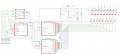
I first checked for heat at both ends of the adjustable voltage and nothing seemed unhappy meaning nothing was burning even after being left in both minimum and maximum voltage for 5 mins. So I did more investigating and looked at everything with a voltmeter looking the vcc there was drop from 9 volts( 9 volt battery) to eight volts probably due to the voltage powering all the circuits(To confirm this I measured the vcc with everything powered without the vcc connected to the voltage regulator). The maximum output of the regulator is around 7.30 volts, while the minimum is of course 0 volts, well within the voltage that it would be without it. If you look through her various designs she has another one where the vcc is connected to resistor which is then connected all the LEDs which are then connected to the bases of their corresponding transistor then to ground. I have tried prototyping that board to very little success, let alone switch the resistor to a potentiometer. The reason I want to be able to dim the LEDs manually is because, this light chaser is an analog signal indicator for handheld acoustic detector, that I am prototyping for a professor who likes "theatrical ways" of demonstrating signal strength in his lectures. He wants to control the brightness of all the LEDs to accommodate his distance away from students in a classroom setting. Just to note I am a applied physics student who has 1-3 of experience prototyping electronics and Wendy seems hesitant about controlling the brightness. So my question is simply does anyone see a problem lurking in controlling the brightness in this way or Is using the voltage regulator overkill?
I wish to state that the only reason I mention the user/moderator Wendy in this thread is because she is the creator of the light indicator thread and its best to give her input that she has given me. I am sorry about the essay introduction but I rather say it all at once instead of begin asked why or any gritty other detail.
I recently followed the schematic of a light chaser circuit from Wendy, here is the url: http://forum.allaboutcircuits.com/threads/leds-555s-flashers-and-light-chasers.19075/#post-117649 .
I followed it pretty loyally except I differed in two areas the first is I used a digital Photometer, that is controlled by a Rpi(Raspberry Pi) and the second which I am not sure on was that I wanted to the ability to dim the LEDs if needed. For a brief recap the way her circuit works is that the Vcc connects to a transistors collector which sends the voltage through the transistor through a resistor to a LED. My first attempt was to have a simple voltage divider between the vcc and all the transistor's bases to act as voltage control but I noticed a lot of heat coming off the resistors and the potentiometer, my first idea was to get a higher wattage resistor and potentiometer. My second idea was that I have a spare LM317 laying around so I hooked it up between the vcc and the transistor's basis which is seen in this schematic:
I first checked for heat at both ends of the adjustable voltage and nothing seemed unhappy meaning nothing was burning even after being left in both minimum and maximum voltage for 5 mins. So I did more investigating and looked at everything with a voltmeter looking the vcc there was drop from 9 volts( 9 volt battery) to eight volts probably due to the voltage powering all the circuits(To confirm this I measured the vcc with everything powered without the vcc connected to the voltage regulator). The maximum output of the regulator is around 7.30 volts, while the minimum is of course 0 volts, well within the voltage that it would be without it. If you look through her various designs she has another one where the vcc is connected to resistor which is then connected all the LEDs which are then connected to the bases of their corresponding transistor then to ground. I have tried prototyping that board to very little success, let alone switch the resistor to a potentiometer. The reason I want to be able to dim the LEDs manually is because, this light chaser is an analog signal indicator for handheld acoustic detector, that I am prototyping for a professor who likes "theatrical ways" of demonstrating signal strength in his lectures. He wants to control the brightness of all the LEDs to accommodate his distance away from students in a classroom setting. Just to note I am a applied physics student who has 1-3 of experience prototyping electronics and Wendy seems hesitant about controlling the brightness. So my question is simply does anyone see a problem lurking in controlling the brightness in this way or Is using the voltage regulator overkill?
I wish to state that the only reason I mention the user/moderator Wendy in this thread is because she is the creator of the light indicator thread and its best to give her input that she has given me. I am sorry about the essay introduction but I rather say it all at once instead of begin asked why or any gritty other detail.