Level Shifting Problem

Thread Starter

joeyd999

Joined Jun 6, 2011
6,279
OK...here's an absolute rarity: I feel completely brain dead in solving this particular problem.

I've got a PIC18F65K90 with which I want to drive the SHDN pin of an LTC2050. Currently, RF7 of the PIC is used to drive the pin.

SHDN must be less than 0.5V (low) to shutdown, and greater than V+ - 0.5V (high) to enable the amp.

There are two modes of operation: standby and active.

During standby, both the PIC and the LTC power can be anywhere between 1.8V and 3.2V, and the SHDN pin is driven low. Power consumption must be an absolute minimum (less than a few microamps).

During active, the PIC is at 3.3V and the LTC is a 5V. Power consumption is not critical.

The standby mode is not an issue. I drive the pin low and all's good.

During active mode, I must drive the pin to >4.5V and I have about 3.3V from the PIC pin.

Normally, I'd just use a transistor to perform the level shifting (obviously inverting the signal which is OK). But the base current (assuming NPN) and pull-up resistor will consume power during standby which is highly not desired. The base current could be eliminated by using a low Vgs FET, but I still have the damn pull-up resistor.

Board space is an absolute premium. I've only got a few square mm of space to do this.

I was considering something like a SN74LV1T34. The datasheet seems to indicate it'll consume less than 10uA (nominally 1uA), and I should easily be able to pull very close to the +5V rail when driving the very high impedance SHDN pin. Am I reading this right?

Any thoughts or alternatives are highly welcome.
 

philba

Joined Aug 17, 2017
959
An NMOSFET with 2 pull-up resistors will work. It's bidirectional. Not super high speed but your use doesn't seem to need it. I've used 2N7002s and BSS138s. SOT-3 is about as small as you can get. Just about any low power NMOS FET will work. 402s are pretty small too.

[edit] you can also tweak the PUs for lower current draw but 500 uA is ok for most of my uses. Lower PU values allow it to run at higher speed. with 10K I can get about 100KHz with super clean square pulses. Above that the form starts to degrade but still usable to about 1 MHz[/edit]

 
Last edited:

Thread Starter

joeyd999

Joined Jun 6, 2011
6,279
An NMOSFET with 2 pull-up resistors will work. It's bidirectional.
I don't need the bidirectionality, so your circuit can reduce to a single FET and pull-up resistor (to HV). But I don't want the passive leakage through the pull-up during standby. That is what I am trying to avoid.

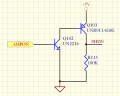
This should work using two small SOTs (with internal resistors) and a pull-down resistor:

Selection_031.png
 

cmartinez

Joined Jan 17, 2007
8,759
OK...here's an absolute rarity: I feel completely brain dead in solving this particular problem.

I've got a PIC18F65K90 with which I want to drive the SHDN pin of an LTC2050. Currently, RF7 of the PIC is used to drive the pin.

SHDN must be less than 0.5V (low) to shutdown, and greater than V+ - 0.5V (high) to enable the amp.

There are two modes of operation: standby and active.

During standby, both the PIC and the LTC power can be anywhere between 1.8V and 3.2V, and the SHDN pin is driven low. Power consumption must be an absolute minimum (less than a few microamps).

During active, the PIC is at 3.3V and the LTC is a 5V. Power consumption is not critical.

The standby mode is not an issue. I drive the pin low and all's good.

During active mode, I must drive the pin to >4.5V and I have about 3.3V from the PIC pin.

Normally, I'd just use a transistor to perform the level shifting (obviously inverting the signal which is OK). But the base current (assuming NPN) and pull-up resistor will consume power during standby which is highly not desired. The base current could be eliminated by using a low Vgs FET, but I still have the damn pull-up resistor.

Board space is an absolute premium. I've only got a few square mm of space to do this.

I was considering something like a SN74LV1T34. The datasheet seems to indicate it'll consume less than 10uA (nominally 1uA), and I should easily be able to pull very close to the +5V rail when driving the very high impedance SHDN pin. Am I reading this right?

Any thoughts or alternatives are highly welcome.
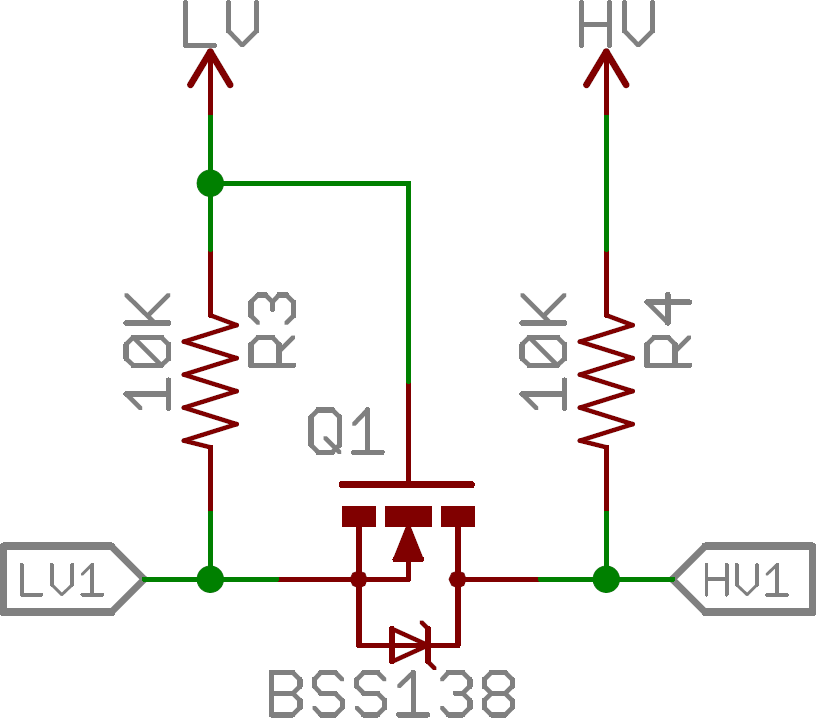
Incidentally, I've run into a problem very much like the one you've just described before. Yes, I think the SN74LV1T34 should do the trick... but I wouldn't consider it a final design until I thoroughly tested it and made sure it complied with your wanted specs.
 

Attachments

Thread Starter

joeyd999

Joined Jun 6, 2011
6,279
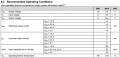
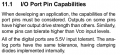
Here's another idea. The PIC datasheet says this:

Selection_032.png

Does this mean I can apply up to 5.5V on an input pin without the pin sinking current? If so, I can eliminate Q102 in the schematic above, drive Q103 base directly from the pin, and toggle the SHDN pin by switching the TRIS bit. Can anyone who has used the 5.5V input tolerance confirm this?

Also, what does the text in the last paragraph mean? Are the analog/digital pins different? Are the digital pins not clamped? Or are the analog pins clamped to a lower voltage with a current limit?

Or, does it mean the pin behaves differently if it is configured as an analog input (vs. digital)?

BTW, all the pins have analog functions except for RB6/7 (which I use for ICD) and RG0 which is already in use but can be repurposed. I tried a pullup on RF7 to +5V, but the pin voltage would not exceed one diode drop above Vdd.
 

cmartinez

Joined Jan 17, 2007
8,759
Did I mention I don't have time to test and confirm? My first cut must be production ready -- on Tuesday.
Errrr... no you didn't ... but still, I wouldn't trust a new circuit like this one to work flawlessly on the first try without at least it being vouched for by someone else (whom you thoroughly trust) with previous experience.
 

Thread Starter

joeyd999

Joined Jun 6, 2011
6,279
Errrr... no you didn't ... but still, I wouldn't trust a new circuit like this one to work flawlessly on the first try without at least it being vouched for by someone else (whom you thoroughly trust) with previous experience.
I am kicking myself pretty bad right now. Usually, my stuff works first shot -- in fact, I generally don't prototype (which is rather hard to do in surface mount). On this design, I missed this one little freakin' detail -- that the input high voltage of the LTC2050 is dependent upon Vdd. It took me a day to figure out why the part wasn't turning on, and I didn't even realize it until I noticed the parameter on the datasheet. Facepalm moment.

It wouldn't have even been a problem if the SHDN pin was active high instead of low. Why call the damn thing SHDN in that case? Just call it EN (enable) so as to be clear.

Anyway, I'll probably go with my two transistor solution. I've got the parts and I can dead-bug it to test tomorrow or Monday. The update to the PCB is almost complete except for the additional routing.

So much for a holiday party weekend...
 

Thread Starter

joeyd999

Joined Jun 6, 2011
6,279
Here's another idea:

Anyone know of a dual analog switch (in a small S/M package) that will operate from 1.8 to 5V, with a guaranteed Vih <= 3.3V at Vdd=5V?
 

AnalogKid

Joined Aug 1, 2013
12,126
Anyone know of a dual analog switch (in a small S/M package) that will operate from 1.8 to 5V, with a guaranteed Vih <= 3.3V at Vdd=5V?
15 years ago I used this part to multiplex the bidirectional data lines to/from 1024 SIMs to a single cell phone. There are other configurations, including single gate parts in a SOT-23-5 or something like that (Maybe National tiny logic?). Datasheet says Vin high is guaranteed 2 V min when operating on 5 V.

https://www.idt.com/products/memory...-high-speed-cmos-quickswitch-dual-41-muxdemux

That part of the circuit worked perfectly right out of the gate.

This might be closer to what you need:

https://www.idt.com/products/memory...dual-bus-switch-individual-active-low-enables

The same single series FET as an analog/digital mux is used in octal and hex bus switches and bus exchanges.


ak
 

Attachments

Last edited:

Thread Starter

joeyd999

Joined Jun 6, 2011
6,279
15 years ago I used this part to multiplex the bidirectional data lines to/from 1024 SIMs to a single cell phone. There are other configurations, including single gate parts in a SOT-23-5 or something like that (Maybe National tiny logic?). Datasheet says Vin high is guaranteed 2 V min when operating on 5 V.

https://www.idt.com/products/memory...-high-speed-cmos-quickswitch-dual-41-muxdemux

That part of the circuit worked perfectly right out of the gate.

This might be closer to what you need:

https://www.idt.com/products/memory...dual-bus-switch-individual-active-low-enables

The same single series FET as an analog/digital mux is used in octal and hex bus switches and bus exchanges.


ak
Thanks for the links. I'll look around -- but it appears that IDT parts are not rated for Vdd down to 1.8V.
 

be80be

Joined Jul 5, 2008
2,395
TS5A3159-Q1
The TS5A3159-Q1 is a single-pole double-throw (SPDT) analog switch that is designed to operate from 1.65 V to 5.5 V. The device offers a low ON-state resistance and an excellent ON-resistance, matching with the break-before-make feature to prevent signal distortion during the transferring of a signal from one channel to another. The device has
 

Thread Starter

joeyd999

Joined Jun 6, 2011
6,279
TS5A3159-Q1
Ask...and you shall receive.

Nice! I knew there had to be something that would do the job.

You have just become my go-to guy for parts research.

The part meets every one of my specifications: power supply range, input range, power consumption, and size. And 4,882 parts immediately available.

Now, I just need to wrap my head around the $0.60 price. It may be worth it.
 
Top