Leslie 825 speaker amplifier blows fuse

Thread Starter

D Jagger

Joined Jul 4, 2024
5
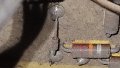
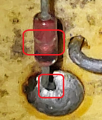
I was wondering if anybody could offer assistance, I'm new to electronics. I have a Leslie 825 amplifier cabinet that repeatedly blows the fuse up on powering on. Opened it up and see lots of seemingly burnt/brown soldered resistors? This one caught my attention and I was thinking this would be a good start for suspecting a reason for the fuse blowing. Any thoughts?
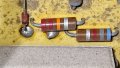
VID_20240626_140456647_exported_266615~2.jpg
 

WBahn

Joined Mar 31, 2012
32,895
Are you talking about the one in the center of the picture (with the two red, the orange, and the silver bands)?

Why do you think it is burnt? Because the body happens to be brown? That's just the color of the body of the resistor.
 

nsaspook

Joined Aug 27, 2009
16,333
Look in the DC power section first.(Post pictures of the entire circuit) Isolate (disconnect wires or connectors) the DC output from the rest of the amp if possible, check rectifiers and filter capacitors with a meter, replace bad components until voltages are good and fuses don't blow.
 

Thread Starter

D Jagger

Joined Jul 4, 2024
5
Are you talking about the one in the center of the picture (with the two red, the orange, and the silver bands)?

Why do you think it is burnt? Because the body happens to be brown? That's just the color of the body of the resistor.
the one on the left ( small red). It looks like the solder at the board has a rust or burnt area. Again not sure whether it's normal and I haven't started disassembling anything. As I progress I'll add more pictures.
 

Thread Starter

D Jagger

Joined Jul 4, 2024
5
Look in the DC power section first.(Post pictures of the entire circuit) Isolate (disconnect wires or connectors) the DC output from the rest of the amp if possible, check rectifiers and filter capacitors with a meter, replace bad components until voltages are good and fuses don't blow.
Thanks for the reply, I do have a meter so I will have to get in there and do a little bit more research, the suggestions of starting with the DC section sounds logical now. Enjoy your Independence Day and thanks for the advice!
 

Thread Starter

D Jagger

Joined Jul 4, 2024
5
I got my phone in there and took a video and took snapshots. This was just the most questionable thing I saw. As I get further along this weekend and get the tester/meter out I'll have additional info and questions. Good 4th of July to you! This is what it looked like before blowing out the dust.
 

Attachments

WBahn

Joined Mar 31, 2012
32,895
the one on the left ( small red). It looks like the solder at the board has a rust or burnt area. Again not sure whether it's normal and I haven't started disassembling anything. As I progress I'll add more pictures.
That looks like a diode, not a resistor. It may have a bad solder joint, though that might be a photo artifact, too. You might try hitting that with a soldering iron to reset it.
 

WBahn

Joined Mar 31, 2012
32,895
Taking another look at that diode, it looks like it might be damaged; though, again, that might be an illusion in the photo. It looks like a hole or two and maybe a crack between them.

If I'm visualizing the solder joint correctly, that looks like a cold solder joint to me.

1720189931062.png
 

MisterBill2

Joined Jan 23, 2018
27,611
The large area coated by some gray substance looks more like the result of some failure of another part that we do not get to see.. In addition, when a resistor i a circuit that was previously working now burns up, it is the fault of some other part that has failed, resulting in excess power over-heating the resistor. So replacing the resistor with a higher power rated one will assure the destruction of a much more expensive component and still not solve the original problem.
IF the TS, or somebody else, can locate a circuit schematic diagram, we will probably be able to point toward the components most likely to have failed, and certainly point to the components to check first.

Within the group of folks who visit these threads are those with a whole lot of understanding and many years of experience, as well as a few with incredible insight.
 

gaber2611

Joined Mar 14, 2013
324
I was wondering if anybody could offer assistance, I'm new to electronics. I have a Leslie 825 amplifier cabinet that repeatedly blows the fuse up on powering on. Opened it up and see lots of seemingly burnt/brown soldered resistors? This one caught my attention and I was thinking this would be a good start for suspecting a reason for the fuse blowing. Any thoughts?

View attachment 326176
There must be a problem within the circuit after the fuse, the fuse in the power part of the circuit?, can you send photo?
 

MisterBill2

Joined Jan 23, 2018
27,611
If the TS has an adequate multimeter then checking diodes that don't look right is a reasonable thing to do. If the resistance in both directions is the same then probably the diode is failed, either shorted or open.
And I am very serious that if the circuit can be provided then suspects for the fault can be listed for additional examination.

and the analysis in post #12 is rather useless, as that includes almost every component in the model 825.

And the really good news is that I was able to locate and download the PDF of the manual on the Leslie 825. That 825 is quite a complex machine, with quite a bit of mains powered mechanical stuff. Really an impressive bit of complexity. What that tells me is that the fuse popping may not involve the electronics portion at all.
The 825 is a whole lot more than just an amplifier, as viewing the circuit schematic in the manual will show.
 

Attachments

Last edited:

MrChips

Joined Oct 2, 2009
34,841
"Questionable circuit?" is of no help for humans or search engines to find this thread.
I have edited the thread title to "Leslie 825 speaker amplifier blows fuse".
 

MisterBill2

Joined Jan 23, 2018
27,611
The manual provides very good photos of the several circuit boards, as well as complete schematics. Probably one of the best manuals I have seen in that regard.
 
Top