LEDs in parallel....trying to estimate battery life.

Thread Starter

mckay3129

Joined Mar 4, 2018
4
Hi guys,

So....here's the question in a nutshell and I'll post a more wordy narrative below.

I've made a nightlight for my kids that uses leds in parallel and then (irrelevantly) topped with little fibre optic decorations. I've been using 4 AA Alkaline batteries (in series = 6V), this works fine, despite the voltage being higher than strictly needed (I'm using a resistor paired with every led). It works perfectly, though probably a very poor design. The batteries last about 10days at a rate of 1 hour on per night (so, 10 hours).

I know this is piss-poor design, but it's an electric mix of leds different colours and some that are color changing. There are 11 leds (thereabout, I've made a night light for each child), each Vf of between 2-3.2V and forward currents between 20-30ma. Using some oversimplified math I estimated that it's pulling around 250ma based on the AA batteries running 10 hours and as such 2500ma must be the capacity of my AAs. This seems very logical to me.

So here's the crux of the matter: I thought "Ok, lets do rechargeable with the biggest capacity that will fit a smallish size in the funniest maner I can find! (My kids are helping here too).

So - I bought 2 rechargeable 26650 batteries with built in circuit protection (3.7V, 5000ma each) and a battery holder. I wired the holder in parallel for 3.7 with 10A. I then figured this will last 50 hours, give or take. Well...I turned it on 132 hours ago as of this writing...it's still going strong.

Why? Is there unused current being fed back into the batteries? Bad math? Black magic? How long should I expect these to last? I have clearly gone wrong somewhere...

Now...the obligatory stuff that makes this unusual - but no more complicated.

Since this was conceived as something for my kids, it started as a toy electronics set. Snap Circuits, I suspect you guys may be familiar. But it took a life of its own on, so I bought empty bits and built my current test ... rig/nightlight out of completely homescratch parts just to make sure I wasn't missing something artificial in there.

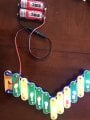
Sorry I don't have a schematic, but I do have pictures. The one with the 26650 batteries is the "controlled" one... the other is a finished one but with AA batteries and a separate timer that can be ignored (it has its own battery supply).

I got to long winded, sorry. Just curious what I'm doing wrong in estimating the use of a battery.
 

Attachments

Alec_t

Joined Sep 17, 2013
15,117
4 AA cells give about 6V. The two rechargeables give nominally 3.7V. So, unless you changed all the resistors, the current draw will be a lot less when powering the LED array with the rechargeables. Since I = (Vbat-Vf)/R, the current reduction will be more dramatic for a Vf of 3.2V than for a Vf of 2V.
 

dl324

Joined Mar 30, 2015
18,326
Welcome to AAC!
I bought 2 rechargeable 26650 batteries with built in circuit protection (3.7V, 5000ma each) and a battery holder. I wired the holder in parallel for 3.7 with 10A. I then figured this will last 50 hours, give or take. Well...I turned it on 132 hours ago as of this writing...it's still going strong.
You're comparing apples to oranges. You designed the circuit for a nominal 6V power source, then you replace it with a 3.7V source. Naturally, the current in the LEDs has gone down from 250mA to about 1/3 of that. 10Ah/85mAh = 117 hours.

BTW, battery capacity rated in Ah (or mAh), not mA (note the spelling).
Why? Is there unused current being fed back into the batteries? Bad math? Black magic? How long should I expect these to last? I have clearly gone wrong somewhere...
You don't understand how batteries work and how you changed the current draw by changing battery voltage.

There's a lot of information at batteryuniversity.com.
 

Thread Starter

mckay3129

Joined Mar 4, 2018
4
Interesting...I had guessed something along those lines, but didn't follow up on it after not seeing a difference in brightness between the AA and Li-Ion.

I had assumed that if there was less current going through it would have appeared dim when comparing the two. Am I right in guessing that in the AA setup all the extra current draw was being dissapated by the resistors?

Or...is it normal for the rated current draw to not relate to luminosity of an led? In the Li-Ion set up it is not drawing the full current yet at least by observers estimation is just as bright.
 

dl324

Joined Mar 30, 2015
18,326
is it normal for the rated current draw to not relate to luminosity of an led?
LED (again, note the spelling) brightness is proportional to current.
In the Li-Ion set up it is not drawing the full current yet at least by observers estimation is just as bright.
The human eye response to light is logarithmic. We can notice differences in brightness, on the order of 2X, if the light sources are in close proximity to each other; but we can't measure absolute brightness without an instrument.
 

Thread Starter

mckay3129

Joined Mar 4, 2018
4
Thanks,

I will do some experimenting with it.

As a side note, I do understand led vs LED, however, please understand, I am typing from a small iPhone with fat fingers...it's not idiocy, it's balance between perfect accuracy and trying not to wing the thing through the window.
 

WBahn

Joined Mar 31, 2012
32,823
Hi guys,

So....here's the question in a nutshell and I'll post a more wordy narrative below.

I've made a nightlight for my kids that uses leds in parallel and then (irrelevantly) topped with little fibre optic decorations. I've been using 4 AA Alkaline batteries (in series = 6V), this works fine, despite the voltage being higher than strictly needed (I'm using a resistor paired with every led). It works perfectly, though probably a very poor design. The batteries last about 10days at a rate of 1 hour on per night (so, 10 hours).

I know this is piss-poor design, but it's an electric mix of leds different colours and some that are color changing. There are 11 leds (thereabout, I've made a night light for each child), each Vf of between 2-3.2V and forward currents between 20-30ma. Using some oversimplified math I estimated that it's pulling around 250ma based on the AA batteries running 10 hours and as such 2500ma must be the capacity of my AAs. This seems very logical to me.

So here's the crux of the matter: I thought "Ok, lets do rechargeable with the biggest capacity that will fit a smallish size in the funniest maner I can find! (My kids are helping here too).

So - I bought 2 rechargeable 26650 batteries with built in circuit protection (3.7V, 5000ma each) and a battery holder. I wired the holder in parallel for 3.7 with 10A. I then figured this will last 50 hours, give or take. Well...I turned it on 132 hours ago as of this writing...it's still going strong.

Why? Is there unused current being fed back into the batteries? Bad math? Black magic? How long should I expect these to last? I have clearly gone wrong somewhere...

Now...the obligatory stuff that makes this unusual - but no more complicated.

Since this was conceived as something for my kids, it started as a toy electronics set. Snap Circuits, I suspect you guys may be familiar. But it took a life of its own on, so I bought empty bits and built my current test ... rig/nightlight out of completely homescratch parts just to make sure I wasn't missing something artificial in there.

Sorry I don't have a schematic, but I do have pictures. The one with the 26650 batteries is the "controlled" one... the other is a finished one but with AA batteries and a separate timer that can be ignored (it has its own battery supply).

I got to long winded, sorry. Just curious what I'm doing wrong in estimating the use of a battery.
Since you seem to, at least in part, be using this to explore electronics for both yourself and your kids, there are lots of things you could do to learn some stuff -- of course some of it will not be jazzy enough for your kids and if you force them to participate it may turn them off, so tread lightly and accept that some of it will be for purely your own edification, at least for now.

Do have a multimeter of any kind? If not, they are quite cheap. You can often get them for free or nearly so at places like Harbor Freight and, for now, the cheapest DMM (digital multimeter) will be more than enough, so pick up a few (having at least two is really nice because then you can monitor current and voltage at the same time).

Use the multimeter to measure the actual total current drawn. You need to put the meter in series with your circuit, so break one of the connections between the battery and the circuit (let's use the one connected to the positive battery terminal) and the connect the positive battery terminal to the positive input to the meter (usually a red lead) and connect the negative input of the meter (usually a black lead) to the circuit. Write down the reading. Also record the open circuit voltage of the battery pack (with the connection broken) and the operating voltage (with the circuit powered up). Repeat this using the other battery type (use the same circuit so that you are only changing one thing).

Next, measure the current in each LED and do this for both power sources. Also measure the supply voltage (voltage across the battery) when the circuit is operating and make a note of that.

You do NOT need to disassemble your circuit and put the meter in series with each LED to do this. Since each LED has a series resistor, just power the circuit up and measure the voltage across each resistor. Since you know the resistance, you can use Ohm's Law to calculate the current and since they are in series, this is the same current that is flowing in that LED. Sum all of these up and it should be very close to the total current you measured before. It may or may not be an exact match since the battery is draining while you do this and so the total voltage applied to the circuit will be dropping as you make the measurements. But if your circuit is lasting ten hours, the drop over the handful of minutes it will take to record the data should be minimal. Also, when you insert the meter in series between the battery and the circuit you are changing the circuit and, hence, the total current draw (it will be a bit less due to the resistance of the meter). Again, hopefully this will only have a minor impact, but it is probably the single largest perturbation to the measurements. Measuring the voltage across the resistors also affects the measurements, but that is almost certainly negligible -- which is why using this approach to measuring current is almost always the preferred method, when it is practical to do so.

Once you have all these numbers, you can do some interesting things (well, I find them interesting and I hope you do, too).

You can determine the voltage across each LED by subtracting the voltage across its resistor from the supply voltage. My guess is that you will see a dozen to perhaps a few dozen millivolts difference between the two types of power sources.

You can also determine the internal resistance of the power supplies (at least at the state of charge that they were at when you made the measurements) by taking the difference between the open circuit and the operating voltages of the batteries and dividing by the operating current.

Next you can make a little table of the forward voltage of each different type of LED (just use the average voltage over all the measurements for each type).

Now you are in a position to predict the current draw of your design. Calculate the current draw for each branch (each LED) and sum them up. Use the nominal battery voltage (the one it's rated at) in your calculations. Compare the totals to what you actually measured. They should be in the ballpark unless your circuit is putting too much of a load on the batteries as indicated by the operating voltage being significantly less than the open circuit voltage.

A few other things you could do, but this is surely enough to get you started (assuming you are interested).
 

dendad

Joined Feb 20, 2016
4,637
LED is actually Light Emitting Diode hence the LED, not led spelling. It is the initals of the words and in English, the correct way to write that is in capitals.
 

Thread Starter

mckay3129

Joined Mar 4, 2018
4
LED is actually Light Emitting Diode hence the LED, not led spelling. It is the initals of the words and in English, the correct way to write that is in capitals.
Wow, guys.

Just...wow. You have no idea how glad I am I registered to ask a basic question. I hope that many future inquisitive minds may also come here for elementary school grammar lessons! I, for one, have learned that I must ensure my iPhone has had its settings carefully tweaked to guarantee the proper capitalization of LED, that or that I must sometimes, retype it many times in the effort to get my fingers to not touch adjoining letters to make sure it is properly capitalized!

Try to remember, your own text box here for replying says to: "Remember the human".

I'm immensely grateful to WBahn for his very thorough and helpful post, I dug out my old digital multimeter and was able to confirm the reduced current being used, completely explains the increased battery life.
 

WBahn

Joined Mar 31, 2012
32,823
Wow, guys.

Just...wow. You have no idea how glad I am I registered to ask a basic question. I hope that many future inquisitive minds may also come here for elementary school grammar lessons!
No one is trying to go out of their way just to make you feel bad. They are trying to help you improve your communication with people in this field. You've explained that you know it is LED and that it is a practical phone issue. Okay. Fine. While some might argue that you need to take the time to communicate correctly, I suspect most of us are willing to shrug our shoulders and deal with it (even though it DOES reduce the effectiveness of the communications back and forth). Also keep in mind that dendad very likely hadn't seen your explanation before making his response to your earlier post.

Another thing to keep in mind is that we see a LOT of people post here who DON'T know the proper/accepted way to refer to these things and to communicate concepts in this field. Since this is principally an educational forum, we would be a bit remiss in not at least pointing them out.
 

dendad

Joined Feb 20, 2016
4,637
As a side note, I do understand led vs LED,
I'm sorry if I offended you but I misread that as "I do not understand..."
And as WBahn says, most of us here are trying to help. I do have a bit of a passion to encourage folk to get into electronics (and 3D printing too) and as a lot of people on this forum do not have English as their first language I thought I was actually being helpful.
 

MrSoftware

Joined Oct 29, 2013
2,273
LEDs can look plenty bright even when their duty cycle is less than 100%, so you perceive the same amount of light, but with improved battery life. Maybe try using a MOSFET to control the LEDs, then build an (adjustable) oscillator circuit to trigger the FET. As long as the oscillator and FET overhead during the off-time adds up to less than the LED, you should get an improvement in battery life. Play with the duty cycle to get the light level that you like.
 

BobaMosfet

Joined Jul 1, 2009
2,211
Something you should be aware of is that it is not necessarily necessary to output the full 20-30mA for each LED-- if anything, they would probably work just as well at say 10mA, thus halving your power requirements. At the very least, consider starting at a lower-current output and seeing if that meets your need-- could be among the easiest ways you extend battery life.
 

KJ6EAD

Joined Apr 30, 2011
1,581
Just to offer a couple of notes:

The color changing LEDs are actually a combination of an integrated circuit and 3 LEDs. As such, the measured current draw through them will vary as the color changes. When powered by 4V, for example, the current will vary from ~20mA to ~65mA.

An inexpensive (starting at $13) bluetooth keyboard can be paired to your phone to solve your HMI (human-machine interface) difficulties.
 
This may be off the subject but my wife uses an inexpensive stylus on her phone and practically can't use the phone without it. I buy them from China by the dozen so there is always one nearby.
 
Top