Facebook
 Google
 GitHub
 Linkedin
Hello everyone!
I’m working on project that entails adding ~150 LEDs to a cloak, to wear to a costume party being held by my astronomy club in two weeks. The LEDs will together make an astronomically correct representation of the night sky. I have no electrical experience, and I desperately need advice.
What I need to know above all else: Is this safe? I really don’t want to be bursting into flames at the party (or anywhere else)!
Any other advice or insights are extremely appreciated!
-----
Background:
I created a similar cape back in 2014. However, the fabric was just a cheap, stretchy cape from the Halloween store, and the lighting consisted of premade strands of LEDs hot-glued to the inside. It worked for Halloween, but was hardly a durable design, and even though I haven’t used it since then, one of the wires has broken and caused a strand to go dead. In addition, I had to use 4 strands of lights, so there were 4 battery packs that I had to tuck into my waistband. No good.
My goal with my current project is to create an improved, durable version, that can be used over and over again. Not only will I want to use it for the astronomy club costume party and Halloween, but also astronomical educational events, where I often work with little kids.
Though I’m an astronomer, I have absolutely no electrical experience. To give you an idea of just how new I am to this, I didn’t even know Ohm’s Law until I started researching this project a few days ago. My mom has a soldering iron and plenty of experience using it, so soldering and putting stuff together shouldn’t be a problem- but since I’m so new to circuits, I don’t know whether I’m missing some kind of fundamental flaw in the design. That’s why I’m asking here.
-----
Details:
I’ve ordered a sturdy cloak made out of canvas to be the base:
http://www.darkknightarmoury.com/p-38301-aaron-canvas-cloak.aspx
I’ll be using Through Hole LEDs, about 150 in total, most likely ordered from here:
https://www.superbrightleds.com/cat/through-hole/?view=standard
I’ll use several colors of LEDs (orange, yellow, white, and blue) to roughly represent the actual star colors.
The LEDs and wires will be attached according to this tutorial:
http://www.instructables.com/id/How-to-Make-a-Color-Changing-Lighted-Faux-Fur-Scar/
In essence, the LEDs will be poked through from the outside, secured on the backside with buttons, and then the wires will be soldered to the LED leads. The exposed parts of the wires and leads will be sealed with hot glue.
The cloak will be lined with a cotton fabric, to cover up and protect the wiring. A pocket will be sewn into the lining to hold the battery pack, as described in the Instructable.
The finishing touches of fainter objects and the Milky Way will be added to the outside using glow in the dark fabric paint.
Here’s my current understanding of the requirements of the circuit:
-----
Questions:
-----
Photos:
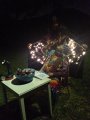
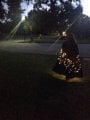
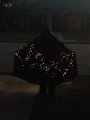
1-3. My previous cape. You can see that the LED strands were exposed on the inside.
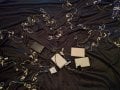
4. The inside of my previous cape.
5. An example diagram of what I’m trying to do. It’s not the final design, because I haven’t figured out where to put the resistor(s) and potentiometer yet (and the locations of the stars will need to be tweaked to account for the distortion of the sky map I used, but I can’t do that until the cloak arrives).
Thank you for your time!
Clear Skies!
Lauren Herrington
I’m working on project that entails adding ~150 LEDs to a cloak, to wear to a costume party being held by my astronomy club in two weeks. The LEDs will together make an astronomically correct representation of the night sky. I have no electrical experience, and I desperately need advice.
What I need to know above all else: Is this safe? I really don’t want to be bursting into flames at the party (or anywhere else)!
Any other advice or insights are extremely appreciated!
-----
Background:
I created a similar cape back in 2014. However, the fabric was just a cheap, stretchy cape from the Halloween store, and the lighting consisted of premade strands of LEDs hot-glued to the inside. It worked for Halloween, but was hardly a durable design, and even though I haven’t used it since then, one of the wires has broken and caused a strand to go dead. In addition, I had to use 4 strands of lights, so there were 4 battery packs that I had to tuck into my waistband. No good.
My goal with my current project is to create an improved, durable version, that can be used over and over again. Not only will I want to use it for the astronomy club costume party and Halloween, but also astronomical educational events, where I often work with little kids.
Though I’m an astronomer, I have absolutely no electrical experience. To give you an idea of just how new I am to this, I didn’t even know Ohm’s Law until I started researching this project a few days ago. My mom has a soldering iron and plenty of experience using it, so soldering and putting stuff together shouldn’t be a problem- but since I’m so new to circuits, I don’t know whether I’m missing some kind of fundamental flaw in the design. That’s why I’m asking here.
-----
Details:
I’ve ordered a sturdy cloak made out of canvas to be the base:
http://www.darkknightarmoury.com/p-38301-aaron-canvas-cloak.aspx
I’ll be using Through Hole LEDs, about 150 in total, most likely ordered from here:
https://www.superbrightleds.com/cat/through-hole/?view=standard
I’ll use several colors of LEDs (orange, yellow, white, and blue) to roughly represent the actual star colors.
The LEDs and wires will be attached according to this tutorial:
http://www.instructables.com/id/How-to-Make-a-Color-Changing-Lighted-Faux-Fur-Scar/
In essence, the LEDs will be poked through from the outside, secured on the backside with buttons, and then the wires will be soldered to the LED leads. The exposed parts of the wires and leads will be sealed with hot glue.
The cloak will be lined with a cotton fabric, to cover up and protect the wiring. A pocket will be sewn into the lining to hold the battery pack, as described in the Instructable.
The finishing touches of fainter objects and the Milky Way will be added to the outside using glow in the dark fabric paint.
Here’s my current understanding of the requirements of the circuit:
- The LEDs should be wired in parallel so that they are all the same brightness.
- In the Instructable they used RGB color changing LEDs, which do not require resistors. However, since I’m using regular LEDs, I will need to use resistors to make sure that the LEDs don’t burn out.
- The LEDs will likely have a continuous forward current of 20mA. I don’t want to quite reach that limit, so 18mA is a better target. That means I need a resistor of at least 4.5V/0.018A = 250Ω.
- The LEDs will most likely be too bright for my purposes. It would be ideal to make them dimmable, so I’ll need to add a potentiometer.
-----
Questions:
- Is it safe to have a circuit sandwiched in between layers of fabric like this?
- Assuming it’s safe if I do it right, are there any risks that develop if I do it wrong by mistake?
- Do I only need one resistor, or several?
- Does it matter where the resistor(s) are placed in the circuit?
- Can I use a potentiometer as a brightness control? If so, can I put it directly next to the battery pack so that it can be accessed from the battery pocket?
- Roughly how much heat will be generated, by the resistor(s) or otherwise? I live in southern Texas, and will be using the cloak primarily outside, so heat is a definite concern.
- What wire should I use?
- Will three AA batteries be sufficient as a source of power, or should I use more for the ~150 LEDs?
- Obviously, not every star in the sky is the same brightness…. Is there a practical way to vary the brightnesses of individual LEDs? 3 different steps in brightness would be ideal, but even two steps would help. To create that effect, would I need to have a circuit for each level of brightness, or is there some other way to do it?
-----
Photos:
1-3. My previous cape. You can see that the LED strands were exposed on the inside.
4. The inside of my previous cape.
5. An example diagram of what I’m trying to do. It’s not the final design, because I haven’t figured out where to put the resistor(s) and potentiometer yet (and the locations of the stars will need to be tweaked to account for the distortion of the sky map I used, but I can’t do that until the cloak arrives).
Thank you for your time!
Clear Skies!
Lauren Herrington
Attachments
-
 79.7 KB Views: 5
 -
 82.6 KB Views: 5
 -
 48.8 KB Views: 4
 -
 226.9 KB Views: 4
 -
 249.5 KB Views: 4