LED set-up for a 1/12 scale model

Thread Starter

mriordan

Joined Jul 10, 2023
6
I am currently making a scaled model display that uses 16 LED in a series and I would like to wire it up to be on one switch, so I need a single power supply to connect them to. I have various different colors that I would like to use in the display. I have 6 red LED (2.0v), 6 white LED (3.2v), and 4 yellow (2.0v) so a total of 36 volts. I would like to know what resistor or resistors I need to use for my power supply which is 48v (it is the closest I could find to 36v). Please provide me with any insight that could help this process as I have been tinkering with it for about a week with only burn marks on my table to show for it (when I added the wrong resistor types). I have tried to put them into a parallel circuit also, but could not get that to work either

Thank you for anyone's quick reply.
 

djsfantasi

Joined Apr 11, 2010
9,237
First, LEDs need to have the correct current supplied, not the voltage. The voltage specified is at a nominal temperature and is used to calculate the resistance. It called its forwardvoltsge. So you need to know how much current each LED needs for the brightness you want.

Here’s the formula for ONE LED. Given that Vs is the supply voltage, Vf is the forward voltage and A is the desired current. The maximum current is on the LED datasheet. You can use 10mA as a guess for the operating current. It can vary from as little as 2mA.

That’s a lot of info, so let’s use it to calculate the resistor for one LED. Assume your supply is 6V, and you want to light one yellow LED. The formula for the resistor is (5-2)/0.01 or 300 ohms. Pick the closest standard resistor. You can go up and down a little to adjust the brightness.

Now multiple LEDs. You wire them in series and add up all the forward voltages. Then add a little headroom. For your yellow LEDs you can wire all four in series (for 8V). Then add a little to get to a common voltage. You can add one volt to get 9V but if the LEDs are a little high 9V might not be enough. So let’s pick 12V. Then the needed resistor would be (22-8)/.01 or 400 ohms.

Six red LEDs would be too much but you can divide it into two strings of three for 6V. Same with the white. Use two strings of two for 6.4V. Wire all the strings in parallel.
 

AnalogKid

Joined Aug 1, 2013
12,126
On the datasheet for each LED, find the spec for luminous intensity. This will be a value usually in milli-candelas, or mcd. Note the current that is given for this spec, For example, an old, garden-variety green LED might have a value of 15 mcd @ 20 mA. It's the 20 mA that is important. This is the value the manufacturer uses to qualify its parts, essentially the recommended operating current.

In a series circuit, all of the current goes through all of the components all of the time. If you have a large series string of mixed LEDs, they all will see the same operating current. Thus, it is important to go through the datasheets and make sure what the highest and lowest values for the group. As a starting point, use the lowest value as the design current for the power circuit. If most of the LEDs are in the 20-30 mA range, but one of them is at 15 mA, choose the current-limiting resistor such that the entire string gets 15 mA.

Now that you have something that works without flaming death, see if you are unhappy with the brightness of any color group. For example, if the reds and yellows are fine, but the whites are a bit dim *compared to the other two colors*, then it is time to get into splitting the LEDs up into multiple strings to allow better brightness matching. But again, check the datasheets. It might be than you have high efficiency or "super-bright" (yes, that is a technical term) LEDs for some colors but not others, If so, we talk more.

Last: Power. While the voltage across an LED varies with different operating currents, you can do a first-order aproximation of the resistor size without getting picky. With a 48 V supply and approx. 36 V across the LEDs, that leaves 12 V across the resistor.

1. Use Ohm's Law to calculate the resistor value for 15 mA.

2. Select the closest available commercial value. It can be above or below the perfect value. All LEDs have a safe operating current range, and 5% or 10% above the "typical" value is not a problem.

3. Re-calculate the operating current using the selected resistor value.

4. Joule's Law to calculate the power in the resistor. With an operating current of 15 mA,

P = V x I == 12 x 0.015 = 0.18 W

A 1/4 W axial resistor will run a bit warm, but not dangerously so. For better long-term reliability, the resistor power rating should be at least twice its operating dissipation. In your case, up the resistor to 1/2 W.

ak
 
Last edited:

Thread Starter

mriordan

Joined Jul 10, 2023
6
On the datasheet for each LED, find the spec for luminous intensity. This will be a value usually in milli-candelas, or mcd. Note the current that is given for this spec, For example, an old, garden-variety green LED might have a value of 15 mcd @ 20 mA. It's the 20 mA that is important. This is the value the manufacturer uses to qualify its parts, essentially the recommended operating current.

In a series circuit, all of the current goes through all of the components all of the time. If you have a large series string of mixed LEDs, they all will see the same operating current. Thus, it is important to go through the datasheets and make sure what the highest and lowest values for the group. As a starting point, use the lowest value as the design current for the power circuit. If most of the LEDs are in the 20-30 mA range, but one of them is at 15 mA, choose the current-limiting resistor such that the entire string gets 15 mA.

Now that you have something that works without flaming death, see if you are unhappy with the brightness of any color group. For example, if the reds and yellows are fine, but the whites are a bit dim *compared to the other two colors*, then it is time to get into splitting the LEDs up into multiple strings to allow better brightness matching. But again, check the datasheets. It might be than you have high efficiency or "super-bright" (yes, that is a technical term) LEDs for some colors but not others, If so, we talk more.

Last: Power. While the voltage across an LED varies with different operating currents, you can do a first-order aproximation of the resistor size without getting picky. With a 48 V supply and approx. 36 V across the LEDs, that leaves 12 V across the resistor.

1. Use Ohm's Law to calculate the resistor value for 15 mA.

2. Select the closest available commercial value. It can be above or below the perfect value. All LEDs have a safe operating current range, and 5% or 10% above the "typical" value is not a problem.

3. Re-calculate the operating current using the selected resistor value.

4. Joule's Law to calculate the power in the resistor. With an operating current of 15 mA,

P = V x I == 12 x 0.015 = 0.18 W

A 1/4 W axial resistor will run a bit warm, but not dangerously so. For better long-term reliability, the resistor power rating should be at least twice its operating dissipation. In your case, up the resistor to 1/2 W.

ak
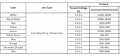
I have attached the data sheet that came with LEDs so that you can see, but what I can tell is that each color has a 20mA value, so I don't know if that helps at all. Please let me know how I can put that into the formula provided as I have used online resistor calculators and used what they said just to see various things catch fire and leave odd smells and singe marks on my work table.

Thank you for all the help and time.
 

Attachments

Thread Starter

mriordan

Joined Jul 10, 2023
6
First, LEDs need to have the correct current supplied, not the voltage. The voltage specified is at a nominal temperature and is used to calculate the resistance. It is called its forwardvoltsge. So you need to know how much current each LED needs for the brightness you want.

Here’s the formula for ONE LED. Given that Vs is the supply voltage, Vf is the forward voltage and A is the desired current. The maximum current is on the LED datasheet. You can use 10mA as a guess for the operating current. It can vary from as little as 2mA.

That’s a lot of info, so let’s use it to calculate the resistor for one LED. Assume your supply is 6V, and you want to light one yellow LED. The formula for the resistor is (5-2)/0.01 or 300 ohms. Pick the closest standard resistor. You can go up and down a little to adjust the brightness.

Now multiple LEDs. You wire them in series and add up all the forward voltages. Then add a little headroom. For your yellow LEDs you can wire all four in series (for 8V). Then add a little to get to a common voltage. You can add one volt to get 9V but if the LEDs are a little high 9V might not be enough. So let’s pick 12V. Then the needed resistor would be (22-8)/.01 or 400 ohms.

Six red LEDs would be too much but you can divide it into two strings of three for 6V. Same with the white. Use two strings of two for 6.4V. Wire all the strings in parallel.

Stringing things together seem like it might be a good idea, but I don't fully understand how to do that and then to string them together. So would each string be complete and then connect to the other strings or does this mean each string needs its own power supply? Can you post a diagram to help better describe how this might work or look so that I can try something like that with what I have?

Again thank you for your help and please let me know if there is any other information I can post to help out with this.
 

LowQCab

Joined Nov 6, 2012
5,101
For ideal operation with multiple LEDs having substantially different Forward-Voltage-Ratings,
and being powered in a series-connected-string(s) ...........

All of the LEDs with identical, ( or very close to the same ),
Forward-Voltage and Current-ratings,
should be in their own separate string,
with their own separate means of Current-Regulation for that particular string.

This is only required if you care about being able to adjust
the relative Light-Output of the various colors.
Each Color will have a different Forward-Voltage-rating.

If You don't care if some of the LEDs appear to be twice as bright as other colors,
then simply put them all in a single-series-string,
with a single means of Current-Limiting for the entire string.
The maximum Current for this single-string must then be less than
the maximum-rated-Current of the LED with the lowest maximum-Current-rating in the string.

The Power-Supply must be able to provide at least ~3 to ~5-Volts in excess
of the total of the Forward-Voltages of all of the LEDs in the string added together,
otherwise, the overall maximum Light-Output from the string will not be attainable.

Fewer LEDs in a String requires less Power-Supply-Voltage for that string,
excessive Power-Supply-Voltage must be wasted as HEAT in a Resistor, or,
a Switch-Mode Current-Limiting-Circuit can be used for much greater efficiency with less waste-Heat.
.
.
.
 

AnalogKid

Joined Aug 1, 2013
12,126
For all LEDs in one series string, use the median value for Vf for each color.

Vf-red = 2.1 V
Vf-yellow = 2.1 V
Vf-white = 3.1 V

Next, total the Vf of all LEDs

Vrt = 12.6 V
Vyt = 8.4 V
Vwt = 18.6 V

Vtotal = 38.6 V

For current limiting resistor R1,

Vr1 = 48.0 - 38.6 = 9.4 V

R1 = E / I = 9.4 / 0.020 = 470 ohms

R1 Power:

P = E x I = 9.4 x 0.020 = 188 mW Use a 1/2 W resistor.

ak
 

bassbindevil

Joined Jan 23, 2014
922
Unless it's for something like an e-bike that already has 36V available, I'd use a more common supply like 12V, and only have one colour per series string and resistor. Resistors are cheap, and efficiency isn't at a premium. This also allows you to use a PWM dimmer or other cheap LED controller to change the brightness of all the LEDs at once.
 

Thread Starter

mriordan

Joined Jul 10, 2023
6
Unless it's for something like an e-bike that already has 36V available, I'd use a more common supply like 12V, and only have one colour per series string and resistor. Resistors are cheap, and efficiency isn't at a premium. This also allows you to use a PWM dimmer or other cheap LED controller to change the brightness of all the LEDs at once.

I am making a scale model for a friend, and I would typically do something like that but I would like to have it all on one power source so that he doesn't have to plug in a bunch of different things. There is also a moving component that we added that has a plug so I would like to keep it to the two (the lights and the movement). At least that is my thinking at this point.
 

Thread Starter

mriordan

Joined Jul 10, 2023
6
For ideal operation with multiple LEDs having substantially different Forward-Voltage-Ratings,
and being powered in a series-connected-string(s) ...........

All of the LEDs with identical, ( or very close to the same ),
Forward-Voltage and Current-ratings,
should be in their own separate string,
with their own separate means of Current-Regulation for that particular string.

This is only required if you care about being able to adjust
the relative Light-Output of the various colors.
Each Color will have a different Forward-Voltage-rating.

If You don't care if some of the LEDs appear to be twice as bright as other colors,
then simply put them all in a single-series-string,
with a single means of Current-Limiting for the entire string.
The maximum Current for this single-string must then be less than
the maximum-rated-Current of the LED with the lowest maximum-Current-rating in the string.

The Power-Supply must be able to provide at least ~3 to ~5-Volts in excess
of the total of the Forward-Voltages of all of the LEDs in the string added together,
otherwise, the overall maximum Light-Output from the string will not be attainable.

Fewer LEDs in a String require less Power-Supply-Voltage for that string,
excessive Power-Supply-Voltage must be wasted as HEAT in a Resistor, or,
a Switch-Mode Current-Limiting-Circuit can be used for much greater efficiency with less waste-Heat.
.
.
.
Light adjustment is not an issue for this project as all of the light is filtered through objects so I don't need to dim or control it, just turn it on and go. I believe all of the added-up value of the wattage for the lights is 36 so I currently have a 48-wattage power source but need the proper resistor combinations to make it work. I know that I should put them into individual series and then connect them but don't know exactly how to do that overall so any assistance with resistors and possible diagrams for what the wiring would look like so that I can try something out that might not burn my table would amazing.

Thank you for helping out.
 
Top