ok my new meter is reading 15.35v across the LED, and 18.07 between the input of the regulator to the out on the LED. I guess that means it's slightly over the recommended voltage. Should I take out one resistor or something?
Is this LED on and bright? It sounds like it might be blown. There is no way you should have that kind of voltage across the LED, it should be around 3.6VDC, give or take.
The other thing is do you have the ground lead of the meter connected to the minus terminal? Remember what I said about the second lead? It is important.
OK, you're only getting about 2.72V across the regulator (18.07-15.35v = 2.72v).
Usually, those regulators need at least 3v of "headroom" in order to regulate current.
Can you measure the actual current through the LED?
Break the circuit between the supply+ and the regulator, or the regulator and the LED, or the LED and the supply return. Set up your meter to read on the 10A DC scale. You will need to move the red test lead to a different jack on the meter, and set the knob to 10A.
Make certain that you return the red test lead to the V/Ohms/mA jack after you are done with the test.
Then multiply the actual LED current by the voltage you read across the LED to determine the power dissipation in the LED.
Is this LED on and bright? It sounds like it might be blown. There is no way you should have that kind of voltage across the LED, it should be around 3.6VDC, give or take.
Ok, I broke the circuit between the LED and the power supply return. The meter read 0.67, is that right? Multiplied with the LED voltage that is 10.3...
Could you show us the power supply you wound up using?
There are other ways to go about this. I'm thinking the LM317 may not be usable as the LEDs are slightly out of spec and the power supply is too close, but Wookie may have another idea.
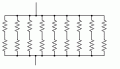
You could use 2 10Ω ¼W resistors in series, or buy some 30Ω ½W resistors. Going with the 10Ω resistors, 9 pairs of these resistors should give you around 1.21A. This would keep you under the 20W limit on the LED. Every pair is 0.135A, 9 X 1.35A is 1.21A
That LED is definitely out of spec, but I suspect the vendor or manufacturer isn't going to co-operate. The OP has a decision to make, I hope it works out well. We'll be here waiting to see how it works out.
Nope, at .67A it is definitely underpowered, so it should last longer than usual, as long as it is properly heatsinked.
My only concern is it has one defect, how many others?
At 15.35V X 0.67A = 10.3W, it is about half its rated power. In other words, you could bump it up a little more if you wanted. If it is of acceptable brightness now, go for it, you've probably increased its lifespan several thousand hours.
Be careful, but the answer is yes. The higher the power, the shorter it's life (but it will still last thousands of hours).
It might be that the LM317 won't let any more current through, since it isn't really a regulator as it is being used. How many resistors do you currently have?
In a perfect setup, every resistor is 0.125A, but we are not even close to perfect right now. You can try it and see, but don't go over 10 resistors, and let us know what the current is then.
Actually, no. Not with that supply and that LED. The LM317 regulator has a minimum voltage dropout of 1.7 from IN to OUT and 1.25v for Vref from OUT to ADJ, for a total of 2.95V. Right now, he's at less than the minimum dropout.
I would write to the customer support and inform them about the defective LED, and how could you get a replacement for the sub-standard LED.
You deserve to get what you have paid for. I would insist on it.
If I say this one is faulty, they'll ask me to send it back, then they'll send another that will be exactly the same. I'll just see how I get on with this one, and if it pops prematurely.. then I'll try and get a replacement.
I've really appreciated your help guys, this would have taken a lot longer to build if it wasn't for you two.
I've got nine resistors at the moment. Could one of you guys maybe write down what equations I need and why (or point me in the direction of a site that teaches you them), so that I can figure out the volts, amps, ohms and watts across my circuit without having to bother you every time I make a change.
Thanks again dudes, I'll post some pics of my projector working when it's all constructed.
The problem is, if you send them a dead one they will definitely refuse to honor any warranty, claiming you burned it out through abuse. This is standard with any parts house, including legitimate ones. If you can show them a part that is good but doesn't meet their quoted specs you have a chance. Personally I think it is a small one, but it might be worth the effort before you go further.
Of course, we haven't seen the part. Have you globbed a lot of solder on it or something? This is not an accusation, but a query why you might not want to try returning an expensive part that is borderline (I think Wookie might argue that it is completely) defective.
We'll be glad to explain how we calculate resistance, but you will need a firm grounding in algebra (hey, better than calculus!).
What you asked for with resistors can be broken into 3 parts, the resistor and their resistance, the amount of heat they make, and how an LED enters this mix.
***********
Resistance
It all revolves around Ohm's Law, where E = Voltage (the E stands for Electromotive Force, same thing), I = Current (in Amps), and R is resistance (in Ohms).
E = I X R
If you have two of the variables, the 3rd pops right out.
2 resistors in series adds, 2 identical resistors in parallel are halved. The formulas for non similar resistors is more complex, but if you are dealing with similar resistors it simplifies nicely.
It can get challenging, it is basic to electronics for new techs, I suggest taking it slow and keeping it where it applies for your project.
***************
The other thing is power, measured in wattage, and is usually expressed as heat (though it is also a unit of work). 1 Watt on a resistor will leave a nice burn on your finger. As a general rule we try to have the resistor rated twice what is needed for the same reason we keep talking about not taking your LED to maximum power. They last longer and are less likely to have a premature failure.
P is Watts, E is voltage, and I is current.
P = E X I
Of course, you can mix ohm's law in this quite nicely.
****************
The last thing is the LED itself. LEDs tend to drop more or less the same amount of voltage over a wide amount of current. The current is what powers the LED, the voltage just starts things moving (like priming a pump). So if you know the amount of voltage the LED drops (Vf) you can calculate the amount of power (heat) it will generate.
If not, then write to them indicating your purchase order or receipt number, the model number, and indicate that the part you received measures 15.35v @ 670mA when the stated specifications are:
Forward voltage [VF]: 13.5 - 15V DC
Forward current [IF]: 1400mA - 1800mA
and explain that your application requires that the LED you purchased from them perform within the published specifications.
LEDs vary in Vf (forward voltage) even within a lot. Roughly 75% of them will fall in a very narrow Vf range at a given current, while the remaining 25% may fall 10% above or below that range.
They might simply send you another LED.
I'll just see how I get on with this one, and if it pops prematurely.. then I'll try and get a replacement.
as Bill said, they won't adjust it if you break it.
I've really appreciated your help guys, this would have taken a lot longer to build if it wasn't for you two.
I've got nine resistors at the moment. Could one of you guys maybe write down what equations I need and why (or point me in the direction of a site that teaches you them), so that I can figure out the volts, amps, ohms and watts across my circuit without having to bother you every time I make a change.

 Facebook
 Google
 GitHub
 Linkedin