Questions about audio power amplifiers

Thread Starter

yxrip

Joined Oct 31, 2025
13
It's my first time trying to work with an audio amplifier, lm386, and i'm a bit confused about how amplifying power works and what gain means in this context.
For example I imagine a voltage amplifier takes a voltage, either the difference between two inputs, or just one input in reference to ground and makes it so the voltage appearing on the output is multiplied by gain value in reference to ground.
And a current amplifier, well, maybe makes it so that the amount of current available is amplified? because current is pulled and not output. or maybe it makes the current to constantly be some specific amount(thinking of constant current source).
But what does even amplifying the power mean? Power is the product of voltage and current. Does it mean just amplifying whichever needed? Then why does the gain called voltage gain in the datasheet?
Also I'm almost sure that the minimum gain of lm386 being 20 does not mean it just multiplies the voltage by 20 because if so, it would turn just 1 volt input to 20 volts which to me sounds quiet a lot, specially because it's stated in its datasheet that it's designed for battery-operated consumer devices and it's hard to imagine them doing 20 times at their lowest.
Oh and also why does it have two inputs when the datasheet says that inputs are referenced to ground? Because two input sounds like whatever their difference is must be the input voltage.
 

sghioto

Joined Dec 31, 2017
8,633
Also I'm almost sure that the minimum gain of lm386 being 20 does not mean it just multiplies the voltage by 20 because if so, it would turn just 1 volt input to 20 volts which to me sounds quiet a lot,
Correct. The output can never exceed the supply voltage and depends on the load resistance.
Oh and also why does it have two inputs when the datasheet says that inputs are referenced to ground?
From AI:
The LM386 has two inputs—a non-inverting (pin 3) and an inverting (pin 2)—to offer flexibility in circuit design. You can use either one by grounding the other, which allows for different amplifier configurations, such as a non-inverting amplifier for a non-inverted output or an inverting amplifier for an inverted output. This design also allows for advanced applications like summing or subtracting multiple signals or improving the signal-to-noise ratio by rejecting common-mode noise
 

WBahn

Joined Mar 31, 2012
32,704
It's my first time trying to work with an audio amplifier, lm386, and i'm a bit confused about how amplifying power works and what gain means in this context.
For example I imagine a voltage amplifier takes a voltage, either the difference between two inputs, or just one input in reference to ground and makes it so the voltage appearing on the output is multiplied by gain value in reference to ground.
And a current amplifier, well, maybe makes it so that the amount of current available is amplified? because current is pulled and not output. or maybe it makes the current to constantly be some specific amount(thinking of constant current source).
But what does even amplifying the power mean? Power is the product of voltage and current. Does it mean just amplifying whichever needed? Then why does the gain called voltage gain in the datasheet?
Also I'm almost sure that the minimum gain of lm386 being 20 does not mean it just multiplies the voltage by 20 because if so, it would turn just 1 volt input to 20 volts which to me sounds quiet a lot, specially because it's stated in its datasheet that it's designed for battery-operated consumer devices and it's hard to imagine them doing 20 times at their lowest.
Oh and also why does it have two inputs when the datasheet says that inputs are referenced to ground? Because two input sounds like whatever their difference is must be the input voltage.
Gain is the ratio of output to input. Don't make it harder than it is.

A voltage gain is the ratio of a voltage output to a voltage input.

A power gain is the ratio of a power output to a power input.

A current gain is the ratio of a current output to a current input.

Again, don't make it harder than it is.

A voltage gain of 20 means that the output voltage is 20 times in the input voltage.

It does NOT mean that putting in 1 V will give you 20 V at the output -- it can only amplify the input within its limitations.

In fact, applying an input voltage of 1 V will significantly exceed the absolute max input voltage, which is from -0.4 V to +0.4 V.

If you are powering the device from a 5 V supply, then your input signal has to be small enough such that 20 times that will not exceed the maximum output limits, which are a fraction of the supply voltage.

Remember, this part is intended as a voltage amplifier that is capable of delivering a modest amount of power to a load (primarily an audio speaker). So the input voltage is expected to be a pretty small signal that is not capable to delivering useful power to a load. It is called a power amplifier because it IS intended to provide useful power to that load, as opposed to providing just an amplified low-power voltage signal used for further information processing.
 

MrChips

Joined Oct 2, 2009
34,628
Power is voltage x current. There are two other ways of calculating power.
Since Ohm's Law is:
I = V / R
we have two mathematical corollaries of Ohm's Law:
V = I x R
R = V / I

By the same token, there are three ways to calculate power:
P = I x I x R
P = V x V / R
P = V x I

For a fixed load resistance R, we don't need to know both voltage and current.
LM386 is designed to drive a loudspeaker which most often has an impedance of 8 Ω.

With R known, and the maximum power output of LM386 limited to 1 W, we can calculate the voltage required to deliver 1 W into an 8 Ω load. Thus we can work backwards and determine the required input voltage to generate 1 W output into 8 Ω, given a voltage gain of 20. (Note that this creates design specifications on the required supply voltage since you cannot amplify a voltage beyond what the power supply is capable of delivering.)

In many instances, the input voltage might be very small, in tens of millivolts, not enough to attain the full 1 W output, even with a voltage gain of 20. Hence you need a pre-amplifier to amplify the signal to the required input level sufficient for the LM386.
 

WBahn

Joined Mar 31, 2012
32,704
LM386 is designed to drive a loudspeaker which most often has an impedance of 8 Ω.
The recommended speaker impedance, per the data sheet, for the LM386 is 4 Ω.

In many instances, the input voltage might be very small, in tens of millivolts, not enough to attain the full 1 W output, even with a voltage gain of 20. Hence you need a pre-amplifier to amplify the signal to the required input level sufficient for the LM386.
The LM386 is designed with Av = 20 as the default, but the addition of external resistors/capacitors allows it to be set to gains between 20 and 200, reducing and sometimes eliminating the need for preamplification.

Similarly, if the input signal is too high (which might be the case when trying to take a high level signal used for something else and "audiblize" it), you might need to attentuate it before applying it to the input. In fact, that is what most of the reference circuits in the data sheet do via the potentiometer between the input signal and the LM386 input.
 

Ian0

Joined Aug 7, 2020
13,097
An amplifier doesn't take the input and make it bigger. It modulates the power supply so that a fraction of the output (say a tenth) looks like the input. Thus the output is like the input but ten times bigger.

The output current and power are just determined from the output voltage by Ohm's law.
In audio, we don't care much about the input resistance, generally they are about 10k, but they can vary from 600Ω to 100k. As we're not bothered by the input impedance, we're equally not bothered by the input current or power, so current and power gain is something you don't come across much in audio.
It's different with RF where the impedances are important.
 

Thread Starter

yxrip

Joined Oct 31, 2025
13
So it's called a power amplifier not because it amplifies power but because it can provide power to a speaker, maybe because of low output impedance(i'm not sure if i'm actually using the right word, i just read random things on the internet and try to understand).
and the actual output voltage and current depend on the rest of the output circuit.
I'm just not sure if i need to use it then, because i'm trying to hear a square wave from an arduino on a 4 ohm speaker which is 5 volts and so it's not really that low i guess, not trying to do "circuit bending". The main reason is that i think the speaker draws too much current from the pins and i need to isolate it. maybe i should just use a 741 op amp with the gain of 1?(what forrest mims calls a unity-gain follower) if the 5 volt from arduino is good enough. I know it's noisy but i don't have anything else and i don't care too much about the audio quality.
 

WBahn

Joined Mar 31, 2012
32,704
5 V across 4 Ω is 1.25 A of current. That's pushing the capabilities of an LM386 and is WAY beyond what you can hope to get from most opamps, particularly a part as old as the 741 (which you should largely forget exists -- at least use opamps designed in the last half century). The 741 has a maximum output short-circuit current of only about 25 mA.
 

BobTPH

Joined Jun 5, 2013
11,463
So it's called a power amplifier not because it amplifies power
Power is voltage times current.

If you multiply the voltage by 2 at the same current, you have multiplied the power by two.

The LM386 multiplies both voltage and the current, and therefore also power, when you drive a low impedance speaker.
 

MisterBill2

Joined Jan 23, 2018
27,186
The above responses are correct, but always there are limits to what an actual amplifier can do. They get called POWER amplifiers because they do deliver POWER to the load, if the gain is set to ten and the signal in is 1 volt, to feed that output into the 8 ohm speaker, some current is also required. If the amplifier can't deliver enough current, then there is DISTORTION.
That is why understanding the limits of a device, such as the LM386, is important. Like has been mentioned already.
 

MrChips

Joined Oct 2, 2009
34,628
Let's examine basic first principles of a source driving a load. You will encounter this when a signal drives the input of an amplifier, when the amplifier has to drive a loudspeaker, when a power supply has to drive a load, or even when a volume control feeds the next stage.

Any time a load is connected to a source, the load draws current from the source. If you do not want the load to adversely affect the voltage output from the source, you must not take more current than the source can provide.

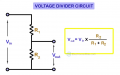
In a voltage divider circuit,

Vout = Vin x R2 / (R1 + R2)

This holds true only if no current is taken from Vout. Once you connect a load to Vout, all bets are off. You now have to take into account the loading effect of the load.


1763847597937.png

The general rule of thumb is: the output impedance of the source must be 10 times lower than the impedance of the load. The rationale behind this is that in such a case, the effect of the load on the source voltage will not be greater than 10%.

As an example, if your source impedance is 10 kΩ feeding the input of an amplifier, you want the input impedance of the amplifier to be 100 kΩ or higher.

If your loudspeaker's impedance is 8 Ω , you want the amplifier's output impedance to be 0.8 Ω or lower.

Note that these are guidelines only and depend on the specific application. When driving transmission lines, the impedance of the source and the load must match the impedance of the transmission line in order to avoid signal reflections.
 

nsaspook

Joined Aug 27, 2009
16,251
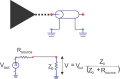
The impedance of the source should still be lower in the transmission line example. If the load is matched there is nothing coming back to be reflected again.
1763849439565.png
https://www.informit.com/articles/article.aspx?p=2916283&seqNum=12
We say that in order to “drive a transmission line”—in other words, launch a voltage into the line that is close to the open-circuit source voltage—we need an output impedance of the driver that is very small compared to the characteristic impedance of the line. If the line is 50 Ohms, we need a source impedance less than 10 Ohms, for example.

Output devices that have exceptionally low output impedances, 10 Ohms or less, are often called line drivers because they will be able to inject a large percentage of their voltage into the line. Older-technology CMOS devices were not able to drive a line since their output impedances were in the 90-Ohm to 130-Ohm range. Since most interconnects behave like transmission lines, current-generation, high-speed CMOS devices must all be able to drive a line and are designed with low-output impedance gates.
 

MisterBill2

Joined Jan 23, 2018
27,186
An unmentioned reality is that the effect of the output load connection line characteristic impedance depends a whole lot on the signal frequency. Audio frequencies are not bothered nearly as much as CB radio frequencies, as an example.
 

kd502

Joined Jul 15, 2012
2
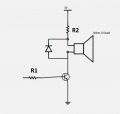
You don't need a good amplifier to send a square wave to a speaker. One transistor is enough. You can decrease the power/volume with resistor R2. Be careful not to turn the transistor on permanently, as the speaker will burn out from the DC voltage.
If you were interested in utilizing the speaker's maximum power, a push-pull circuit with DC blocking would be better.
 

Attachments

Last edited:

MisterBill2

Joined Jan 23, 2018
27,186
The circuit shown in post #15 is certainly FAR FROM a good amplifier! The rise time of the square wave to the speaker is stretched by the RL time constant and the fall time is greatly extended by that "protective" diode. Of course, both of those effects will tend to reduce the harsh sound of an actual square wave.
Then I went back to post #1 to revisit what the TS was actually asking about. I see the thread has wandered a bit.

So, back to the description of "power amplifier",
The SIGNAL POWER OUT is greater than the SIGNAL POWER IN, Of course that is a "Black Box" definition, which neglects to include the other black-box input of total power input, which is greater than the SIGNAL power output, unless the amplifier is able to provide 100% efficiency, which might only happen in a simulation, maybe.
In the real world, AMPLIFIER GAIN is either expressed as a simple numerical ratio, as already described in detail, or in DECIBELS, which are a handy way of describing ratios accurately without having to multiply fractional numbers, since Decibels add rather than multiply..

Certainly I have repeated a bit of what has already been said, but hopefully added a bit of insight.

AND, the output VOLTAGE from an amplifier can be much greater than the supply voltage IF the amplifier includes an output transformer, and the output is measured at the output terminals of the transformer.
 
Top