LED Overdrive Circuit with current control

Thread Starter

cl10Greg

Joined Jan 28, 2010
67
Hello,
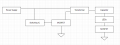
I am working on a LED overdrive circuit design and could use some help. I have been working on the design and running simulations in LTSpice. I have the charging part figured out where I am using a Capacitor Charger IC and transformer to quickly charge a large capacitor (1 - 2.2mF). I am charging it up to around 120V currently and now I am trying to figure out how to handle the discharge phase of the circuit. The application is an LED flash at much higher current for a small pulse for machine vision. It needs to be able to to have different pulse widths and current control. The previous hardware I looked at that does this uses the same setup and just a low side MOSFET to do the pulse. My question is how can you do this while controlling the current? I want to be able to set the current to 20,30,40,50A setting.

One option would be to use 4 parallel low side drives and resistors to set this. Another I have been looking at was using the MOSFET it its linear region to try and make it a variable resistor. This method requires a low side gate drive with a variable voltage so not sure if that would work. Anyone have any other suggestions on how to do the current control?
1704915395954.png
 

LowQCab

Joined Nov 6, 2012
5,101
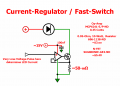
The following Circuit is a Voltage-Controlled Current-Regulator.

The Voltage-to-Current relationship is determined by
the Voltage generated at the Current-Sense-Resistor.

This Input-Voltage will vary depending upon the LED Power-Supply-Voltage,
minus the Forward-Voltage of the LED(s).
.
.
.
Current Pulse Regulator .png
.
 

MisterBill2

Joined Jan 23, 2018
27,186
I doubt that this would be a single LED application and i EVEN MORE SERIOUSLY DOUBT THAT A SINGLE led WOULD SURVIVE EVEN ONE FLASH .
Does the TS have an LED array in mind? If so, what are the electrical specifications, Max current, max voltage, max POWER, average power.
Next, a capacitor discharge source will provide a very rapidly changing amount of light, even if you use a suitable XENON flash tube. An LED light source should have the power switched on and then off, with some current limit and temperature feedback.
 

Quacker

Joined May 21, 2021
6
Hello,
I am working on a LED overdrive circuit design and could use some help. I have been working on the design and running simulations in LTSpice. I have the charging part figured out where I am using a Capacitor Charger IC and transformer to quickly charge a large capacitor (1 - 2.2mF). I am charging it up to around 120V currently and now I am trying to figure out how to handle the discharge phase of the circuit. The application is an LED flash at much higher current for a small pulse for machine vision. It needs to be able to to have different pulse widths and current control. The previous hardware I looked at that does this uses the same setup and just a low side MOSFET to do the pulse. My question is how can you do this while controlling the current? I want to be able to set the current to 20,30,40,50A setting.

One option would be to use 4 parallel low side drives and resistors to set this. Another I have been looking at was using the MOSFET it its linear region to try and make it a variable resistor. This method requires a low side gate drive with a variable voltage so not sure if that would work. Anyone have any other suggestions on how to do the current control?
I would put a resistor in the source of the power mosfet that developed about .65 volts across it when the desired current flows through it. Across the resistor , oil would place the base emitter junction of a n NPN junction transistor like a 2N3904. The the collector of the small transistor to the gate of the mosfet. Turn the fet on through a resistor. When the current in the source resistor develops voltage to start turning on the on the 2N3904, it will current limit. You can even adjust the current by tying the base to a voltage divided across the source resistor. Disclaimers: you will need to work out the power dissipation issues and use any caps etc that may be needed to stop any oscillations. In addition, a resistor in series with the base may be needed to avoid over stressing the base-emitter junction under overshoot or oscillation events. Have fun!
View attachment 312403
Hello,
I am working on a LED overdrive circuit design and could use some help. I have been working on the design and running simulations in LTSpice. I have the charging part figured out where I am using a Capacitor Charger IC and transformer to quickly charge a large capacitor (1 - 2.2mF). I am charging it up to around 120V currently and now I am trying to figure out how to handle the discharge phase of the circuit. The application is an LED flash at much higher current for a small pulse for machine vision. It needs to be able to to have different pulse widths and current control. The previous hardware I looked at that does this uses the same setup and just a low side MOSFET to do the pulse. My question is how can you do this while controlling the current? I want to be able to set the current to 20,30,40,50A setting.

One option would be to use 4 parallel low side drives and resistors to set this. Another I have been looking at was using the MOSFET it its linear region to try and make it a variable resistor. This method requires a low side gate drive with a variable voltage so not sure if that would work. Anyone have any other suggestions on how to do the current control?
I would put a resistor in the source of the power mosfet that developed about .65 volts across it when the desired current flows through it. Across the resistor , oil would place the base emitter junction of a n NPN junction transistor like a 2N3904. The the collector of the small transistor to the gate of the mosfet. Turn the fet on through a resistor. When the current in the source resistor develops voltage to start turning on the on the 2N3904, it will current limit. You can even adjust the current by tying the base to a voltage divided across the source resistor. Disclaimers: you will need to work out the power dissipation issues and use any caps etc that may be needed to stop any oscillations. In addition, a resistor in series with the base may be needed to avoid over stressing the base-emitter junction under overshoot or oscillation events. Have fun!

View attachment 312403
 

Quacker

Joined May 21, 2021
6
Sorry if this is a repeat. Thus page is not working properly.
I would put a resistor in the source of the power mosfet that developed about .65 volts across it when the desired current flows through it. Across the resistor, I would place the base emitter junction of a n NPN junction transistor like a 2N3904. The the collector of the small transistor to the gate of the mosfet. Turn the fet on through a resistor. When the current in the source resistor develops voltage to start turning on the on the 2N3904, it will current limit. You can even adjust the current by tying the base to a voltage divided across the source resistor. Disclaimers: you will need to work out the power dissipation issues and use any caps etc that may be needed to stop any oscillations. In addition, a resistor in series with the base may be needed to avoid over stressing the base-emitter junction under overshoot or oscillation events. Have fun!
 

MisterBill2

Joined Jan 23, 2018
27,186
It has been TEN DAYS since the question was posed. Once again we need information about the LED light source before even a guess can be offered.
The information will include the number of LEDs in the flash package and the specifications of voltage and current for the LED array, since my guess is that it must be more than one LED to work with 120 volts.
 

Quacker

Joined May 21, 2021
6
I would posit that if it’s a properly designed current limiter, that it’s load agnostic- save of course, the power dissipation in the current pass element.
 

MisterBill2

Joined Jan 23, 2018
27,186
Depending on the LED forward voltage and the 120 volt supply internal resistance, the current limiter shown may not be fast enough to prevent destruction of the LED light source. I did once burst a xenon flash tube by providing it with a lot more voltage. AND that was an instant burst, not a staying ignited burst. I did learn from that.
So IF the TS returns and provides the requested information then probably a good answer can be provided.
 
Top