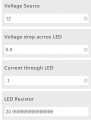
If I have 10 LEDs in series controlled by a CCR at 100 mA and 12volts would the calculation be derived from Vf-3.3V and supply of 12 Volts and number of LEDs. 3.3 x 10=33
33x12=396mA?
Granted I do have these LED circuits in parallel of each other
I do not understand. Can you make a picture/drawing?
You have 10 LEDs in series. 3.3V each, you need 33V for current to flow.
I do not understand 12Volts.
I do not understand 396mA.
In addition to the fact that you cannot run 10 3.3V LEDs in series from 12V, LEDs is series draw the same current as a single LED, the current does not add.
The premise of that calculator is completely bogus. The inrush current to an LED driver has nothing to do with the constant current it produces in steady state. The inrush current depends on the size of capacitors and the resistance in it’s AC to DC converter.
The premise of that calculator is completely bogus. The inrush current to an LED driver has nothing to do with the constant current it produces in steady state. The inrush current depends on the size of capacitors and the resistance in it’s AC to DC converter.
You have ten 3.3V LEDs, then the voltage will be about 33V. (because the 3.3 is not accurate and changes with temperature the 33 could be 36 to 30)
I think you have a constant current driver (power supply) so each LED will have about 3.3V and 100mA. In series the voltage adds up while the current is 100mA.
Several things first. Where did the 3.3 volts figure come from?? That is not a typical forward voltage for most LEDs, and so the number is suspect, unless the data sheet for the LEDs states that is the voltage at 100 mA. And whatever the forward voltage is, it certainly does change with temperature.
If you have a number of strings of ten LEDs connected in parallel and you are operating them all at the maximum rated current, then the current would be 100mA multiplied by the number of strings.
LEDs do not exhibit any inrush current, so that is not a consideration.
If the intended supply voltage is 12 volts, you will not get much light from a string of 10 LEDs in series. POSSIBLY putting FOUR leds in series across 12 volts will give you quite a bit of light, and the current will be a bit less than the 100mA. So I suggest trying them four in series first.
But if this is for an automotive application then the voltage source will frequently exceed 13.4 volts and so a way to limit the current will be required. That could be a series resistor or an actual current regulator circuit.
The LED Inrush Current article is rubbish.
They say when three 3V LED are in series and are powered directly from 12V then the inrush current is "9V x 12V= 108mA".
Actually, the current will be the maximum amount the 12V power supply can produce and will explode the LEDs.
3.3V is typical forward voltage of a blue or white LED. Some of the LEDs might have the minimum voltage of about 3V and others might have the maximum voltage of 3.6V. The current MUST be limited by a series resistor or other current limiting circuit.
I have been building lighted displays for decades and never once considered LED inrush current.
Sometimes I feel like the coyote in those roadrunner cartoons expecting all of my project to suddenly fail when I realize I'm over the cliff. (did everything wrong according to the internet)
If I have 10 LEDs in series controlled by a CCR at 100 mA and 12volts would the calculation be derived from Vf-3.3V and supply of 12 Volts and number of LEDs. 3.3 x 10=33
33x12=396mA?
Granted I do have these LED circuits in parallel of each other
That is what I understood the TS to be stating: Strings of ten LEDs in series, connected in parallel.
AND, for the unlimited current situation, the initial inrush current spike ends when the first LED in the string "fuses"'
For LEDs operated within their specified current, the inrush ends when the current reaches the other end of the string. Thus it is very short and difficult to detect.
It‘s really worse than you make it. The formula (shown at the bottom of the page) is:
\[ I_C = SSC\ \times\ 100\ \times\ D \]
Where SSC is Steady State Current and D is the number of drivers. In other words, it uses a blind coefficient of 100 for any driver. So, if I have an LED driver that can provide 10A, my calculated inrush is 1000A!
It‘s really worse than you make it. The formula (shown at the bottom of the page) is:
\[ I_C = SSC\ \times\ 100\ \times\ D \]
Where SSC is Steady State Current and D is the number of drivers. In other words, it uses a blind coefficient of 100 for any driver. So, if I have an LED driver that can provide 10A, my calculated inrush is 1000A!
It‘s really worse than you make it. The formula (shown at the bottom of the page) is:
\[ I_C = SSC\ \times\ 100\ \times\ D \]
Where SSC is Steady State Current and D is the number of drivers. In other words, it uses a blind coefficient of 100 for any driver. So, if I have an LED driver that can provide 10A, my calculated inrush is 1000A!
For LEDs rated at 3.3V @ 100 mA and using a 12V supply, the calculator is not rubbish, only misunderstood. I chose 3x3.3V= 9.9V
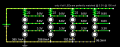
So at best you can use 9 LEDs 3 in series and 3 in parallel but I would add a 1 ohm resistor in series with each 3S string to prevent thermal runaway which drops 0.1V only but enough to minimize the effects of -4mV/'C rise in junction temperature rise. Thus (12V-10V)/0.1A = 20 Ohms (* 0.1A = 2W) (instead of 21 ohms) so use a 5W resistor or four 5 Ohms 1W in series (derated for power by 50%) or four 80 ohms 1W in parallel or three 1A diodes in series to get a ~ 2.1V drop. This biggest variable is the Vf=3.3V on each LED, which could be as low as 3V. So your datasheet will help tell us.
This is more like what you want. With 22 Ohms will draw > 200 mW @ 120 'C so use a 1/2W R or multiple R's to share power.
OK, that bit makes sense, except the diagram is 3S4P not 3S3P. But that's not inrush current, that's just normal operating current. It was the inrush current calculator we were referring too.

 Facebook
 Google
 GitHub
 Linkedin