The 393 comparator has an open collector output. To drive an NPN, there would have to be a pullup resistor to source the base current when the transistor is on, and the comparator output has to short this current to GND when the transistor is off. This is a much less efficient setup, usually used only if a grounded switch is required.
Here is an updated schematic with all of the recently discussed additions. As part of the input protection, it attenuates the incoming audio approximately 12%. This should be within the range of the trip level adjustment. This circuit separates the trip level from the incoming audio to make things easier to design.
Thanks, AK! This improved sensitivity considerably -- I'd prefer even more sensitivity, but this definitely falls within the range of acceptable for me.
Unfortunately, Dennis, this behaves the same way as the previous iteration (as described in #24). In short, when the speakers are on, the LED flutters; when they're off, the LED turns on solid at full brightness.
Believe it or not, last time I was at the store, I picked up a matched pair of 2N4401/2N4403 "just in case" -- so I was able to try this. But it didn't make me grin at all. It works, but sensitivity is poor; you have to blast the stereo darn close to max to get the LED to light.
Well, folks, I think I'm moving forward with AnalogKid's "AUDIO DETECTOR LED DRIVER - 2." Thank you so much to everyone for your help; I really have learned a lot. I'm definitely not cutting ties, here -- if I have any issues during the final build, I'll definitely be back. And I'll be sure to post pictures once I'm done with the project.
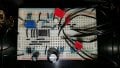
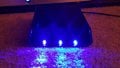
As promised, here are a couple pics of the final circuit... I know a breadboard isn't ideal, but I'll live with it this way for a while -- if it fails on me, I guess I'll graduate to a perfboard or printed board. Thanks, again, everyone!
Here's the board:
And here it is all buttoned up and doing its thing:
So how sensitive did it end up being? Subjectively, does it come on at "barely audible", or "more quietly than I ever listen", or "moderate volume", or what? Just curious.
It gets tripped on my Yamaha receiver right around -42.5 dB, which I would classify as "very light background music while you're trying to have a conversation."
That's low, yes. With my Yamaha, watching a movie at -20 dB is something I can usually only do when I have the house to myself. More like -30 dB if the wife is around.

 Facebook
 Google
 GitHub
 Linkedin