LED AUDIO Spectrum Analyzer

Thread Starter

circuit28

Joined Apr 13, 2018
9
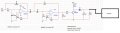
Hello, I decided to build an LED audio spectrum analyzer and I want to know if I'm going in the right direction to get it to work. The simulation tool I have available(multisim) does not have the LM3916 and I have been unable to find a way to add it to its library so I drew out the diagram. How does this look so far? The bandpass circuit design I got from http://www.learningaboutelectronics.com/Articles/Bandpass-filter-calculator.php#answer3.

upload_2018-4-23_21-46-58.png
 
Last edited by a moderator:
Sensacell

Joined Jun 19, 2012
3,785
The problem is the band-pass filter, it's too wide for a good spectrum analyzer.

You need a much more complex analog or digital filter.
The analog versions are hard to tune.
 

AnalogKid

Joined Aug 1, 2013
12,130
The problem is the band-pass filter, it's too wide for a good spectrum analyzer.
You need a much more complex analog or digital filter.
The analog versions are hard to tune.
Not really. In his thread on another forum I made an argument for multi-pole analog filters, and presented a topology with very simple math requirements, no weirdo component values, and no ratio matching.

ak
 

AnalogKid

Joined Aug 1, 2013
12,130
Here is what I wrote about better filters:

If you search for 'color organ project' or 'color organ schematic', you will find many examples of how to separate an audio input into three frequency bands. The better systems use multi-pole active filters. Since you have lotsa 324's, use them. There are many active filter calculator websites to make things less painful, but with one circuit parameter change the math becomes very simple.

Start with a basic 2-pole Butterworth lowpass filter. My favorite is a variation of the Sallen-Key topology that has a gain of 2. This is the change from the traditional S-K filter with a gain of 1. At a gain of 2, all of the R's and C's that set the filter's corner frequency are equal-value, making the circuit fairly easy to configure for your application. The passband gain is not perfectly flat; it peaks a bit at the corner frequency. Since this is not a critical listening application, I think that is a reasonable tradeoff for overall circuit simplicity. Next, a highpass version of the same circuit. One lowpass creates the bass range; one highpass followed by one lowpass sets the midrange; one highpass sets the treble range. The midrange will have a through gain of 4 rather than 2, but that is easy enough to attenuate before the output sections.

Toward the middle of the page, example #2:
https://www.electronics-tutorials.ws/filter/second-order-filters.html

Mouser has low cost 1% tolerance film capacitors that are excellent for this circuit.

ak
 
Top