LD1117 voltage regulator 9v to 3.3v

Thread Starter

icydash

Joined Jan 14, 2009
148
Hi everyone,

I'm kind of new to electronics and trying to power an ESP8266 wifi module with a LD1117 voltage regulator. It looks like, per the datasheet (attached), there should be a capacitor at the input and another capacitor at the output, like this:ZTUFe.png
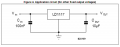
It seems that Cin and Cout are supposed to be changed from what's shown in the above figure depending on what the Vin and Vout are going to be. What values should Cin and Cout be to go from a 9v battery to 3.3v for my wifi module? I don't think I'm understanding the datasheet, since it seems like Cout is always 10uF and they don't tell you what Cin should be.

Thanks!
 

Attachments

crutschow

Joined Mar 14, 2008
38,316
It seems that Cin and Cout are supposed to be changed from what's shown in the above figure depending on what the Vin and Vout are going to be. What values should Cin and Cout be to go from a 9v battery to 3.3v for my wifi module? I don't think I'm understanding the datasheet, since it seems like Cout is always 10uF and they don't tell you what Cin should be.
The capacitor values used are largely unrelated to Vin and Vout, they are determined by noise and ripple filter requirements (and sometimes circuit stability requirements).
 

DickCappels

Joined Aug 21, 2008
10,661
I just used a 10 uf on the input and output and it works fine. You will probably need to heatsink the regulator -you can just solder the tab to a small piece copper clad circuit board.
 

Thread Starter

icydash

Joined Jan 14, 2009
148
Thanks everyone! So I tried that circuit and my voltmeter seems to be reading at around a constant 4v, rather than 3.3v. Is that typical? I just want to make sure I'm not going to harm my ESP8266.

@DickCappels - you mentioned that I may need to heatsink the regulator...Why?
 

OBW0549

Joined Mar 2, 2015
3,566
So I tried that circuit and my voltmeter seems to be reading at around a constant 4v, rather than 3.3v. Is that typical?
Try connecting a 330Ω resistor between the output and ground, so the regulator is outputting 10 mA or thereabouts. Some voltage regulators require a minimum load current; without any load, they go out of regulation and the output "floats" upward.
 

Thread Starter

icydash

Joined Jan 14, 2009
148
Still seems to be floating at around 4v with the 330 ohm resistor. Odd. Oh well, I guess it doesn't really matter unless it's going to harm my ESP, which it shouldn't.
 

OBW0549

Joined Mar 2, 2015
3,566
Still seems to be floating at around 4v with the 330 ohm resistor. Odd. Oh well, I guess it doesn't really matter unless it's going to harm my ESP, which it shouldn't.
Ummm... something is wrong, somewhere. You should be getting 3.3 volts out of that regulator, within a few hundredths of a volt. If you don't, something is awry.
 

DickCappels

Joined Aug 21, 2008
10,661
Thanks everyone! So I tried that circuit and my voltmeter seems to be reading at around a constant 4v, rather than 3.3v. Is that typical? I just want to make sure I'm not going to harm my ESP8266.

@DickCappels - you mentioned that I may need to heatsink the regulator...Why?
4 volts:
Is the GND pin connected to ground? You might have an out-of-specification part, or (unlikely) your DVM may be out of calibration, or maybe you don't have enough capacitance and your regulator is oscillating -something you can see with a suitable oscilloscope but not with a DVM.

Heatsink:
With an 9V input to the regulator and the ESP8266 as a load the regulator will dissipate about 1 watt. With a TO-220 package you should be ok without a heatsink, but the metal tab will feel hot. With the SOT-223 the junction temperature is likely to be over 150°C. The D-pack will be somewhere in-between.
 
Top