Laplace transform in circuits

Thread Starter

thisonedude

Joined Apr 20, 2014
52
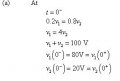
So i'm working on this problem. I don't undersntad how they got 20 and 80 volts. i know the voltage across both capacitors is equal to 100V since it's been a long time. But how did they get that .2V1=.8V2? and how did they solve for each voltage? the Answer is at the bottom. I just need help with a.1.JPG 2.JPG
 

dalam

Joined Aug 9, 2014
58
For any capacitor the basic equation is Q=C*V.
So V=Q/C, thus, V is inversely proportional to C.

Hence the division.
 

MrAl

Joined Jun 17, 2014
13,707
Hi,

Another approach is as follows...

You know the total Z presented to the input source in position 'a' is:
Z=R1+1/s/C1+1/s/C2

and you know the voltage is 100 and so you know the current is:
I=100/Z

and so you know the voltage across C2 is:
vC2=I*(1/s/C2)

and the voltage across C1 is:
vC1=I*(1/s/C1)

Now if we calculate out vC2 we get:
vC2=I*(1/s/C2)=100/Z*(1/s/C2)=12500/(s+625)

Now using the Laplace final value theorem:
"The limit of f(t) as t approaches infinity is equal to s*F(s) as s approaches zero (all poles of s*F(s) in LHP)"
we get:
lim s*F(s) (as s--.0)=lim 12500/(s+625) (as s-->0)=12500/625=20

and doing the same for vC1 we get:
lim 50000/(s+625) (as s-->0) =80

so we get 20 and 80 volts for vC2 and vC1 respectively.

We can also do it symbolically and then we get the formula:
vC2=Vs*C1/(C1+C2)
and
vC1=Vs*C2/(C1+C2)

(Vs is the source voltage which is 100 for this exercise)

From inspection we can see that the final voltage denominator is the sum of the two capacitors, and the numerator is the opposite capacitor. Another thing you will notice is that the resistance is not present because it disappears in the limit.
 
Top