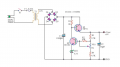
Lab power supply internal components

AnalogKid

Joined Aug 1, 2013
12,130
My question is how do we account for this voltage drop of few hundred mV.
Use fatter wire. Seriously. 500 ma is not a very high current. #16 wire through a 10 meter loop should have a voltage drop of around 67 mV, not a few hundred.

What regulation parameters do you have to meet? +/-xx%, +/-xx mV, other - ?

ak
 
Last edited:
Thread Starter

engr_david_ee

Joined Mar 10, 2023
362
Use fatter wire. Seriously. 500 ma is not a very high current. #16 wire through a 10 meter loop should have a voltage drop of around 67 mV, not a few hundred.

What regulation parameters do you have to meet? +/-xx%, +/-xx mV, other - ?

ak
Yes, I understand that thick wire will have smaller resistance and will have lower voltage drop.
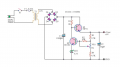
Apart from my application. I would like to understand how the circuit work. How the Vout is calculated and how the two transistors are switching in order to maintain the Vout. Can someone please describe how the attached circuit is working. I would like to learn the operation of the attached circuit.
 

Attachments

Thread Starter

engr_david_ee

Joined Mar 10, 2023
362
The followings points are clear.

- In the start, the output voltage is zero. This also means that base of the Q2 is also zero that comes from resistance network.
- As the power supply turn on. The voltage across C1 increases.
- The base of Q1 crosses 0.6 V.
- The emitter of Q1 starts rising but it stays that 0.6 V below the base voltage.
- The increasing output voltage will also make the base of the Q2 increasing.
- As the base of the Q2 reaches at Zener voltage added with 0.6 V, the transistor Q2 starts conducting. Note before Q2 start conducting, the Q1 was conducting.

What happend next ?
The Q1 will turned off ?
 

boostbuck

Joined Oct 5, 2017
1,043

MrChips

Joined Oct 2, 2009
34,810
The followings points are clear.

- In the start, the output voltage is zero. This also means that base of the Q2 is also zero that comes from resistance network.
- As the power supply turn on. The voltage across C1 increases.
- The base of Q1 crosses 0.6 V.
- The emitter of Q1 starts rising but it stays that 0.6 V below the base voltage.
- The increasing output voltage will also make the base of the Q2 increasing.
- As the base of the Q2 reaches at Zener voltage added with 0.6 V, the transistor Q2 starts conducting. Note before Q2 start conducting, the Q1 was conducting.

What happend next ?
The Q1 will turned off ?
This is not a switching circuit. It is an analog circuit with negative feedback. Think what happens when it reaches steady state.

1722468956652.png
When the base of Q2 reaches about 5.1 V + 0.6 V = 5.7 V.
Q2 starts to conduct.
This reduces the current drive via R1 into the base of Q1. This causes +Vout to fall.
The base voltage at Q2 falls, i.e. negative feedback. The circuit will stabilize at one voltage determined by the setting of VR1.
 

AnalogKid

Joined Aug 1, 2013
12,130
In theory, both ZD1 the Q2 base-emitter voltage are rock-solid constants. In reality, not so much, but good enough for this supply. And to be clear, this is merely a good-enough design. They combine to form a 5.7 V reference, which is the lowest possible output voltage. Q1 has all of the gain in this circuit, and since it is just one transistor instead of an opamp, the relatively low loop gain means less tight regulation. Much of this is due to the V-I characteristic of the transistor base-emitter junction. It has a relatively soft "knee", the transition region between zero base current because there is not enough voltage across the junction, and a constant junction voltage no matter how much the base current increases. Depending on the transistor, the Vbe span between the beginning of collector current conduction and hard saturation can be up to 0.4 V (0.45 V to 0.85 V).

In terms of a more conventional regulator circuit with an opamp, look at this circuit like this: The Q2 emitter is the non-inverting input for the reference; the base is the inverting input from the negative feedback. The Q1 emitter is the output. R3 plus a portion of VR1 are the series leg of the feedback loop. The rest of VR1 plus R4 are the shunt leg. If the output voltage sage below the setpoint, Q2 base current decreases, Q2 collector current decreases, and R1 pulls up Q1 to increase the output voltage. If the output voltage is too high, Q2 base current increases, and Q2 collector current increases, pulling down Q1 and decreasing the output voltage. This is identical to the operation of a common opamp-based regulator.

A problem with this circuit is thermal drift. ZD1 might be a super whiz-bang reference diode, but the Q2 BE junction has a relatively large and very well-documented negative temperature coefficient. This causes the output voltage to decrease as the circuit warms up. I ran into this in a large and expensive TV station routing switcher in the 70's (Good switching is VITAL). It had large, heavy, quasi-stabilized ferro-resonant (!) supplies making + and -8 (-ish) volts. This was run to various circuit subsections where it was locally regulated to +/-5 V with this circuit. We wound up replacing a bunch of these little circuit boards with LM309s, one of the first monolithic voltage regulators.

This raises a point about your application. Is it possible to locate a regulator out at the load?

ak
 

Thread Starter

engr_david_ee

Joined Mar 10, 2023
362
This is not a switching circuit. It is an analog circuit with negative feedback. Think what happens when it reaches steady state.

View attachment 328305
When the base of Q2 reaches about 5.1 V + 0.6 V = 5.7 V.
Q2 starts to conduct.
This reduces the current drive via R1 into the base of Q1. This causes +Vout to fall.
The base voltage at Q2 falls, i.e. negative feedback. The circuit will stabilize at one voltage determined by the setting of VR1.
Excellent. Thank you for this explanation. Now I am wondering how do we calculate the value of Vout provided the resistors R2, R3, R4, and VR1 is known.
 

Thread Starter

engr_david_ee

Joined Mar 10, 2023
362
In theory, both ZD1 the Q2 base-emitter voltage are rock-solid constants. In reality, not so much, but good enough for this supply. And to be clear, this is merely a good-enough design. They combine to form a 5.7 V reference, which is the lowest possible output voltage. Q1 has all of the gain in this circuit, and since it is just one transistor instead of an opamp, the relatively low loop gain means less tight regulation. Much of this is due to the V-I characteristic of the transistor base-emitter junction. It has a relatively soft "knee", the transition region between zero base current because there is not enough voltage across the junction, and a constant junction voltage no matter how much the base current increases. Depending on the transistor, the Vbe span between the beginning of collector current conduction and hard saturation can be up to 0.4 V (0.45 V to 0.85 V).

In terms of a more conventional regulator circuit with an opamp, look at this circuit like this: The Q2 emitter is the non-inverting input for the reference; the base is the inverting input from the negative feedback. The Q1 emitter is the output. R3 plus a portion of VR1 are the series leg of the feedback loop. The rest of VR1 plus R4 are the shunt leg. If the output voltage sage below the setpoint, Q2 base current decreases, Q2 collector current decreases, and R1 pulls up Q1 to increase the output voltage. If the output voltage is too high, Q2 base current increases, and Q2 collector current increases, pulling down Q1 and decreasing the output voltage. This is identical to the operation of a common opamp-based regulator.

A problem with this circuit is thermal drift. ZD1 might be a super whiz-bang reference diode, but the Q2 BE junction has a relatively large and very well-documented negative temperature coefficient. This causes the output voltage to decrease as the circuit warms up. I ran into this in a large and expensive TV station routing switcher in the 70's (Good switching is VITAL). It had large, heavy, quasi-stabilized ferro-resonant (!) supplies making + and -8 (-ish) volts. This was run to various circuit subsections where it was locally regulated to +/-5 V with this circuit. We wound up replacing a bunch of these little circuit boards with LM309s, one of the first monolithic voltage regulators.

This raises a point about your application. Is it possible to locate a regulator out at the load?

ak
I understand you are referring to Q2 transistor which causes lazy turning ON and OFF of the transistor Q1. I actually have seen OpAmp in place of Q2 in some linear regulator where it is often called Error Amplifier. I guess with OpAmp in place of Q2 there will be hard ON/OFF the output of the OpAmp connected to the base of Q1.

In case of having OpAmp in place of Q2. The non-inverting input of the OpAmp is connected to the voltage reference which is ZD1 (5.1V) and the inverting input of the OpAmp is connected to the negative feedback, in other words connected at the mid point of the voltage divider from Vout. The voltage divider mid point which is connected at the inverting input of the OpAmp should be set at 5.1 V for a given set voltage of Vout.

As the Vout drops below the set point. The voltage divider mid point will be below 5.1 V which is inverting input of OpAmp, causing the OpAmp output high because the non-inverting input is connected to the reference 5.1 V. This will turn on the Q1, causing the Vout to increase.

As the Vout increases beyond the set point, the mid point of the voltage divider will be higher then 5.1 V connected at inverting input of the OpAmp. This will make the OpAmp output lowm causing the Q1 to turn off.

The operation of the circuit is clear to me when we have OpAmp in place of Q2 and a voltage divider from Vout which only require two resistors.

But in the original circuit diagram where we have Q2 and the resistors R2, R3, R4, and VR1. How these resistors set the Vout is still un-known to me.
 

Thread Starter

engr_david_ee

Joined Mar 10, 2023
362
I think, the resistor R2 is simply preventing feedback path to go completely open and thus prevents the output voltage to go extremely high. This resistor R2 is just for protection.


The Vout is set by the R3, R4, and VR1.

If the base of Q2 is directly to the Vout, then the output voltage would be 5.7 V.

If we have 1:1 voltage divider, we get 5.7 V across the bottom resistor and 5.7 V across the top resistor. This gives the total output voltage Vout 5.7 V + 5.7 V = 11.4 V

If we have a 1:2 voltage divider, we get 5.7 V across the bottom resistor and 2 x 5.7 V = 11.4 V across the top resistor. This gives the total output voltage of 5.7 V + 11.4 V = 17.1 V

Now I understand how the Vout is calculated using the resistors R3, R4, and VR1.

There is still one question remaining. Which option is better Q2 transistor or OpAmp ?
 

Thread Starter

engr_david_ee

Joined Mar 10, 2023
362
The last thing I would like to add in this post is where do we connect the sense wire ?

Consider the experimental setup is located at some meters away and there is voltage drop across the power cables. We will have the sense wires from the experimental setup load.

The question is where we will be connecting/attaching the sense wires in the circuit which is already attached above.
 

MrChips

Joined Oct 2, 2009
34,810
Excellent. Thank you for this explanation. Now I am wondering how do we calculate the value of Vout provided the resistors R2, R3, R4, and VR1 is known.
You can ignore R2. It is there in case the VR1 slider lifts off the track.
For analysis, ignore VR1. Simply use R3 and R4 as a voltage divider.

Vf = Vo x R4 / (R3 + R4)
Vo = Vf x (R3 + R4) / R4
where Vf = 5.1 V + 0.7V

If you want, you can include VR1 in your determination of R3 and R4 at VR1 min and max settings.
 

sarahMCML

Joined May 11, 2019
697
The last thing I would like to add in this post is where do we connect the sense wire ?

Consider the experimental setup is located at some meters away and there is voltage drop across the power cables. We will have the sense wires from the experimental setup load.

The question is where we will be connecting/attaching the sense wires in the circuit which is already attached above.
You can take the ends of R3 and R4 that are connected to +Vout and GND respectively, and run them via separate wires right out to your load point to sense the voltage there. This overcomes the voltage drop in the current carrying wires!
You'll often see extra output terminals on high end PSU's where this is done.
 

Thread Starter

engr_david_ee

Joined Mar 10, 2023
362
You can ignore R2. It is there in case the VR1 slider lifts off the track.
For analysis, ignore VR1. Simply use R3 and R4 as a voltage divider.

Vf = Vo x R4 / (R3 + R4)
Vo = Vf x (R3 + R4) / R4
where Vf = 5.1 V + 0.7V

If you want, you can include VR1 in your determination of R3 and R4 at VR1 min and max settings.
Thanks
 

Thread Starter

engr_david_ee

Joined Mar 10, 2023
362
You can take the ends of R3 and R4 that are connected to +Vout and GND respectively, and run them via separate wires right out to your load point to sense the voltage there. This overcomes the voltage drop in the current carrying wires!
You'll often see extra output terminals on high end PSU's where this is done.
Yes, I got it. The resistors R3 and R4 can be physically present located at the linear power supply position but the ends of R3 and R4 which are connected to +Vout and GND respectively. I need to run them longer using two wires and attach them to the point of load to sense the voltage there which can be couple of meters away. This will compensate the voltage drop in the current carrying wire.
 
Top