Lab power supply internal components

Thread Starter

engr_david_ee

Joined Mar 10, 2023
362
Hi,

I am wondering if it is possible to get to know the schematic of standard lab power supply. How do they adjust the output voltage when we change the knob voltage and how the sense circuit works at component level.
 

BobTPH

Joined Jun 5, 2013
11,515
There us no such thing as a standard lab supply.

There are many circuits for adjustable voltage sources. Study and understand simple circuits first. The simplest would be an LM317 based supply, which needs only few components.
 

AnalogKid

Joined Aug 1, 2013
12,127
Commercial "lab" or "bench" power supplies usually have similar characteristics:

Adjustable output voltage
Adjustable constant-current limiting
Voltage and current displays

As long as the current being drawn from the supply is less than the Current Limit setpoint, the supply functions as a common constant-voltage source. When the output current exceeds the current limit value, the output voltage automatically is decreased to keep the output current at the set value. The automatic changeover is sometimes abbreviated as CV/CC. Thus, there are three main sections to the schematic - the voltage regulator, the current regulator, and the changeover control circuit.

Here is what I get in a search for 'lab power supply schematic'. Of course not all of them apply to your question, but you should be able to see some common elements - a voltage reference, a voltage regulator output power stage, an output current sensor, and the CV/CC management.

https://images.search.yahoo.com/sea...+power+supply+schematic&fr2=piv-web&fr=fp-top

ak
 

sparky 1

Joined Nov 3, 2018
1,218
There are a variety of different lab power supplies. For example a linear power supply 0 - 30 Volt. 5 Amp with current limiting.
A lab power supply may require the output to adjust and remain stable having enough filter to be low ripple.
One design type uses a Howland constant current pump which includes the voltage and current controls.

A lab power supply with current control can be complex. Instead I will refer you to a 5V op amp circuit that initially set for 3mA
You can vary the circuit as a step toward approaching an understanding. LTspice is available at no cost..
Try changing the Vin to 3V and Rstray to 1K
Howland Current Source - CircuitLab

Howland ltspice almost complete
 

Attachments

Last edited:

MrChips

Joined Oct 2, 2009
34,807
We can group the design of Lab Power Supplies into different categories.

1.0 Linear PSU (Power Supply Unit)
2.0 SMPS (Switch Mode Power Supply)

For this part, I will discuss case 1.0 only, Linear Power Supply.
There are various options available in power supplies.

1.1 Voltage Limit - also known as Constant Voltage (CV)
1.2 Current Limit - also known as Constant Current (CC)
1.3 Voltage Readout
1.4 Current Readout
1.5 Remote sensing
1.6 Remote programming

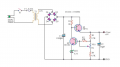
For discussion on 1.1 only, here is a basic design of a constant voltage power supply.
1722267992226.png

1.1.1 Input power transformer, T1
1.1.2 Bridge rectifier, D1-D4
1.1.3 Reservoir (or smoothing) capacitor, C1
1.1.4 Pass transistor, Q1
1.1.5 Output voltage sense and feedback, Q2
1.1.6 Voltage limit setting, VR1
1.1.7 Voltage reference, ZD1


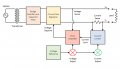
In the form of a block diagram, here are the major components in a CV/CC PSU. The sample circuit shown above does not have Current Sense and Current Limit.
PSU Block Diagram.jpg
 

LowQCab

Joined Nov 6, 2012
5,101
Colors can be very useful in reducing confusion when following lines in a Schematic,
and the whole purpose of a Schematic is clear communication of
the purpose, and various interactions of the Components.
Color that improves communication is always a bonus.
.
.
.
 

crutschow

Joined Mar 14, 2008
38,503
A few others we can quibble about.
BRITISHUS
colourcolor
flavourflavor
humourhumor
labourlabor
neighbourneighbor

And of course here we often run into analogue versus analog.

Perhaps it pertains to differences in pronunciation between the British and us here in the Colonies. ;)
 

dl324

Joined Mar 30, 2015
18,326
I worked on a refrigerator-sized computer constructed from TTL (with the exception of the memory boards) where each of the boards (ROM, memory controller, etc) took 3-5 E-sized schematics and they were all monochrome (blue line). Well drawn schematics don't need to resort to using colors.

The colors in the schematics in question do nothing to clarify anything. Meaningless colors are meaningless colors, no matter how you try to spin it.
 

Thread Starter

engr_david_ee

Joined Mar 10, 2023
362
There us no such thing as a standard lab supply.

There are many circuits for adjustable voltage sources. Study and understand simple circuits first. The simplest would be an LM317 based supply, which needs only few components.
LM317 is an adjustable linear voltage regulator. It comes in fixed output version in which the voltage divider inside and also in adjustable output in which the voltage divider has to be outside. How we do add sense circuit ?
 

Thread Starter

engr_david_ee

Joined Mar 10, 2023
362
We can group the design of Lab Power Supplies into different categories.

1.0 Linear PSU (Power Supply Unit)
2.0 SMPS (Switch Mode Power Supply)

For this part, I will discuss case 1.0 only, Linear Power Supply.
There are various options available in power supplies.

1.1 Voltage Limit - also known as Constant Voltage (CV)
1.2 Current Limit - also known as Constant Current (CC)
1.3 Voltage Readout
1.4 Current Readout
1.5 Remote sensing
1.6 Remote programming

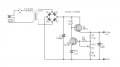
For discussion on 1.1 only, here is a basic design of a constant voltage power supply.
View attachment 328105

1.1.1 Input power transformer, T1
1.1.2 Bridge rectifier, D1-D4
1.1.3 Reservoir (or smoothing) capacitor, C1
1.1.4 Pass transistor, Q1
1.1.5 Output voltage sense and feedback, Q2
1.1.6 Voltage limit setting, VR1
1.1.7 Voltage reference, ZD1


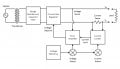
In the form of a block diagram, here are the major components in a CV/CC PSU. The sample circuit shown above does not have Current Sense and Current Limit.
View attachment 328104
Thank you very much. You have listed the types of power supplies and described linear power supply with circuit diagram and block diagram. I was looking for this circuit. I will try to understand the circuit.
 

Thread Starter

engr_david_ee

Joined Mar 10, 2023
362
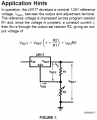
At this point, you need to read the datasheet for the part, which describes it's behaviour, operation and application. It's all in there:

View attachment 328248
Thanks for sharing this circuit. This is already known to me that will help to understand further how and where the sense wires are placed in the circuit. I understand that

1- The current through R2 is the sum of current I1 (through R1) and the IADJ (small amount of constant current).
2- The VREF is also fixed and the value is 1.25 V.
3- The resistor R2 is a variable resistor and is responsible for adjustable Vout given the resistor R1 is fixed. The Vout can be calculated by the equation already given in the datasheet of LM317.

Let's suppose we have this linear regulator with Vout as output voltage. We have experimental setup which is located at 5 meter from the power supply which is in our case is LM317. Consider the current is 500 mA and the voltage we need is 3.3 V.
There will be voltage drop across the 5 meter cable because the cable act as a series resistor.

My question is how do we account for this voltage drop of few hundred mV. We can route back a thin cable as sense wire from the experimental setup but where do we connect it back to the LM317. Should it be added in series to R2 ?
 

Pyrex

Joined Feb 16, 2022
502
Keep in mind , that when you ask Google search for "Lab PSU" , you will get some hundred circuit diagrams.Unfortunately, nine out of ten of those schemes are useless.
Some of them have no current limitation.
Some of them can not adjust from zero volts.
Some of them are untested and generate oscillations.
Some of them give a voltage jump during switching on.
Some are invented by unskilled developers and those circuits cannot work in principle
 

Thread Starter

engr_david_ee

Joined Mar 10, 2023
362
Keep in mind , that when you ask Google search for "Lab PSU" , you will get some hundred circuit diagrams.Unfortunately, nine out of ten of those schemes are useless.
Some of them have no current limitation.
Some of them can not adjust from zero volts.
Some of them are untested and generate oscillations.
Some of them give a voltage jump during switching on.
Some are invented by unskilled developers and those circuits cannot work in principle
The question is about the attached circuit.
 
Top