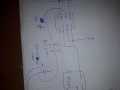
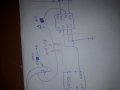
Audioguru then ok fine I take the electrolytic capacitor with the negative terminal that I connect it to the 0 V line, but I have a question the capacitors must also be inserted in parallel with each other as in the image below, then another thing the battery I'll put is 12V 500mA, but is 500mA okay? because the 555 accepts max 10mA input, I don't want to do damage. And then I would like to insert the preamp IC so that the sound is well audible
Audioguru then ok fine I take the electrolytic capacitor with the negative terminal that I connect it to the 0 V line, but I have a question the capacitors must also be inserted in parallel with each other as in the image below, then another thing the battery I'll put is 12V 500mA, but is 500mA okay? because the 555 accepts max 10mA input, I don't want to do damage. And then I would like to insert the preamp IC so that the sound is well audible
A 555 is an oscillator with no amplifier input. It draws a typical power supply current of 8mA from a 12V power supply when it has no load. It will draw the same low 8mA from a 12V 500A car battery when it has no load. Its maximum allowed output current is 200mA into a high power load that your circuit does not have because the inputs current of the TC4428A is almost nothing.
The 500A car battery does not destroy the clock that draws 1mA in the car.
Please post the datasheet of your 12V 500mA battery to see its chemistry and range of voltage and current.
Un 555 è un oscillatore senza ingresso amplificatore. Esso trae una corrente tipica di alimentazione elettrica di 8mA da una alimentazione di 12V quando non ha alcun carico. Si tratterà lo stesso basso 8mA da una batteria di auto da 12V 500A quando non ha alcun carico. La sua corrente di uscita massima consentita è di 200mA in un carico di energia che il vostro circuito non ha perché l'input corrente della TC4428A non è quasi nulla.
La batteria automobilistica 500A non distrugge l'orologio che disegna 1mA in auto.
Si prega di pubblicare il nome della batteria 12V 500mA per vedere la sua chimica e la sua gamma di tensione e corrente.
I haven't purchased the battery yet but I would like a Li-po rechargeable battery, a transistor battery or connect 8 rechargeable batteries in series, which is the best choice? send me some internet links
Un 555 è un oscillatore senza ingresso amplificatore. Esso trae una corrente tipica di alimentazione elettrica di 8mA da una alimentazione di 12V when it has no load. Si tratterà lo stesso basso 8mA da una batteria di auto da 12V 500A quando non ha alcun carico. La sua corrente di uscita massima consentita è di 200mA in un carico di energia che il vostro circuito non ha perché l'input corrente della TC4428A non è quasi nulla.
La batteria automobilistica 500A non distrugge l'orologio che disegna 1mA in auto.
Si prega di pubblicare il nome della batteria 12V 500mA per vedere la sua chimica e la sua gamma di tensione e corrente.
A 555 is an oscillator with no amplifier input. It draws a typical power supply current of 8mA from a 12V power supply when it has no load. It will draw the same low 8mA from a 12V 500A car battery when it has no load. Its maximum allowed output current is 200mA into a high power load that your circuit does not have because the inputs current of the TC4428A is almost nothing.
The 500A car battery does not destroy the clock that draws 1mA in the car.
Please post the datasheet of your 12V 500mA battery to see its chemistry and range of voltage and current.
A 555 is an oscillator with no amplifier input. It draws a typical power supply current of 8mA from a 12V power supply when it has no load. It will draw the same low 8mA from a 12V 500A car battery when it has no load. Its maximum allowed output current is 200mA into a high power load that your circuit does not have because the inputs current of the TC4428A is almost nothing.
The 500A car battery does not destroy the clock that draws 1mA in the car.
Please post the datasheet of your 12V 500mA battery to see its chemistry and range of voltage and current.
also because besides the question of the battery, the only other problems are: 1) the arrangement of the capacitors between them 2) the preamp IC 3) if I have to make some modifications for the generation of the pwm as you said
I have read thru all of the posts and no place did I see any explanation of the purpose for driving a bunch of ultrasonic transducers in parallel. Many references to that poorly executed circuit that certainly will not work EVEN IF that driver was able to deliver power at 40 KHZ.
So the first question is for what purpose? And the second question is how much power is desired? Certainly there is a power limit on what those transducers can handle without damage, and that has never been mentioned.
In addition, the 555 timer IC generates a square wave, which contains many harmonics and so the driver device will need to be able to handle at least three times the 40 KHZ intended frequency.
What makes much more sense would be a push-pull power oscillator with a tuned transformer to match the impedance of the collection of ultrasonic transducers.
I have read thru all of the posts and no place did I see any explanation of the purpose for driving a bunch of ultrasonic transducers in parallel. Many references to that poorly executed circuit that certainly will not work EVEN IF that driver was able to deliver power at 40 KHZ.
So the first question is for what purpose? And the second question is how much power is desired? Certainly there is a power limit on what those transducers can handle without damage, and that has never been mentioned.
In addition, the 555 timer IC generates a square wave, which contains many harmonics and so the driver device will need to be able to handle at least three times the 40 KHZ intended frequency.
What makes much more sense would be a push-pull power oscillator with a tuned transformer to match the impedance of the collection of ultrasonic transducers.
hello misterbill2 unfortunately now I'm not understanding anything anymore, so the piezos arrive at a voltage of 40 V and a current of about 10mA, I drive the piezos in parallel because that's how other projects do the same. furthermore the fact of using the 555 is also my choice because it is easier to use but if I have to change it to create the pwm signal I do it but tell me what I can replace it with, furthermore the power oscillator that you told me is not I have the slightest idea what it is, so please draw me the circuit as it should be, so I understand, thanks misterbill2
What is the reason for considering driving the ultrasonic transducers with a PWM signal??? The transducers do not create any signal by themselves, they are ONLY TRANSDUCERS. To get a signal out a signal must be supplied. That signal should be a sine wave of an amplitude to provide the sound level desired.
So one more time I ask, "what is the purpose intended???"
The other "projects" that claim to use a PWM signal are FAKE, as much of what is shown on you tube.
What is the reason for considering driving the ultrasonic transducers with a PWM signal??? The transducers do not create any signal by themselves, they are ONLY TRANSDUCERS. To get a signal out a signal must be supplied. That signal should be a sine wave of an amplitude to provide the sound level desired.
So one more time I ask, "what is the purpose intended???"
The other "projects" that claim to use a PWM signal are FAKE, as much of what is shown on you tube.
but in all the other diy projects that are on the web they all use a pwm signal to drive the piezos. however the goal of the project is to create an ultrasonic speaker. anyway misterbill2, show me with a little drawing how you create the sine wave for the signal, remembering that the audio signal comes from my smartphone, I don't know if a sine wave can work but you are much more expert than me, so let me see with a drawing how you do it
What is the reason for considering driving the ultrasonic transducers with a PWM signal??? The transducers do not create any signal by themselves, they are ONLY TRANSDUCERS. To get a signal out a signal must be supplied. That signal should be a sine wave of an amplitude to provide the sound level desired.
So one more time I ask, "what is the purpose intended???"
The other "projects" that claim to use a PWM signal are FAKE, as much of what is shown on you tube.
also because there is a small detail, and that is an audio signal has an average frequency of 15khz, but the signal that will have to reach the piezos will have to be translated by at least 10-12 khz more, in order to reach the ultrasonic level, moreover Audioguru he was talking about a preamp IC to boost the sound
OK, now it is clear that the intention is to create an amplitude modulated 40 KHz ultrasonic sound field, with the modulation coming from the headphone connection of a smart phone. That should have been stated in post #1, it would have clarified a lot.
OK, now it is clear that the intention is to create an amplitude modulated 40 KHz ultrasonic sound field, with the modulation coming from the headphone connection of a smart phone. That should have been stated in post #1, it would have clarified a lot.
yes then, from my smartphone I send the audio signal to the modulator which from the beginning was the 555 in astable mode, then the 555, after suitably modulating the audio signal into a pwm signal on ultrasonic frequency, would send the signal to the driver in this case the tc44288a. so do you think I should continue with the 555 or should I choose another solution, to be able to modulate? you tell me
Our new member found a You Tube video link that was in a foreign language and had a very poor translation with errors printed on the screen. A schematic had serious errors and the parts list also had serious errors.
The circuit uses an array of 40kHz piezo transducers that is fed 40kHz that is PWM modulated with audio. The ultrasonic beam is very narrow and the is demodulated when the beam hits somebody or hits an object.
Expensive products are sold to Conference Halls where the beam is in a foreign language that is aimed at a group listening to that language, and to Museums where an object "talks" to you and tells you about itself.
Since the You Tube project had many errors and I found more copies of it in You Tube, then I found a better circuit that seems to have no errors DIY Ultrasonic Audio Laser.
Our new member found a You Tube video link that was in a foreign language and had a very poor translation with errors printed on the screen. A schematic had serious errors and the parts list also had serious errors.
The circuit uses an array of 40kHz piezo transducers that is fed 40kHz that is PWM modulated with audio. The ultrasonic beam is very narrow and the is demodulated when the beam hits somebody or hits an object.
Expensive products are sold to Conference Halls where the beam is in a foreign language that is aimed at a group listening to that language, and to Museums where an object "talks" to you and tells you about itself.
Since the You Tube project had many errors and I found more copies of it in You Tube, then I found a better circuit that seems to have no errors DIY Ultrasonic Audio Laser.
Audioguru on youtube I also found another video in which an l293d and a 7805 are used, perhaps you are referring to that one, and if I'm not mistaken it is the video that inspired Gene Hackman. anyway I solved the problem of the capacitors it's the decoupling capacitors right? so I have to put two in parallel to the power pins of the tc44288a and another two always in parallel to the power pins of the preamp, right? for the battery I take a 12 vdc, and if it's a lipo I should take a 3s, but the current is 2000mA, okay? or is the current too high? For the pwm modulation I do it with the 555 in astable mode, because I don't know how to use it with the stm32 (if maybe you help me use it, I will use it), or if there is something else to do the pwm modulation tell me. but maybe now the problem is the preamp and on the web like you they have advised me against the lm358, if there is any other preamp tell me. oh well enough said already, please answer all my questions

 Facebook
 Google
 GitHub
 Linkedin