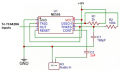
L293D Piezo

Audioguru again

Joined Oct 21, 2019
6,826
When the ICs are fairly close together then they share one 100uF capacitor for low frequencies and share one 0.1uF capacitor for high frequency decoupling.
A Li-PO and most other batteries are not rated in mA, instead they are rated in mAh which is how long a certain load current will last. A circuit does not use all of a battery's current that might be many amps for a Li-PO, the circuit uses only as much current as it needs. The preamp should use the same supply voltage as the other two ICs, not just 5V.

The LM358 preamp in the DIY project has a gain of 101 times for a low level microphone Your phone might produce 30 times more then the preamp will need much less gain to avoid severe distortion.
With the volume control on the phone turned up does your circuit work and play voices very clearly?
 

Thread Starter

Tryui

Joined Sep 20, 2021
202
When the ICs are fairly close together then they share one 100uF capacitor for low frequencies and share one 0.1uF capacitor for high frequency decoupling.
A Li-PO and most other batteries are not rated in mA, instead they are rated in mAh which is how long a certain load current will last. A circuit does not use all of a battery's current that might be many amps for a Li-PO, the circuit uses only as much current as it needs. The preamp should use the same supply voltage as the other two ICs, not just 5V.

Il preamp LM358 nel progetto DIY ha un guadagno di 101 volte per un microfono di basso livello Il tuo telefono potrebbe produrre 30 volte più poi il preamp avrà bisogno di molto meno guadagno per evitare gravi distorsioni.
Con il controllo del volume sul telefono che è apparso il tuo circuito funziona e suona le voci molto chiaramente?
happy new year 2023. Yes, the two ICs, the tc44288a and the 555, will be 3 cm close, but to improve I put two for each or if you tell me to put only two capacitors near the battery in such a way as to make them share between the two IC then I do like this. ok for the battery then I'll take a lipo 3s 12v and 2.2 Ah, not a transistor. I do the pwm modulation with the 555, but in the meantime I want to learn how to use the stm32, I will learn to program it even if Gene Hackman left the code on Github and it seems to me very similar to python. of transducers (piezo) I will put more than 7 because gene hackman has put 10 if I remember correctly in his circuit on youtube. so the only thing left is the preamp since a smartphone produces little power and I want a loud sound instead, which preamp ic do you recommend and how to mount it? I haven't built the circuit yet because now the piezos have to arrive
 

Audioguru again

Joined Oct 21, 2019
6,826
Both ICs should be close together on a pcb or on a compact stripboard layout.
The capacitors go close to both ICs, not close to the battery. We want the battery voltage at both ICs to be smoothly filtered by the capacitors, not jumping up and down with the signal.

All audio systems have detailed specs for power output and distortion. This project has no rated power output but I think it will be low. Someone said each transducer draws 10mA from 40V which is a power output of only 0.4W.
But you do not have 40V RMS, instead you have 24Vp-p which is 8.4V RMS and the current will also be reduced to 6mA. Then each transducer will produce only 8.5V x 6mA= 0.05W which is almost nothing.

The DIY video has 20 transducers then its power output is 0.05W x 20= 1W. Like a cheap clock radio max loudness.
A preamp produces more sensitivity to low levels, not more power.

Your battery power is 12V x 2200mA=26.4W. so it should play this project for 26.4 hours for each charge.
The battery power is draining all the time since the 40kHz is playing all the time.
 

Thread Starter

Tryui

Joined Sep 20, 2021
202
Both ICs should be close together on a pcb or on a compact stripboard layout.
The capacitors go close to both ICs, not close to the battery. We want the battery voltage at both ICs to be smoothly filtered by the capacitors, not jumping up and down with the signal.

All audio systems have detailed specs for power output and distortion. This project has no rated power output but I think it will be low. Someone said each transducer draws 10mA from 40V which is a power output of only 0.4W.
Ma non avete 40V RMS, invece avete 24Vp-p che è 8,4V RMS e la corrente sarà anche ridotta a 6mA. Poi ogni trasduttore produrrà solo 8,5V x 6mA= 0,05W che non è quasi nulla.

Il video DIY ha 20 trasduttori, poi la sua produzione di energia è 0,05W x 20= 1W. Come una radio a basso costo.
Un preamp produce più sensibilità ai bassi livelli, non più potere.

La vostra potenza di batteria è 12V x 2200mA=26.4W. quindi dovrebbe svolgere questo progetto per 26,4 ore per ogni carica.
La potenza della batteria si sta drenando tutto il tempo da quando il 40kHz sta giocando sempre.
the values I reported of the piezos were told to me by an Italian electronic engineer, he too used them and I too had arrived at which piezos consume 0.05W of power. so what do I do for the preamp ic, do I put it?
 

Audioguru again

Joined Oct 21, 2019
6,826
Try the circuit without a preamp and slowly turn up the volume control on the phone.
If the audio level from this project increases as the volume is being increased then reaches maximum volume without severe distortion then a preamp will allow more output level.
When the output produces severe distortion then that is the maximum loudness and the volume should be turned down a little so there is no distortion.

The You Tube circuit with all the errors uses a 0.1uF capacitor for C2 that feeds audio to the 555 pin 5. Then mens voices will sound tinny like chipmunks because the capacitor should be 1uF for it to pass low audio frequencies.
 

Thread Starter

Tryui

Joined Sep 20, 2021
202
Try the circuit without a preamp and slowly turn up the volume control on the phone.
If the audio level from this project increases as the volume is being increased then reaches maximum volume without severe distortion then a preamp will allow more output level.
When the output produces severe distortion then that is the maximum loudness and the volume should be turned down a little so there is no distortion.

The You Tube circuit with all the errors uses a 0.1uF capacitor for C2 that feeds audio to the 555 pin 5. Then mens voices will sound tinny like chipmunks because the capacitor should be 1uF for it to pass low audio frequencies.
ok for now I won't insert the preamp, so the capacitor C2 instead of 0.1 microfarad, I'll put one of 1 microfarad right?
 

Thread Starter

Tryui

Joined Sep 20, 2021
202
I would NEVER buy one tiny 470uF/4V ceramic capacitor for $13.50 US made by a company "over there".
I wonder if it is more microphonic than a microphone?
Audioguru one last question, but are you really sure that 12V to power the 555 is ok? all the projects i'm seeing use 5V, what do you think is better?
 

Audioguru again

Joined Oct 21, 2019
6,826
The maximum allowed input voltage for an old L293 that does not work in this circuit is only 7V then the NE555 needs a supply voltage less than about 8V.
The maximum allowed input voltage for the TC4478A is 0.3V higher than its supply voltage that you want as 12V.
The maximum allowed supply voltage for the NE555 is 16V so 12V is fine and does not need a 5V regulator.

Notice that the modern circuit uses a TC4427A Transducers driver being fed differential (complementary) inputs from a processor. The 555 circuit needs to have a TC4428A driver IC that produces differential (complementary) outputs when both its inputs are fed from the output of the NE555.
 

Thread Starter

Tryui

Joined Sep 20, 2021
202
The maximum allowed input voltage for an old L293 that does not work in this circuit is only 7V then the NE555 needs a supply voltage less than about 8V.
The maximum allowed input voltage for the TC4478A is 0.3V higher than its supply voltage that you want as 12V.
The maximum allowed supply voltage for the NE555 is 16V so 12V is fine and does not need a 5V regulator.

Notice that the modern circuit uses a TC4427A Transducers driver being fed differential (complementary) inputs from a processor. The 555 circuit needs to have a TC4428A driver IC that produces differential (complementary) outputs when both its inputs are fed from the output of the NE555.
Ok im understand thank you so much
 

Thread Starter

Tryui

Joined Sep 20, 2021
202
The maximum allowed input voltage for an old L293 that does not work in this circuit is only 7V then the NE555 needs a supply voltage less than about 8V.
The maximum allowed input voltage for the TC4478A is 0.3V higher than its supply voltage that you want as 12V.
The maximum allowed supply voltage for the NE555 is 16V so 12V is fine and does not need a 5V regulator.

Notice that the modern circuit uses a TC4427A Transducers driver being fed differential (complementary) inputs from a processor. The 555 circuit needs to have a TC4428A driver IC that produces differential (complementary) outputs when both its inputs are fed from the output of the NE555.
audioguru sorry if I bother you again, but I had read in an article that the tc4428a at the inputs A and B accepts a maximum of 5.4v, but if they receive the signal from the output of the 555 which is powered with 12V do they risk burning? they told me to use a voltage divider. and then another question what polarity do the outputs of the tc4428a have? ouput A is positive and output B is negative
 

MisterBill2

Joined Jan 23, 2018
27,620
Certainly a voltage divider can work, but I suggest looking at the actual specification sheet. That 5.4 volts max might be for operation with a 5 volt supply.
 

Thread Starter

Tryui

Joined Sep 20, 2021
202
Certainly a voltage divider can work, but I suggest looking at the actual specification sheet. That 5.4 volts max might be for operation with a 5 volt supply.
those 5.4 V are the maximum voltage allowed not for Vcc of the TC4428A, but for the two input pins A and B, but I have a lm7805, which I put at 555 so I'm sure that the output of the 555 is lower than 5v, also because with the voltage divider, it's more complicated but I know how to do it, so which of the two methods do you recommend? and then the outputs of the tc44288a have a polarity to connect them to the piezos or can I connect output A to the positive or negative?
 

MisterBill2

Joined Jan 23, 2018
27,620
Certainly follow the spec sheet limits for the TC4482A device. I am not familiar with it, BUT certainly the spec sheet will be correct. As for polarities, I am not aware of a piezo device being polarized, but the last ones I worked with were PVDF, which is different.
 

Audioguru again

Joined Oct 21, 2019
6,826
The datasheet for the TC4428A says that the logic inputs maximum voltage is the supply voltage plus 0.3V.
If the 555 is powered from +12V then its max output voltage is +10.7V then nothing burns. The LM7805 is not needed.
The TC4428A has opposite polarity outputs that connect to the piezos. TC2844A output a can connect to the piezos + or to the piezos - and it does not matter. But the piezos must all have the same polarity because they are speakers that must all be in phase.
 

Thread Starter

Tryui

Joined Sep 20, 2021
202
The datasheet for the TC4428A says that the logic inputs maximum voltage is the supply voltage plus 0.3V.
If the 555 is powered from +12V then its max output voltage is +10.7V then nothing burns. The LM7805 is not needed.
The TC4428A has opposite polarity outputs that connect to the piezos. TC2844A output a can connect to the piezos + or to the piezos - and it does not matter. But the piezos must all have the same polarity because they are speakers that must all be in phase.
Ok thank you audio guru, you are always the best
 

MisterBill2

Joined Jan 23, 2018
27,620
The datasheet for the TC4428A says that the logic inputs maximum voltage is the supply voltage plus 0.3V.
If the 555 is powered from +12V then its max output voltage is +10.7V then nothing burns. The LM7805 is not needed.
The TC4428A has opposite polarity outputs that connect to the piezos. TC2844A output a can connect to the piezos + or to the piezos - and it does not matter. But the piezos must all have the same polarity because they are speakers that must all be in phase.
This is what I thought, because that is the case with most op-amps. And what the article did not mention, or was not understood, was that the 5.4 volt max for inputs was when the device was powered by 5.1 volts. That is why I stated to look at the device specifications sheet. There is so very much half-truths and just plain wrong stuff presented so that going to the manufacturers data is the best way to go. And a big "ThankYou" to AG for looking at the data sheet!!
 

Thread Starter

Tryui

Joined Sep 20, 2021
202
This is what I thought, because that is the case with most op-amps. And what the article did not mention, or was not understood, was that the 5.4 volt max for inputs was when the device was powered by 5.1 volts. That is why I stated to look at the device specifications sheet. There is so very much half-truths and just plain wrong stuff presented so that going to the manufacturers data is the best way to go. And a big "ThankYou" to AG for looking at the data sheet!!
ah so when in the datasheet it says "vcc + 0.3V to gnd -5v" it means that if the vcc is powered at 5v then the inputs must be powered at a maximum of 5.4v, ok ok I understand
 
Top