Kemo time switch - re latch relay??

Thread Starter

igotnoideawhatimdoing

Joined Sep 16, 2025
9
Hello,

First time on here, please go easy... I have a slight problem on a boat that i could use your assistance with.

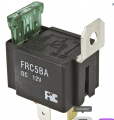
When I shower all the water goes into a sump which needs to be pumped out. In the sump is a float switch that activates a pump which pumps out all my rank shower water. Before there was a simple 12VDC 20 amp relay, however the pump would short cycle, turn on/off randomly which is no good. my fix was to install a time switch (Kemo #M113A) which works perfectly, well kinda.

My issue is if your really enjoying your shower and stay in longer than you should, the water level rises quicker than the pump can remove the water, and if the time switch times out, why the float switch is still up in the NC state, the timer will NOT re trigger, and in turn turn the pump on.

As im at my whits end Im reaching out to the internet for assistance. when you power cycle the time switch, it starts the timer automatically so im wondering if I could wire a relay into the float switch circuit, which would latch when the float was in NC (sump full), but then unlatch when the float switch changes to NO (sump empty), but im unsure how that is gonna work, or if there is another option using a diode and resistor/s?

(please dont laugh at my crude drawing)(im normally much better in life)Screenshot 2025-09-16 at 7.25.41 pm.png
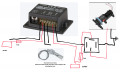
Im hoping someone has an idea how I can make this work. happy to buy you a coffee or a beer if you can help with my dirty delemour...
 

Ya’akov

Joined Jan 27, 2019
10,226
Welcome to AAC.

The simplest scheme (from what I surmise of the details) would be to run the float switch power (or ground) though the NC contacts of a really that is powered by the time switch output.

If the time switch is OFF, the float switch would send 12V (or 0V) to it's the START pin. However, if the time switch is ON, there is no power (or ground) going to the float switch and so when the time switch timed out, and the relay loses power, it would reconnect 12V (or 0V) to the start pin, recycling for as long as the float switch was ON.
 

Thread Starter

igotnoideawhatimdoing

Joined Sep 16, 2025
9
Hi Ya'akov,

Thank you so much for burning brain cells on my issue. So if i change the currently used 12VDC 20 Amp NO relay , with a NO/NC relay, and connect the float switch through terminals 87A and terminal 30, or would I need a seperate NC relay to operate the float? if thats the case im pretty sure thats an easy mod. and to be honest even to run a seperate relay in the float switch circuit is not a major issue.

Thank you again!
 

Ya’akov

Joined Jan 27, 2019
10,226
Hi Ya'akov,

Thank you so much for burning brain cells on my issue. So if i change the currently used 12VDC 20 Amp NO relay , with a NO/NC relay, and connect the float switch through terminals 87A and terminal 30, or would I need a seperate NC relay to operate the float? if thats the case im pretty sure thats an easy mod. and to be honest even to run a seperate relay in the float switch circuit is not a major issue.

Thank you again!
I don't know the pin numbering for automotive relays but let me ask a question before I write a confusing answer.

Does the time switch START pin require a voltage or to be pulled to ground (0V)?
 

Ya’akov

Joined Jan 27, 2019
10,226
I wanted to draw a schematic but I am having trouble with my usual tool, so—a narrative. Hopefully it will be clear...

SPDT or greater relay:

Coil connected across pump motor power
Common connected to time switch COM
NC connected to float switch

Float Switch:

Free contact connected to Start

OPERATION:

Time switch OFF
Float switch ON

The time switch start pin is pulled low through the NC contacts, starting the pump and pulling in the relay disconnecting the float switch and resetting the Start input. Time switch runs to time out.

Time switch TIME OUT
Float switch ON

The time switch drops its relay output shutting off the pump and dropping the float switch relay. The float switch reconnects to COM, pulling Start low and restarting the timer.


Time switch TIME OUT
Float switch OFF

The time switch drops its relay output shutting off the pump and dropping the float switch relay. The float switch reconnects to COM, but us open and so the timer does not restart.
 

Tonyr1084

Joined Sep 24, 2015
9,744
Your module is basically a one-shot, or a Mono-Stable Non-Retriggerable control. Once triggered it will run till it times out regardless of any further input. That's why your pump runs until it shuts off, then the module needs to be reset. I don't know if the "Stop" can act as a reset. Please provide a link to the module so we can get a better understanding of how it works.
 

Thread Starter

igotnoideawhatimdoing

Joined Sep 16, 2025
9

Thread Starter

igotnoideawhatimdoing

Joined Sep 16, 2025
9
I wanted to draw a schematic but I am having trouble with my usual tool, so—a narrative. Hopefully it will be clear...

SPDT or greater relay:

Coil connected across pump motor power
Common connected to time switch COM
NC connected to float switch

Float Switch:

Free contact connected to Start

OPERATION:

Time switch OFF
Float switch ON

The time switch start pin is pulled low through the NC contacts, starting the pump and pulling in the relay disconnecting the float switch and resetting the Start input. Time switch runs to time out.

Time switch TIME OUT
Float switch ON

The time switch drops its relay output shutting off the pump and dropping the float switch relay. The float switch reconnects to COM, pulling Start low and restarting the timer.


Time switch TIME OUT
Float switch OFF

The time switch drops its relay output shutting off the pump and dropping the float switch relay. The float switch reconnects to COM, but us open and so the timer does not restart.
Thank you Ya'akov, This makes perfect sense and im pretty sure i can make this work. thank you for your time!
 

Tonyr1084

Joined Sep 24, 2015
9,744
Ya’akov correct me if I'm wrong:
View attachment 355952
Makes a lot of sense to me. When the float closes it starts the timer. When the timer starts it closes the internal relay. The internal relay turns the pump on. It also turns the additional relay on, opening the Normally Closed contacts. The timer times out and the pump and additional relay shuts off. If the float is still closed the timer starts all over again. When the tank is sufficiently low the timer will not restart. BRILLIANT Ya'akkov!
 

Ya’akov

Joined Jan 27, 2019
10,226
Ya’akov correct me if I'm wrong:
View attachment 355952
Makes a lot of sense to me. When the float closes it starts the timer. When the timer starts it closes the internal relay. The internal relay turns the pump on. It also turns the additional relay on, opening the Normally Closed contacts. The timer times out and the pump and additional relay shuts off. If the float is still closed the timer starts all over again. When the tank is sufficiently low the timer will not restart. BRILLIANT Ya'akkov!
That's the theory. If there is any timing issue (short trigger), he'll need a one shot between the relay and the time switch. But I suspect it will work fine.

Thanks for the drawings!
 

Thread Starter

igotnoideawhatimdoing

Joined Sep 16, 2025
9
Hello, thank you both very much for your time with this project, you have helped me to no end! Its funny being a mechanic I can pull almost anything apart and put it back together, but electronics/circuits and I completely draw a blank!

Thank you again, and when i get back to the boat in a weeks time ill make the changes, and report back on the outcome.
 

MisterBill2

Joined Jan 23, 2018
27,164
It seems that I am a day late on an alternative pair of solutions. The first one is to copy the scheme that is used for most "Sump pumps". Those are usually centrifugal pumps used to empty an accumulation of water from a space that it accumulates in. The control is a maintained-position switch, operated by a float that travels on a rod. The process is that when the water level rises, the float pushes the switch up, switching the pump on. As the water is removed, the float slides down the rod, and eventually reaches the lower point so that it hits a stop on the rod, pulling it down, and moving the switch back to the off position. This scheme, with minor variations, has been used for at least 65 yrars, on thousands of sump pumps.
The second scheme uses two normally open float switches, one towards the bottom that is closed until the tank isempty. The other float switch is located at the top, and closes at the level where the tank must be emptied.
When the upper switch operates, it operates the relay that starts the pump and also latches with a "sealing" contact. The pump runs until the level drops so that the lower float switch opens, which is in series with the latching contact of the relay..
 
Top