Keep constant LED brightness between 3V and 1,8V

Thread Starter

Goxeman

Joined Feb 28, 2017
176
Hello,

I have a battery powered device with two AA batteries. I have LEDs and the problem, as it is expected, is that the LEDs brightness change as soon as the batteries drain.

The device works perfectly between 3V and 1,8V so I would like to use the all battery capacity, but it doesnt look good that the LEDs brightness is affected by the battery voltage level or even could almost turn off because you cant see them.

Within my device I have a new PIC MCU (works between 3,5V and 1,8V I think) and everything is powered directly from the two AA batteries


Thanks
 

Alec_t

Joined Sep 17, 2013
15,121
A DC-DC boost converter could raise the voltage to keep the LEDs at constant brightness. Unfortunately, the converter's current draw would probably drain the batteries quickly.
 

Sensacell

Joined Jun 19, 2012
3,785
What color LED? it matters because the Vf is different depending on color.

The tricky part is that the battery voltage begins above the LED Vf, then ends below it.
 

Thread Starter

Goxeman

Joined Feb 28, 2017
176
A DC-DC boost converter could raise the voltage to keep the LEDs at constant brightness. Unfortunately, the converter's current draw would probably drain the batteries quickly.
Yes, I dont consider that option because as you said the battery drain would be too fast. The option I am searching for has to be power efficient, that is what is keeping me thinking about the matter

What color LED? it matters because the Vf is different depending on color.

The tricky part is that the battery voltage begins above the LED Vf, then ends below it.
I am using 4 different colors, red (1,8V), green (1,8V), blue (2,7V) and white (2,7V). I could use all LEDs of 1,8V or all LEDs of 2,7V but in any case what is just affecting is the resistor value. At the end even if I use all LEDs 1,8V and with its proper resistor, the combination would be affected by the voltage drop
 

danadak

Joined Mar 10, 2018
4,057
Constant current source insures brightness, but added circuitry to do that
lowers overall effirciency.

Another approach use a photosensor, and a UP with PWM, A/D, in a control loop.
Based on photosensor output vary PWM duty cycle to control brightness.
Thats easy to do, ATTINY85 could do that. Or PSOC -

upload_2019-1-18_9-7-9.png

LED, R, Photosensor offship, the rest is inside PSOC chip. Just used a
fraction of overall PSOC chip resources.

Regards, Dana.
 

Attachments

crutschow

Joined Mar 14, 2008
38,532
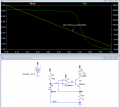
Below is the LTspice simulation of a low power, low voltage constant-current source.
It uses a micropower op amp, and the low forward voltage drop of a Schottky diode as a reference voltage.
The LED constant current is ≈160mV/R2.
The simulation shows the LED current fairly constant down to a battery voltage of ≈2V with a 1.8V LED (the slope is due to the change in D2 forward voltage with current).

Edited to use low cost (U$0.46 for 1k units), low voltage (1.8v-5.5V) op amp.
upload_2019-1-18_12-45-46.png
 
Last edited:

danadak

Joined Mar 10, 2018
4,057
Would be instructional to calc the total energy delivered in both methods,
PWM switched current source vs analog linear current source. That would
establish which gives most battery life for a fixed LED brightness.

Its complicated -

http://www.pathwaylighting.com/prod...Linear+vs+Logarithmic+Dimming+White+Paper.pdf

https://forum.allaboutcircuits.com/threads/led-brightness-vs-pwm.83957/

https://www.uv.es/~esanchis/cef/Caracteristicas/abd004.pdf

Then there is a G factor associated with persistence of vision, eg, brain seeing
LED on when PWM off, "filling in" light where there is none. Effectively reducing
energy needed by PWM approach......


Regards, Dana.
 
Last edited:
Top