KCL - Current Division Assistance

Thread Starter

10th&Bennett

Joined Apr 15, 2018
27
Possible breakthrough! Ok now I'm hopefully seeing where they are finally getting the 6A as source, since we have the 8V across both resistors, and divide that by the Req (4/3 Ohms) and you get 6A for the current (I= V/R).

But what about that 5 Ohm resistor? It would be in series with Req I thought.

What direction is that current 'I' flowing in the 4 Ω resistor?

I selected the clockwise direction, but the thing is that current "splits" in two directions at the node. So from the note yesterday, going in the loop all of the current flows were positive.
 

WBahn

Joined Mar 31, 2012
32,848
Possible breakthrough! Ok now I'm hopefully seeing where they are finally getting the 6A as source, since we have the 8V across both resistors, and divide that by the Req (4/3 Ohms) and you get 6A for the current (I= V/R).

But what about that 5 Ohm resistor? It would be in series with Req I thought.
It is. So what? The 6A is flowing in the current source, the 5 Ω resistor, and the equivalent resistance of the two parallel resistors precisely because all three are in series and that's what it means to be in series.

What direction is that current 'I' flowing in the 4 Ω resistor?

I selected the clockwise direction, but the thing is that current "splits" in two directions at the node. So from the note yesterday, going in the loop all of the current flows were positive.
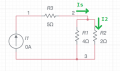
Yep, that I is flowing clockwise in the 4 Ω resistor, which is upward. So you have a current of -2 A flowing upward in that resistor and a current of 4 A flowing down in the 2 Ω resistor. So how much current must be flowing into that node from the 5 Ω resistor?


Now let's go back to the current divider equation and see how we could have solved for the source current directly using just that.

Prob3.png

The current divider equation tells us that

\(I_2 \; = \; I_S \frac {R_1}{R_1 \; + \; R_2}\)

We know I2 (4 A), we know R1 (4 Ω) and we know R2 (2 Ω). So solve for Is.

\(I_S \; = \; I_2 \frac {R_1 \; + \; R_2}{R_1}\)
 

Thread Starter

10th&Bennett

Joined Apr 15, 2018
27
Ah ok, I see. Thank you. So you can solve this problem solely with KVL and Ohms Law, but current division makes the process quicker (if you know what you're doing).

So my last follow up - can all circuit problems be broken down to KVL, KCL, and Ohms Law?
 

WBahn

Joined Mar 31, 2012
32,848
Ah ok, I see. Thank you. So you can solve this problem solely with KVL and Ohms Law, but current division makes the process quicker (if you know what you're doing).

So my last follow up - can all circuit problems be broken down to KVL, KCL, and Ohms Law?
If we are talking about circuits containing nothing but resistors and linear voltage and current sources, then yes. Everything else are just shortcuts and systematic ways of applying them so that we can do the work much more easily and with a much greater chance of making mistakes that we don't catch.
 

WBahn

Joined Mar 31, 2012
32,848
You may need to use superposition if the circuit contains multiple power sources.
I'd be very interested in seeing an example of such a circuit. I can't think of such a situation off the top of my head, even if the sources are dependent.
 

WBahn

Joined Mar 31, 2012
32,848
Wait wait please don't confuse me!!! So I guess it is possible to solve a circuit just based on KVL, KCL, and Ohm's?
Under the constraints I mentioned. Once you add other components, such as capacitors, inductors, diodes, transistors, etc., you need the constitutive equations for those devices (Ohm's Law is merely the constitutive equation for a linear resistor). These are sufficient to solve all problems using these components, but the process gets real ugly real fast, so we have developed many powerful analysis techniques to streamline the process considerably.

Another step up is when you start talking about electromagnetic effects and at that point KVL simply doesn't hold and you have to step back even further into the fundamentals of Maxwell's Equations, but we have then developed powerful analysis techniques that are applicable for those situations, too. Then we move into high frequency circuits (circuits where the wavelengths are on the order of or less than the circuit's physical dimensions) and the assumptions we made about the voltage being the same everywhere along a node and current being the same everywhere along a series path no longer hold. But, again, we've developed techniques to help us out there, as well.
 

Thread Starter

10th&Bennett

Joined Apr 15, 2018
27
Phew thanks @WBahn! Ok, eventually I'll get to those components, but I want to start slow and build up. Thanks for all your help so far. Long ways to go, but not going to give up.
 

WBahn

Joined Mar 31, 2012
32,848
Phew thanks @WBahn! Ok, eventually I'll get to those components, but I want to start slow and build up. Thanks for all your help so far. Long ways to go, but not going to give up.
Vanishingly few people can learn this stuff at first blush. It takes years and few ever master any significant fraction of the whole -- you dive deep into the parts you need for what you do and let others deal with the other stuff because you haven't delved deep enough into those waters to do a good job.
 
Top