Current Division in the Circuit.

Jony130

Joined Feb 17, 2009
5,593
First, you need to solve for I1. But you need to include 125 ohms resistor also in your calculations and combine the rest of the resistors.
Also (40Ω + 20Ω)||240Ω is not equal to 34.7Ω
So check your math.
 

Jony130

Joined Feb 17, 2009
5,593
OK, I see what you have done. But this is wrong. The 125 ohms resistor is on the left side and for sure he is not in parallel with (40Ω + 20Ω)||240Ω.

Also, why did you skip 2 ohms resistor?
 

Thread Starter

hunter6

Joined Feb 22, 2018
35
OK, I see what you have done. But this is wrong. The 125 ohms resistor is on the left side and for sure he is not in parallel with (40Ω + 20Ω)||240Ω.

Also, why did you skip 2 ohms resistor?
It's all correct now, But I'm not sure what to do next
 

Jony130

Joined Feb 17, 2009
5,593
Very good. First, solve for I1 by using current divider rule.


I1 = 120mA * ???


And by knowing I1 current you can use I1 and solve for I2 again by using the current divider rule.

I2 = I1 * ???
 

Thread Starter

hunter6

Joined Feb 22, 2018
35
Very good. First, solve for I1 by using current divider rule.


I1 = 120mA * ???


And by knowing I1 current you can use I1 and solve for I2 again by using the current divider rule.

I2 = I1 * ???
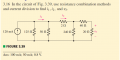
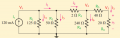
Is = 120mA , and we have to find I1 , I2 and V3.
 

Thread Starter

hunter6

Joined Feb 22, 2018
35
Very good. First, solve for I1 by using current divider rule.


I1 = 120mA * ???


And by knowing I1 current you can use I1 and solve for I2 again by using the current divider rule.

I2 = I1 * ???
I'm getting 50mA for both the currents , it's wrong . As I1=100mA and I2=50mA. please help
 

Thread Starter

hunter6

Joined Feb 22, 2018
35
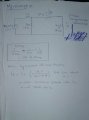
let R1= 125 ohm, Ri1= 50 ohm(for i1) , Ri2(for i2)

I1= 120mA * ( Ri2 || R1 / (Ri2||R1) +Ri1)

=120 * (34.7 / (50+34.7)) = 50mA.
 

Jony130

Joined Feb 17, 2009
5,593
Wrong
120 * (34.7 / (50+34.7)) = 49.161mA which is wrong


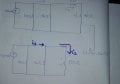
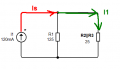
You need to back to this diagram

1.png

From KCL we can see that

Is = Ix + I1


and

I1 = Iy + I2

And to be able to find I1 you need to know the equivalent resistance for R2 and R3

Where
R3 = 2Ω + ((40Ω + 20Ω)||240Ω) = 2Ω + 48Ω = 50Ω

So the equivalent resistance is Rx = R2||R2 = do you know this value ?

Can you solve for I1?
 

Attachments

WBahn

Joined Mar 31, 2012
32,745
One mistake that you are consistently making and that will bite you when the time comes is that you are carrying v3 in all of your diagrams and it is NOT v3. The voltage v3 is the voltage across the 20 Ω resistor in the original circuit. It is NOT equal to ANY of the voltages you have it associated with in any of your diagrams. So you need to either leave it off, or adjust things so that the relationships are correct. At this point in your learning, I'd recommend just leaving it off the modified diagrams.

Then approach things one step at a time. The first step is to find I1. So ONLY worry about finding I1. Forget that there are other currents that you need to solve for. How would you find I1 if that was ALL you needed to do?

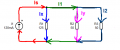
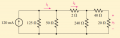
Here's your starting point.
problem.png

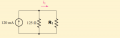
The first problem you want to solve using current division is
problemI1a.png

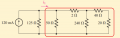
So R1 needs to be the equivalent resistance of all the resistors in the red box as seen at the point where the wires cross the box.
problemI1.png

Once you have I1, the follow this same approach to get I2.

Then find I3 (not shown), which would be the current flowing through the 20 Ω resistor.
 

Thread Starter

hunter6

Joined Feb 22, 2018
35
One mistake that you are consistently making and that will bite you when the time comes is that you are carrying v3 in all of your diagrams and it is NOT v3. The voltage v3 is the voltage across the 20 Ω resistor in the original circuit. It is NOT equal to ANY of the voltages you have it associated with in any of your diagrams. So you need to either leave it off, or adjust things so that the relationships are correct. At this point in your learning, I'd recommend just leaving it off the modified diagrams.

Then approach things one step at a time. The first step is to find I1. So ONLY worry about finding I1. Forget that there are other currents that you need to solve for. How would you find I1 if that was ALL you needed to do?

Here's your starting point.
View attachment 146895

The first problem you want to solve using current division is
View attachment 146897

So R1 needs to be the equivalent resistance of all the resistors in the red box as seen at the point where the wires cross the box.
View attachment 146896

Once you have I1, the follow this same approach to get I2.

Then find I3 (not shown), which would be the current flowing through the 20 Ω resistor.
Thanks for your guidance , I'll try it again and respond.
 

Thread Starter

hunter6

Joined Feb 22, 2018
35
One mistake that you are consistently making and that will bite you when the time comes is that you are carrying v3 in all of your diagrams and it is NOT v3. The voltage v3 is the voltage across the 20 Ω resistor in the original circuit. It is NOT equal to ANY of the voltages you have it associated with in any of your diagrams. So you need to either leave it off, or adjust things so that the relationships are correct. At this point in your learning, I'd recommend just leaving it off the modified diagrams.

Then approach things one step at a time. The first step is to find I1. So ONLY worry about finding I1. Forget that there are other currents that you need to solve for. How would you find I1 if that was ALL you needed to do?

Here's your starting point.
View attachment 146895

The first problem you want to solve using current division is
View attachment 146897

So R1 needs to be the equivalent resistance of all the resistors in the red box as seen at the point where the wires cross the box.
View attachment 146896

Once you have I1, the follow this same approach to get I2.

Then find I3 (not shown), which would be the current flowing through the 20 Ω resistor.

Thanks! , I was able to find out both the currents correctly by this approach. But for the voltage what should I do? I'm Applying KCL at the "Node joining 2 ohms and 40 ohms" as i1+i2=i3 . But I'm getting the wrong value for i3 for which the voltage V3 will be 0.8volts (as provided in the answers) .
 

Jony130

Joined Feb 17, 2009
5,593
If you know I2 use a current divider and solve for the current that is flowing (40Ω +20Ω) resistors. And solve for V3 = 20Ω*I
 

WBahn

Joined Mar 31, 2012
32,745
Thanks! , I was able to find out both the currents correctly by this approach. But for the voltage what should I do? I'm Applying KCL at the "Node joining 2 ohms and 40 ohms" as i1+i2=i3 . But I'm getting the wrong value for i3 for which the voltage V3 will be 0.8volts (as provided in the answers) .
It would REALLY help if you showed your work!

If you have i2, then just use the exact same procedure as before (current division) to find how much current flows down through the 240 Ω resistor and how much flows into the equivalent resistance of everything to the right of that resistor. Once you know how much current flows into the resistance to the right, do you not now know how much current is flowing in the 20 Ω resistor across which is the voltage you are looking for?
 

Thread Starter

hunter6

Joined Feb 22, 2018
35
It would REALLY help if you showed your work!

If you have i2, then just use the exact same procedure as before (current division) to find how much current flows down through the 240 Ω resistor and how much flows into the equivalent resistance of everything to the right of that resistor. Once you know how much current flows into the resistance to the right, do you not now know how much current is flowing in the 20 Ω resistor across which is the voltage you are looking for?
Yes , I was able to solve the whole question Yesterday , and was able to find the current flowing through 20 ohms . I'm very thankful for the help !
 

WBahn

Joined Mar 31, 2012
32,745
Yes , I was able to solve the whole question Yesterday , and was able to find the current flowing through 20 ohms . I'm very thankful for the help !
Glad you got it. Now that you have, let's look at some options. I know that the instructions told you to use current division and resistance combinations, but let's consider other approaches that could have been used had you not had that constraint. Or, even with that constraint, could be used to verify the correctness of your answers.

Let's reduce the resistors to a since effective resistance that will let us determine the voltage across the current source. In doing so, we will keep track of the relationship of v3 to the reductions we make.

I've annotated the original diagram to aid communication:

problem.png

Before reducing R5 and R6, note that

V3 = V2 * [20 Ω / (20 Ω + 40 Ω)] = V2/3

No we place R4, R5 and R6 with

R456 = R4 || (R5 + R6) = 48 Ω

Next we node that

V2 = Vs * [48 Ω / (48 Ω + 2 Ω)] = 0.96·Vs

Therefore

V3 = V2/3 = (0.96·Vs)/3 = 0.32·Vs

Now once we get Vs, we can immediately solve for V3.

After combining R456 with R3 to get

R3456 = 50 Ω

we can quickly determine the total equivalent resistance as

Req = R1 || R2 || R3456 = 125 Ω || 50 Ω || 50 Ω = 20.833 Ω

Therefore

Vs = Is·Req = 120 mA · 20.833 Ω = 2.5 V

V3 = 0.32·Vs = 0.32 · 2.5 V = 0.8 V

I4 = Vs / R1 = 2.5 V / 125 Ω = 20 mA

I1 = Is - I4 = 120 mA - 20 mA = 100 mA

I5 = Vs / R2 = 2.5 V / 50 Ω = 50 mA

I2 = I1 - I5 = 100 mA - 50 mA = 50 mA

Sanity check: It makes sense that I2 is 50 mA since the total resistance that it is flowing through is also 50 Ω.

We now have the three things we were asked for, but we should check our answers for consistency. We can do that by continuing down this road and finding V2 and confirming that it is 3x our V3 (or 2.4 V) and finding I3 and confirm that it is V3/R6 (or 40 mA). If those two things are correct, we have very high confidence that our answers are correct.

V2 = Vs - I2·R3 = 2.5 V - (50 mA · 2 Ω) = 2.4 V (check)

I6 = V2 / R4 = 2.4 V / 240 Ω = 10 mA

I3 = I2 - I6 = 50 mA - 10 mA = 40 mA (check)
 
Top