I've seen high prices at specialty stores before but this is crazy

WBahn

Joined Mar 31, 2012
33,076
Not my problem where the money came from.

Do yo worry about where other peoples money comes from when they buy something from you or if they get audited that their auditor is going to track you down and question you about what you sold and why?

I never have.
If you are the person that bought the transistor (and then later sold the tube), when you get audited they are going to be asking where the money came from that you bought the transistor with. If the other guy gets audited and they see that someone bought a transistor for tens of thousands of times the reasonable market price, they are likely to take steps that result in auditors knocking on your door.

Now, the claim that you are simply a really bad business person and are eccentric and thought it would be cool to have a $25k transistor and that it might have investment value might fly to some degree. But when you bought it with money that appeared out of thin air -- well, that is probably not going to fly (since the whole point of laundering money is that having money appear out of thin air doesn't fly very well).


If something turns up in the audit (done as part of an investigation, particularly a federal criminal investigation) of someone that you've done business with, then the investigators are very likely to track you down and question your side of the transaction. If you can't satisfy them that you are on the up and up, then they can expand their investigation to include you. Happens all the time. Even if the audit was not in conjunction with a criminal probe they are likely to bring the matter to the attention of the FBI, the IRS, and whatever other agencies they think might be appropriate.
 

joeyd999

Joined Jun 6, 2011
6,441
Not my problem where the money came from.

Do yo worry about where other peoples money comes from when they buy something from you or if they get audited that their auditor is going to track you down and question you about what you sold and why?

I never have.
I remember back in the '80s, I read that nearly every $20 bill in circulation had traces of cocaine on it. Not sure this is true, but having lived in Miami (in the days of Miami Vice), I believed it.
 

WBahn

Joined Mar 31, 2012
33,076
I once talked to a vendor about a similar situation with his website. He said that it was priced like that when they were out of stock on an item. The software that he ran caused so many problems when it came to removing the item, then replacing it when the item came back into stock that it caused him to grossly inflate the price so nobody would order it until it came back into stock. It seems stupid to do it like this, but sometimes the website designers did such a crappy site design that terrible work-arounds were forced on the vendor.
Then I'd say that the vendor should probably hire a different web designer. There's no shortage of even canned shopping carts that are capable of handling out of stock conditions just fine. They show the potential buyer that the item is out of stock (if only by simply reporting: In Stock: 0) and if the person tries to buy the item anyway it tells them that the item will be placed on backorder.
 

tcmtech

Joined Nov 4, 2013
2,867
Okay. Fine. Poor example on my part. Frigging antique vehicle or tractor or something bigger that can be claimed as having sentimental value or some crap like that. :rolleyes:

It can easily be done being not every single person gets audited every time they suposedly bought something of high dollar value stuff.

My apparently poorly made point was it's easy enough to slip though the cracks if you know what you are doing and don't act suspicious. Hide in plain site and make yourself look too obvious to be purposely doing something wrong. It works very well blah blah blah and stuff. :rolleyes:
 

WBahn

Joined Mar 31, 2012
33,076
Oh I agree. Laundering reasonably small amounts of money is pretty easy to do. Someone that needs to launder a few tens of thousands of dollars (or probably even a couple hundred thousand dollars) one time can do it pretty easily. In most cases they really don't even need to launder it at all -- just spend it over a reasonable amount of time on things that don't draw attention to yourself; go on a $30k vacation instead of buying a $30k boat or car. Most people in that situation aren't really trying to launder money, but rather avoid paying taxes on the money, which is a very different goal. Large and on-going money laundering operations usually make little attempt to avoid taxes -- they want Uncle Sam to have no reason to even consider auditing them and, if they do get audited they want it to be plainly obvious right away that any refiguring of the tax bill is going to result in a considerable refund. They view the taxes as just another routine cut being taken in the laundering process. But by the same token, such operations are not trying to just launder a couple hundred grand, but rather millions and millions (and sometimes billions) of dollars year after year. They can't operate on the assumption that they are safe because their odds of getting audited based on a single transaction are real low -- they have to assume that law of averages is going to catch up to them sooner or later (and probably more than once) and that they WILL get audited and investigated at some point.
 

Thread Starter

GopherT

Joined Nov 23, 2012
8,009
Every CASH transaction over $10k must have paperwork submitted to the IRS by the receiving "person".

Trying to get money into the system is much more difficult as the fed shifted policy from war on drug dealers to war on drug money. Having the IRS and DEA confiscating cash and using that cash to self-fund agencies has proven much more palatable to lawmakers than spending billions of tax dollars to find and confiscate drugs.

Thinking a one-time cash transaction of millions of dollars will go unnoticed under the radar is foolish. Even thinking you can take a $30k vacation and pay cash is crazy. Taking more than 10k in or out of the US must be reported and cross-reporting of expenditures by other governments back to the US is now common. When a hotel asks for your passport as ID, the info and room rate is delivered to Uncle Sam.

https://www.irs.gov/businesses/smal...300-and-reporting-cash-payments-of-over-10000
 
Last edited:

WBahn

Joined Mar 31, 2012
33,076
No one has talked about making one-time cash transactions of millions of dollars.

Making a law saying that more than $10k going in or out of the country must be reported does not mean that people that don't want to report taking $10k in cash out of the country are going to actually report it. Last time I went out of the country (a couple years ago) I took about $4k in cash and just left it in my pants pocket as I went through customs and security. Why do I suspect that I could have taken $20k or $30k through without any problems?

I don't care if the hotel reports my room rate; I'm not trying to hide all of my expenditures -- in fact I don't WANT to hide ALL of my expenditures. I want it to look like I took a nice vacation largely on the cheap and spent a lot of time relaxing on the beach reading books, snorkeling in the local lagoon, and doing a few free and low-cost things here and there. In reality, I did a couple dozen scuba dives, ate at high end restaurants, attended a half dozen fancy social events, spent a week on a catamaran, and was almost constantly doing high-cost things that all accept cash, either directly or indirectly -- for instance I'm not going to rent the catamaran, but rather I'm going to just be a passenger and split the costs with a few others of whom one of them is going to rent it. I can easily make a $30k vacation look like a $5k vacation via cash expenditures in ways that won't raise eyebrows. This is particularly true if I'm doing this as a one-time thing where my concern is avoiding getting caught after the fact.

If this is part of a much larger, longer-term activity then I have to consider the possibility that I'm already being looked at and so someone is observing me not spending all day relaxing on the beach reading a book. But there are plenty of ways to launder larger sums of money, many of which involve breaking it into relatively small transactions made over time by multiple people as it passes through the anti-money laundering traps and filters. Furthermore, once you are talking about that kind of money, you are also in the realm where there are plenty of people willing to do this for you, for a cut, who do this for a living and have a vested interested in keeping up to date on all the traps and filters and how to get around them.
 

tcmtech

Joined Nov 4, 2013
2,867
Yep same here. I have done as much of my general spending with cash as I can all my life. How I look on paper does not translate to how I look in cash.

As far as 10K in cash goes that's easy. Just take less than that out or put in the bank at any single transaction.

And yes I too was not talking about high volume millions or billions laundering either. Doing small scale under say $50 - $100K a year can be done easily right in the open using common processes we all use or have access to and not raise any attention at all.
 

WBahn

Joined Mar 31, 2012
33,076
Yep same here. I have done as much of my general spending with cash as I can all my life. How I look on paper does not translate to how I look in cash.

As far as 10K in cash goes that's easy. Just take less than that out or put in the bank at any single transaction.

And yes I too was not talking about high volume millions or billions laundering either. Doing small scale under say $50 - $100K a year can be done easily right in the open using common processes we all use or have access to and not raise any attention at all.
Yep -- it's particularly easy to do if you take care that doing so results in few residual tangible assets or an easily spotted increase in lifestyle beyond your means. But someone that makes $40k (on paper) can make an additional $100k disappear pretty easily with just a modicum of thought and care, especially if they provide "services" as a side business and bring some fraction of it into the open. Again, most people operating at this scale are seldom actually trying to launder money, but rather evade taxes.

Interestingly I did somewhat the reverse of that a couple decades ago. I has a sideline business and I wanted to purchase some equipment but that year I knew I wasn't going to have much income at all. But I didn't want to show a loss because I had shown a loss the prior two years and I didn't want to lose the presumption of profit seeking going forward. So I talked to the IRS and found out that they don't have any problem with someone reporting more income than they actually received (although they might in conjunction with something like the earned income credit where in some circumstances you get more of a credit as your income goes up -- but that was completely aside from the conversation I was having with them). So I reported a few thousand dollars more in income than I had actually received as well as not claiming all of the deductions I was entitled to. But since then I've wondered if the IRS's position was very well thought through since over-reporting income on tax returns can be used to become eligible for loans (particularly home mortgages) and other things that you really don't qualify for. I suspect that this would fall under fraud laws even if the over-reporting itself is legal since you are using the returns, however legal, to materially misrepresent your situation to the lender.
 

tcmtech

Joined Nov 4, 2013
2,867
Personally I have never had any issues with paying in on taxes. The way I look at it is simple.

Would you rather make <$20K a year and get $500 back from the government or would you rather make $100K a year and pay $35K in? o_O

I've been on both ends and I can say for certain that making the $100K and taking $35K out is a way better lifestyle than making <$20K and getting the $500 back. :D

To be honest I know I worked harder in those jobs for that <$20K a year than I did in the ~$100K a year work. ;)
 

WBahn

Joined Mar 31, 2012
33,076
Sadly, there are lots of people that are perfectly happy making under $20k/year and getting far, far, far more than $500 from the government. A few years ago there was a spate of investigative stories demonstrating how many people receive so much in state and federal assistance that a single mother of two making $18k had a disposable income that matched that of someone making over $76k in the same situation but receiving no government help. In one state (PA) the equivalent income was over $90k.

But that's on a completely different track than what we are talking about here. So the question here is would you rather make $100k and pay $35k in taxes or make $100k and pay $3k.

Actually, if you make $100k then the most federal income tax you should pay would be about $18k since, even filing 1040EZ (let's call the income $99,999 so you can use it) as a single person you tax liability would be $18.2k. If you are married filing jointly on a 1040EZ, then the tax liability is only $11.4k.

A few years ago my revenue into the house was a bit over $90k. Since I brought most of it into the business I was able to expense most of it away on tax-exempt employee benefits (I hired my wife) and other expenses such as home office, utilities, transportation, and depreciation -- all perfectly legitimate above board. At the end of the day my total federal income tax liability was $18. Had I just brought it in without carefully expensing in the business our federal income tax liability would have been about $9k. But we save a lot more than that because self-employment tax would have taken the total up into the $23+k range whereas the FICA taxes on my employee (both sides) brought the actual total to about $5k, IIRC. After taking into account the impact on our state taxes we got nearly all of that back. So, in one sense, we paid essentially zero in taxes to the federal government (both income and payroll) and just pad somewhat less than would we would have expected to pay in State taxes along. The net savings was in the $24k range, IIRC. Yes, it involved a lot of time spent researching the tax code and running all kinds of alternative scenarios, but my total time spent on it was probably well under 50 hours (and, as a math nerd, it was mostly fun!). Pretty good return on investment.
 

tcmtech

Joined Nov 4, 2013
2,867
Actually, if you make $100k then the most federal income tax you should pay would be about $18k since, even filing 1040EZ (let's call the income $99,999 so you can use it) as a single person you tax liability would be $18.2k. If you are married filing jointly on a 1040EZ, then the tax liability is only $11.4k.
Well they most certainly disagreed with that when I was in the oil fields. :(

I took zero deductions and maximum withholding plus opted to pay an extra $100 out towards taxes and still got hit for several thousand to pay in after that. Total pay for one year fell at just short of $100K and just a hair over $34 K went to taxes related stuff.

Maybe if a guy makes $100K on a 40 hour a week 2000 hour a year base they don't stick it to you but if you do it on a 3000+ hour work year they stick it to you big time. :mad:
 

WBahn

Joined Mar 31, 2012
33,076
Well they most certainly disagreed with that when I was in the oil fields. :(

I took zero deductions and maximum withholding plus opted to pay an extra $100 out towards taxes and still got hit for several thousand to pay in after that. Total pay for one year fell at just short of $100K and just a hair over $34 K went to taxes related stuff.

Maybe if a guy makes $100K on a 40 hour a week 2000 hour a year base they don't stick it to you but if you do it on a 3000+ hour work year they stick it to you big time. :mad:
How does that work? I've never seen a single tax form that asked how many hours you worked. Or, for that matter, a form that cared whether you got all your income from one job or five jobs.

Why did you have to pay a penny more than what you would have had to pay filling out a 1040-EZ?
 

JoeJester

Joined Apr 26, 2005
4,390
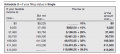
Here is the 2015 Tax Rate for a single person.

If you paid more than the specified rate, something is amiss.

2015-TaxRate-single.png

For 100k income the tax is 21,071.25 Federal Taxes

What was your State taxes?

On edit, ND income tax is 2.27 % for income near 100k. So add another 2270 to your taxes.

just a hair over $34 K went to taxes related stuff.
There must be alot of "related stuff" in there to make up that additional 10k.
 
Last edited:

WBahn

Joined Mar 31, 2012
33,076
Here is the 2015 Tax Rate for a single person.

If you paid more than the specified rate, something is amiss.

View attachment 110717

For 100k income the tax is 21,071.25 Federal Taxes
But that is not taking into account the standard exemption and standard deduction, which for 2015 was $4000 and $6300, respectively. So that would bring the taxable income down to $89,700 making the federal income tax $18,218.75.

The employee portion of the payroll tax would add another $7,650 but the employer would have paid that and it would not have been reflected in the tax return. Unless he's being paid as a contactor and having to file Form C and pay self-employment tax, in which case it would add $15,300 if he didn't expense anything, though his income tax would have been reduced by about $1400.

What other things could increase your tax bill above the single rate? The value of any taxable benefits should be included in the $100k figure.

@tcmtech: Don't feel like we are pushing you to reveal anything you don't want to. For my part I'm just interested in further exploring the tax code.
 

Aleph(0)

Joined Mar 14, 2015
597
What other things could increase your tax bill above the single rate?
Wbahn I say capital gains tax is the real killer:mad:! And it's just mean spirited cuz its like they're trying to penalize success and good judgment with investment! Anyhow I agree that income tax is unfair too cuz rate shouldn't increase with income:mad:! It's morally totally wrong and also it's disincentivizing hard work! I know flat tax has snags but it's fairest idea I've heard cuz no one should have to pay like 40% of their income to just feds:rolleyes:!
 
Last edited:

tcmtech

Joined Nov 4, 2013
2,867
How does that work? I've never seen a single tax form that asked how many hours you worked. Or, for that matter, a form that cared whether you got all your income from one job or five jobs.
Ever work hourly and look at your take home pay per paycheck Vs hours worked? I always have and depending on how much I made most of my jobs I have had in my life there was a tipping point in overtime pay were it literally didn't pay to keep showing up for work.

On one of my first jobs I ever had I noticed that on a two week paycheck that at ~95 hours for the two weeks combined I made just over $1100 take home but somewhere between there and 100 hours per two weeks I made around $980. When inquired to what was going with the company HR department on I was told, "welcome to overtime tax hikes kid. Most people never figure that stuff out on their own." :(

Ever since then I have always watched my paychecks to see what my total working hours were doing for my take home pay and pretty much every job I have had there was always some take home pay drop at a certain number of overtime hours. Some that drop was negligible but at others it was more of a hit than I cared to swallow for the company I worked for.

But that is not taking into account the standard exemption and standard deduction, which for 2015 was $4000 and $6300, respectively. So that would bring the taxable income down to $89,700 making the federal income tax $18,218.75.
Exemptions? What exemptions? I'm a white guy. I don't get no stinking exemptions. Really. I don't ever recall seeing anything about any exemption I have ever been qualified for. Hell, I can't recall ever even having any thing I have ever tried to use as a deductions even go through.
Is there some other form I have should have been filling out all these years that give me those sizes of exemptions? o_O

@tcmtech: Don't feel like we are pushing you to reveal anything you don't want to. For my part I'm just interested in further exploring the tax code.
There's a whole bunch of other things they take out for that come on a W-2 form than just those two federal and state tax rate and I consider anything on that W-2 that I don't get to chose not to pay as part to my taxes.

That's where my numbers come from. So yea maybe the federal and state tax number themselves take about 21 % but add in in all that other crap and there's another 12 -13% of my gross pay gone too.

So yea maybe you guys don't count that stuff as taxes but if its on a end of the year tax form and I don't have a choice about not paying for it I call it a tax.

When I signed onto that job and was filling out my paperwork related to that stuff I asked what I should expect to be taken out and I was told that at my pay scale and typical annual working hours expect around 1/3 to never go in me and it wouldn't be a bad idea to add another $20 - $50 withholding to my paycheck for just in case of which I went with $100 and still came up ~$2000 something short in the end that year. :(

I know there are a number of people who brag up how many exemptions/deductions and everything else they can get away with but apparently I never learned that secrete handshake or my SSN is just not in that group.:rolleyes:
 
Last edited:

tcmtech

Joined Nov 4, 2013
2,867
I did some digging to find my tax info so here's the numbers as they stand on my paperwork done by H&R Block.

Box 1. 99,102.54
Box 2. 13,538.63
Box 4. 7020.96
Box 6. 1686.06
Box 14. 2824.98
Box 17. 1942.68

So that's 99,102.54 - 26,013.31 = 72,087.36 or ~28% of my gross pay.

Opps my bad.:oops: I guess it was just over 1/4 of my pay not 1/3. Still I'm not going to complain about making ~$100K and paying ~$28K in over making <$20K and getting $500 back. ;)
 
Last edited:
Top