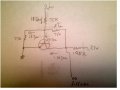
It=sum of all current branches...not with transistors??

Thread Starter

rougie

Joined Dec 11, 2006
410
Hello,

Everyday that I play around with transistors, they never cease to amaze me.

Today I wanted to take down some current measurements, so I started measuring currents with my multi meter... here's what I found:

In the attachment below I have the following currents coming into the base circuit:

18.5ua + 8.1ua = 26ua

And I have the following currents leaving the base circuit:

18.9ua + 26ua = 44.9

Why is there more current leaving then coming in ???
Where is all this extra current coming from?

All feedback very appreciated!

Thnak you
r
 

Attachments

Audioguru

Joined Dec 20, 2007
11,248
Your current meter causes a voltage drop which affects the very low base-emitter voltage which affects the currents.

Instead of measuring currents, measure the base voltage and calculate the currents in the resistors using ohm's Law.
 

WBahn

Joined Mar 31, 2012
33,327
Hello,

Everyday that I play around with transistors, they never cease to amaze me.

Today I wanted to take down some current measurements, so I started measuring currents with my multi meter... here's what I found:

In the attachment below I have the following currents coming into the base circuit:

18.5ua + 8.1ua = 26ua

And I have the following currents leaving the base circuit:

18.9ua + 26ua = 44.9

Why is there more current leaving then coming in ???
Where is all this extra current coming from?

All feedback very appreciated!

Thnak you
r
Any time you measure something, you affect the quantity that you are measuring. As already noted, when measuring small currents in high impedance circuits, typical ammeters cause significant errors. You either need better measurement tools (ammeters designed specifically for this type of application or using voltmeters to make less intrusive measurements and then calculating the currrents from there) or you need to understand your mesurement technique well enough to compensate for the errors and back out the actual results that you would have measured had you been able to make an ideal measurement.
 

Thread Starter

rougie

Joined Dec 11, 2006
410
Instead of measuring currents, measure the base voltage and calculate the currents in the resistors using ohm's Law.
So then, I can do this for the 33k which would be 0.7/33k = around 20ua
and i can also do the same for the 75k resistors... right?

But what if I wanted to know the current entering the base????
if we don't know the resistance of the Be junction, then we
are missing the ohmic value!!! so to get the actual ib, instead
of measuring it I would just assume that ib = ic(beta) right?

it's funny though how the measured base current is so much
higher than it should be due to my ohm meter's internal
resistance. 26ua that's way off... and also one more thing,
shouldn't the effect of the internal resistance in my amp
meter make my ib much smaller instead of bigger???

thanks Audioguru !!!!
thanks all
r
 

WBahn

Joined Mar 31, 2012
33,327
Don't make the mistake of assuming that the current your meter is reading is the correct value. You have to analyze the circuit to determine the effect of having your meter in the circuit and to determine what the current would probably be if the meter weren't there.

As for determining how much current is entering the base, you can either do it by carefully measuring the current in series with the base ('carefully' means taking into account the disruptions) or measuring all of the other currents carefully and using KCL to determine the base current.
 

Audioguru

Joined Dec 20, 2007
11,248
So then, I can do this for the 33k which would be 0.7/33k = around 20ua?
No.
You must measure the base-emitter voltage, not guess it. The datasheet shows a typical base-emitter voltage of 0.62V at a collector current of 1mA but every transistor is different. Maybe the current in the 33k resistor is 18.8uA.

and i can also do the same for the 75k resistors... right?
Yes, if you accurately measure the resistances and voltages.

But what if I wanted to know the current entering the base????
The add and subtract the accurate currents.

we don't know the resistance of the Be junction then we are missing the ohmic value!!!
It sets its own voltage, not resistance.

so to get the actual ib, instead of measuring it I would just assume that ib = ic(beta) right?
But you do not know the beta that is different for every transistor and it changes with current and with temperature.

it's funny though how the measured base current is so much higher than it should be due to my ohm meter's internal resistance. 26ua that's way off...
Your meter messed up the circuit.

also one more thing, shouldn't the effect of the internal resistance in my amp
meter make my ib much smaller instead of bigger???
It messes up the entire circuit. Measure the resistances and voltages accurately then calculate accurate currents.
 

Thread Starter

rougie

Joined Dec 11, 2006
410
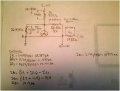
Audioguru, I apologize because I assigned the wrong feedback resistor value. So here it is with the new values... see attachment below.

The add and subtract the accurate currents.
I measured evrey ohmic value and every voltage across every resistor.
Please view if my calculation is correct... Ib seems to be 10ua... please confirm.

Another question is why doesn't VR2 + VR3 = 1.110 VDC ???? KVL no?

PS. Note t1 is a pn2222.

OOOOPS I made an error in the attachment... VR2 = 0.331VDC (VR2 voltage varies so much!!! )

So my currents now become:
IR1 = 18.787
IR2 = 0.331/62500 = 5,296ua <***
IR3 = 19.41 ua


Calculated Ib now become:
Ib = (18.7 + 5.29)-19.4 = 4.59ua

Beta now seems to be 239 ?? is this possible??
HFE = 1.0977ma/4.59ua = 239!!!


Thank you for your help!
r
 

Attachments

Last edited:

wayneh

Joined Sep 9, 2010
18,183
You have a second voltage source at the base, so the currents are not equal on both sides and don't have to add up to Vc.

Anyway, looks like you've got a current gain of 100. Quite reasonable. Your analysis looks fine to me, although I haven't double checked anything.
 
Top