Isolating USB power to prevent ground loops

Thread Starter

mattomatto

Joined May 30, 2017
7
Hi there,

I'm developing a USB powered device that outputs audio, and communicates via USB. It produces an audible ground loop hum when powered from the same source as a USB soundcard that it is connected to. I'd like to eliminate this noise and I'm looking into the best options.

I currently have a prototype that has the data lines connected as normal, but the power and ground are routed through an isolated DC-DC converter.
This stops the ground hum entirely, and USB communication still works as expected.

In trying to research this topic, I regularly see comments that it not OK to disconnect the USB ground line, as this can prevent data being read properly, or even damage the device. Also, every USB isolator for audio isolates the data lines as well as the ground and power. My question is - why would it be ok to isolate both the data lines and the power/ground, but not just power/ground? Is my solution perfectly acceptable, or am I overlooking something fundamental?

Many thanks,

Matt
 

Thread Starter

mattomatto

Joined May 30, 2017
7
Hello,

USB isolators are commercialy available:
usb isolator

Bertus
Hi Bertus,

If you are referring to a consumer USB isolator dongle, then this is not appropriate as I'm looking for an in-circuit solution.
If you are referring to USB isolating ICs, such as the Analog Devices range, then they generally do not provide adequate power, and require an additional DC-DC converter, hence my above post.

Thanks
 

DickCappels

Joined Aug 21, 2008
10,661
Perhaps you can investigate the available isolators and learn what works from the, and apply the techniques to your own circuit. No need to start from scratch is somebody has already found good solutions.
 

Thread Starter

mattomatto

Joined May 30, 2017
7
Perhaps you can investigate the available isolators and learn what works from the, and apply the techniques to your own circuit. No need to start from scratch is somebody has already found good solutions.
Indeed - I've bought 4 different isolators, and they all work in exactly the same way, isolating data lines using one IC, and providing power with a second IC. Using both ICs isn't really an option due to cost, hence why I'm wandering if I really need to isolate data as well as power.
 

cmartinez

Joined Jan 17, 2007
8,741
Hi there,

I'm developing a USB powered device that outputs audio, and communicates via USB. It produces an audible ground loop hum when powered from the same source as a USB soundcard that it is connected to. I'd like to eliminate this noise and I'm looking into the best options.

I currently have a prototype that has the data lines connected as normal, but the power and ground are routed through an isolated DC-DC converter.
This stops the ground hum entirely, and USB communication still works as expected.

In trying to research this topic, I regularly see comments that it not OK to disconnect the USB ground line, as this can prevent data being read properly, or even damage the device. Also, every USB isolator for audio isolates the data lines as well as the ground and power. My question is - why would it be ok to isolate both the data lines and the power/ground, but not just power/ground? Is my solution perfectly acceptable, or am I overlooking something fundamental?

Many thanks,

Matt
USB data lines are differential, that is, in a sense they work by referencing themselves and do not need a ground reference to work. The +5V and GND pins are there mainly to power devices that they're connected to, but it's not indispensable that they be used. Perhaps you could use a differential receiver IC instead of a USB isolator if you don't need to power your device from the USB port itself.
 

crutschow

Joined Mar 14, 2008
38,400
The signal lines need a ground reference, even if they are differential, so that there is not a significant voltage difference between the two grounds.
But you might be able to sufficiently isolate the grounds with a small resistor (say 1k-1okΩ) in series with the ground with an isolated supply for the 5V.
Such a resistor should provide a sufficient reference connection for the signals while minimizing ground loop current, which is what causes the hum.
 

dendad

Joined Feb 20, 2016
4,636
You may have trouble not isolating everything or just the power/ground if for instance the 0V of the host and target are different. While it is true the signal wires are differential, there is a max voltage to common that the drivers can handle without saturating or worse, popping!
Years ago I did an installation that had RS485 half duplex comms. That is a "2 wire" differential network, BUT... the machines at each end had differing ground potentials, mainly when the big motors started up, and it killed the network. We had to run a common connection to fix it.
Some switch mode power supplies, like on laptops, do not have a ground connection on the mains and the input filter caps are connected to the output 0V line. If you have the power supply powered from the mains but not plugged into the laptop, measure with a multimeter on ACV from the 0V to mains ground. I have seen at least half the mains voltage there. It is relatively high impedance, usually, but still enough current can flow to kill a network driver. And it can give you a bight, as here in Oz, it can be over 100VAC.
A common connection is needed and I've found in practice you can get away with an added series resistor as Crutschow noted above.
Have you tried to just isolate the 5V power, leaving the 0V and D+ D- lines normal? It may help.
But I would recommend a fully isolated option if you can go that way.
When it comes to isolation, "With me, it's all or nothing " to quote the song ;)
 

Thread Starter

mattomatto

Joined May 30, 2017
7
Thanks all for your answers. @dendad @crutschow - If the device will be communicating over USB, then it will be powered by USB also, so I guess the question is - Using an isolated DC-DC converter, are the grounds going to be the same between the device and the USB host?

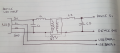
Attached is a schematic of my current USB input. When you suggest just isolating 5v and connecting ground with a resistor, does the below illustrate what you mean? (R1 is your suggested resistor)

Screen Shot 2017-05-31 at 10.35.27.png
 

cmartinez

Joined Jan 17, 2007
8,741
Thanks all for your answers. @dendad @crutschow - If the device will be communicating over USB, then it will be powered by USB also, so I guess the question is - Using an isolated DC-DC converter, are the grounds going to be the same between the device and the USB host?

Attached is a schematic of my current USB input. When you suggest just isolating 5v and connecting ground with a resistor, does the below illustrate what you mean? (R1 is your suggested resistor)

View attachment 127939
Yes, R1 will make sure that the grounds remain the same, while also reducing the ground-loop current responsible for the humming sound you've been hearing. You could experiment with different values for R1 to find which works best. Or better yet, yo could use a potentiometer instead and make real time adjustments to it.
 

Deleted member 115935

Joined Dec 31, 1969
0
How fast do you want the USB isolation to go ?
is the USB device a stand alone component, or in the 'CPU' or what ever ?

various solutions exist to isolate the dreaded ground on the USB.
provided you only need USB 2 , above that, things get hairy.

If the USB device is stand alone, the standard method is to power that off the USB , and isolate its digital IO and powe r, using these sort of things. http://www.ti.com/product/ISO7221C

these are the other type of method,
http://www.analog.com/en/analog-dia...isolators-in-medical-and-industrial-apps.html

just follow the app notes,
 

Thread Starter

mattomatto

Joined May 30, 2017
7
Thanks for the reply @andrewmm, it is indeed USB2. The problem with these logic isolating devices is that they are not design to deliver much current through the 5v and ground lines. The one you mention is +/- 4mA. My circuit will draw about 120mA, which requires a separate DC-DC converter.
 

Thread Starter

mattomatto

Joined May 30, 2017
7
Why not use the isolator and an extra DC to DC converter to get you the current you need?
My original post was asking whether it's entirely necessary to isolate both, because it appears to work fine just isolating power and ground.

I'm pretty sure I wouldn't be able to fit both a DC-DC converter and a logic isolator on the board, and it would push my BOM to an uncomfortable amount.
 

Deleted member 115935

Joined Dec 31, 1969
0
Extra USD 4 or so to isolate both power and data compared to just one.

Thats engineering ah,
impossible compramises.

If you just isolate power, you risk blowing the data inputs to the computer, or your device.
if you isolate power , a little, with say a resistor and inducter to 'join' the grounds,
you won't pop the computers or your data , but not as good performance as isolating both.
 

Thread Starter

mattomatto

Joined May 30, 2017
7
Extra USD 4 or so to isolate both power and data compared to just one.

Thats engineering ah,
impossible compramises.

If you just isolate power, you risk blowing the data inputs to the computer, or your device.
if you isolate power , a little, with say a resistor and inducter to 'join' the grounds,
you won't pop the computers or your data , but not as good performance as isolating both.
@andrewmm The configuration my picture above, (keeping data lines intact, using an isolated DC-DC converter for 5V and GND, then joining the grounds with a resistor) works really well for my application. It's also the cheapest solution I've found.

If the general consensus is that I'm not going to pop any data inputs in that arrangement, bearing in mind that the device is only powered from the USB port anyway, I think I'll go with this solution.

Many thanks
 

charanj

Joined Feb 28, 2020
1
Thanks all for your answers. @dendad @crutschow - If the device will be communicating over USB, then it will be powered by USB also, so I guess the question is - Using an isolated DC-DC converter, are the grounds going to be the same between the device and the USB host?

Attached is a schematic of my current USB input. When you suggest just isolating 5v and connecting ground with a resistor, does the below illustrate what you mean? (R1 is your suggested resistor)

View attachment 127939
Its wrong....how can DC voltage be converted in to DC voltage using a transformer without switching on and off input voltage..
 
Top