It's a Hotel. I was hired as a frontdesk manager. Was getting instructions 24x7. Do this. Do that. But after a week I fell sick and quit that job. Not even a penny was paid. Despite of travelling 10 to 20 kilometres from my home to keep that hotel running.
It's a Hotel. I was hired as a frontdesk manager. Was getting instructions 24x7. Do this. Do that. But after a week I fell sick and quit that job. Not even a penny was paid. Despite of travelling 10 to 20 kilometres from my home to keep that hotel running.
I have no idea what the labor laws are like in India, but I would think that they have to pay you for the days you actually worked. It might depend on your employment agreement and how it handles you quitting in the middle of a pay-period, for instance.
I have a hard time believing they were telling you to do things 24/7. What were they having you do while you were traveling this 10 to 20 km (and why was the distance so variable? Traffic?). What were they having you do while you were asleep? While you were eating? While you were taking a shower? It doesn't help your case to exaggerate your victimhood.
Here (and I suspect most places), you are either paid hourly or are salaried. If you are hourly, then (in theory), if they require that you do something, they have to pay you for the time you are doing it. Lower-tier jobs are generally more explicit about this that higher-tiered ones. For instance, when I was working in restaurants out of high school you generally got an unpaid meal break, typically 30 minutes, if you were scheduled to work at least six hours. But, it was clearly stated, if they asked you to do anything, even sign a time card that you forgot to sign, during that 30 minutes, they had to pay you for the entire 30 minutes. If you are salaried, then the expectation is that you will spend however much time it takes to accomplish the tasks that come with the position. In practice, many professional positions end up involving unpaid work to some degree or other (teaching being a very common case).
In many companies/industries, salaried employees are expected to average somewhere in the 45 to 55 hours per week, with some weeks peeking out much higher, but with some kind of compensatory time off later. This is why the owner/president of the company I worked for for most of my professional career paid everyone, himself included, hourly. If you worked the time, you got paid for it (at normal rate, no overtime pay rate), but if you didn't work the time, you didn't get paid. That gave a lot of flexibility to the employees since the company only cared about the projects making acceptable progress and being within budget. As long as we averaged 30 hours a week over any few month time-span, the company was happy (the 30 hour expectation was to justify the very, very nice benefits that we got).
My recollection is that the salaried jobs were a lot more fun and that I almost always put in over 8 hours but never flt unappreciated. AND there were at most of them assorted fringe benefits, some that I could not buy, such as using the machine shop, (on my own time) and the electronics shop, during lunch. Also the pay was higher than hourly jobs, although I probably could have demanded more. But with higher pay comes higher pressure and that is very seldom much fun.
I have no idea what the labor laws are like in India, but I would think that they have to pay you for the days you actually worked. It might depend on your employment agreement and how it handles you quitting in the middle of a pay-period, for instance.
If you knew what the labour laws were like in the third world you would be horrified. The laws are often there but are just ignored with impunity. Legal redress is clumsy, slow, protracted and biased. It's a simple illustration of the market in operation in a high-supply, low-demand situation without effective government oversight.
My recollection is that the salaried jobs were a lot more fun and that I almost always put in over 8 hours but never flt unappreciated. AND there were at most of them assorted fringe benefits, some that I could not buy, such as using the machine shop, (on my own time) and the electronics shop, during lunch. Also the pay was higher than hourly jobs, although I probably could have demanded more. But with higher pay comes higher pressure and that is very seldom much fun.
I've been very, very fortunate in my career, both professional and non-professional (like part-time restaurant jobs while in college). There have been plenty of both salaried and hourly where I happily put in extra time without qualms because I enjoyed it so much. At the same time, most of that was when I was single with very little in the way of a personal life. Now I'm a lot more aware of how extra time spent working is time taken away from watching and being involved with my daughter growing up.
A lot of that has come down to working for employers that appreciate your extra work and effort, instead of just expecting it as their due. That comes down to workplace culture and neither big nor small companies have monopolies on either good or bad workplace environments. I've been in bad workplace environments about three times in my life and I left as soon as possible. Life's too short to put up with that.
If you knew what the labour laws were like in the third world you would be horrified. The laws are often there but are just ignored with impunity. Legal redress is clumsy, slow, protracted and biased. It's a simple illustration of the market in operation in a high-supply, low-demand situation without effective government oversight.
Agreed. It's not what the law says, but what you can get away with that matters. If you live in a place where you have no effective redress, about the only thing you can do is walk/run away, chalk it up to lessons learned, and move on with your life.
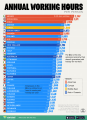
Here's a little graphic info, for context. The silly thing is that Mexicans are sometimes stereotyped as lazy bums taking a nap by the side of the road wearing very large sombreros:
But, if I may add for the sake of objectivity; working hard, long hours is a very different thing than working smartly and productively ... we're getting there, though.
But, if I may add for the sake of objectivity; working hard, long hours is a very different thing than working smartly and productively ... we're getting there, though.
This infographic (like the preceding) is a very one dimensional view and lacks context—by. choosing GDP without normalizing it Ireland and Norway stand out (tax haven and oil wealth in small populations) but, here it is anyway as a data point.
The “lazy Mexican“ stereotype is incredibly offensive. As an American living in the midwest I can tell you with certainty that a stereotype for Mexicans who I encounter should be hardworking, motivated people who are willing to work their way to a better life.
I only say this because this “lazy” nonsense is dehumanizing and we have enough trouble understanding our friends to the south without blocking a clear view of who they actually are with rhetorical idiocy. Of course, there are much worse characterizations than “lazy“ that we, as Americans, need to stand up against when the politicians try to pit us against people who risk everything to make themselves a better life and help their families back in Mexico and then are called “illegal” it boils my blood.
I always say running a survival course through a desert, then managing to stay out of trouble while working hard for years is a hell of a more convincing citizenship test than a 50 question trivia contest. I don’t get political here but to me this is an issue of morality and how we treat human being—particularly when those calling for mistreatment will also exploit the same people as cheap and disposable labor.
I spent several weeks in a pickup truck plant in Mexico City. It was amazing because the plant produced different versions entirely. But instead of flexible automation there was flexible assembly , where different parts were installed for the different models. And while the workers were certainly exploited (by UAW standards), they were better paid than other folks in other jobs. So certainly all at that location were very hard working.
As far as the TS complaint, that seems rather a lot like a recent accounting grad being in a management position. And probably a previously undescribed position being filled. That, coupled with an employee with the wrong outlook, is certain to cause problems.
That is by no means limited to any one area.
Here's a little graphic info, for context. The silly thing is that Mexicans are sometimes stereotyped as lazy bums taking a nap by the side of the road wearing very large sombreros:
I spent several weeks in a pickup truck plant in Mexico City. It was amazing because the plant produced different versions entirely. But instead of flexible automation there was flexible assembly , where different parts were installed for the different models. And while the workers were certainly exploited (by UAW standards), they were better paid than other folks in other jobs. So certainly all at that location were very hard working.
As far as the TS complaint, that seems rather a lot like a recent accounting grad being in a management position. And probably a previously undescribed position being filled. That, coupled with an employee with the wrong outlook, is certain to cause problems.
That is by no means limited to any one area.
Certainly my views have come from my experiences, no question about that! AND, as I do not have a split personality, that limits it to one point of view. Of course, accepting folks as they are is also my form of "judgement", although "evaluation" is a better word for it. But a lazy person who does not do the job they were employed to do will not work for me very long. But part of the hiring process is verifying that one is both willing and able to do the job.
I recall one US Tech I spoke to, he had just returned from installing an in-floor milling M/C for locomotive wheels in India .
He put the word out he would need a high capacity crane or hoist in order to lower it into the pit.
The next day around 100 guys showed up, all with some kind of chain hoist.
Around 30 went into the pit, under the M/C to "steady" it !
The others rigged hoist up as needed and just about made it !
NO OSHWA there !!!

 Facebook
 Google
 GitHub
 Linkedin