Aluminum foil is fine. The important thing is to prevent a voltage potential between any the legs of the devices from being high enough for a static discharge to cause damage.
What's under the foil? If that's not antistatic (e.g. styrofoam or similar), there's some risk if the foil doesn't keep all of the legs shorted together.
What's under the foil? If that's not antistatic (e.g. styrofoam or similar), there's some risk if the foil doesn't keep all of the legs shorted together.
What's under the foil? If that's not antistatic (e.g. styrofoam or similar), there's some risk if the foil doesn't keep all of the legs shorted together.
Then you need to be careful that the aluminum foil is touching all legs. If you don't have anything better (like antistatic tubes/baga/foam), stack the chips and wrap them in aluminum foil.
Foil on foam might be better than no solution at all. It was used in the very early days of CMOS IC's and it sort of works. The problem with the foil is that it is conductive rather than dissipative. The difference being that dissipative materials like antistatic bags and foam gently leach away the charge while with conductive metal foil the charge is zapped away. Zaps are not good for CMOS.
On the other hand, being a hobbyist making one or a few of something is different from running a factory in which you will make hundreds of thousands of something each day are very different. If a hobbyist has an ESD problem it cost a few dollars and a few days, but if a manufacturer starts getting returns from the field of only a small percentage of units, that is a real problem.
This is a bit of an aside, but has relevance to the topic.
I had often saved the, so-called, anti-static foam that ICs would sometimes come in.
I stored two chips on piece of a "Styrofoam". Where exactly I got it was forgotten long ago.
Those chips were stored in a plastic parts drawer along with a dozen or so other ICs.
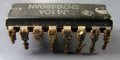
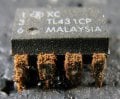
After 20-30 years, this is what they looked like.
The first was after I removed it and lightly brushed the legs, which promptly fell apart.
Here is the other chip, untouched and still on the foam.
Every other chip in the drawer, some stored on different anti-static foam and a few just in the drawer with no foam at all, were fine. The ambient climate for all the chips was the same, strongly suggesting that the foam that those two chips were stored on was the culprit. Maybe it was a coating (paint?) on the foam.
This had never happened before, or since. Don't know and, at this point, I don't care, except that I will never store ICs in anything other than plastic tubes or legitimate anti-static foam.
This had never happened before, or since. Don't know and, at this point, I don't care, except that I will never store ICs in anything other than plastic tubes or legitimate anti-static foam.
One other possible factor: if I recall correctly, at one time TI made at least some of its ICs with silver-plated leads. They had the nasty habit of turning black in certain environments (sulfur in the air, I think), and I'm wondering if that could be at least partially the cause of that horrible gunk on the chips you showed above.
Aluminium foil will certainly short the pins and eliminate static buildup - but you need to worry about any stray charges that might've gathered before you insert the ICs.
Low level static can exist that doesn't do much till you discharge it. Always grip the IC by its plastic package while handling. If you breathe on it just like you would cleaning a pair of spectacles - the moisture in your breath dissipates static charges. Hold the foil so your body resistance equalises any charges and it should be safe to push the IC into it.
Always remember that gate oxides can be impaired by lesser static discharges, and look OK till they fail later in the field.
Every other chip in the drawer, some stored on different anti-static foam and a few just in the drawer with no foam at all, were fine. The ambient climate for all the chips was the same, strongly suggesting that the foam that those two chips were stored on was the culprit. Maybe it was a coating (paint?) on the foam.
This had never happened before, or since. Don't know and, at this point, I don't care, except that I will never store ICs in anything other than plastic tubes or legitimate anti-static foam.
This had never happened before, or since. Don't know and, at this point, I don't care, except that I will never store ICs in anything other than plastic tubes or legitimate anti-static foam.
These devices were stored in the same drawer but in different types of foam (for about 40 years). The ones still in the foam so no sign of corrosion, but some white residue has formed. The other has significant corrosion (there's also some corrosion on the underside of the can):
These TI IC's were loose in the same drawer. Some have more corrosion than others:
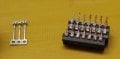
There was an occasion where I wanted to breadboard a counter circuit and I needed two CD4510. I only had two and when I removed one from the foam, I found that it had significant corrosion on the leads; about half of the leads were gone. I used some of the leadframes in the picture above to repair the leads. I put the IC in a machined pin socket so I could insert it in the breadboard without worrying about leads being further abused. The chip still worked, though I'm concerned that there may be corrosion on the die.
The devices that only have white residue on the leads have been in that foam for 40 years; so I'm not going to worry about them. Others in the same drawer, but different foam also have no noticeable residue/corrosion.
Other loose DIP in the same drawer have varying degrees of corrosion.

 Facebook
 Google
 GitHub
 Linkedin




 How much would a hobbyist really need?